
Unbiased headlines. Facts, not spin.
Unbiased Headlines is an independently owned news organization. We bring you the facts, not opinions, written fresh from 110+ named sources. Sources linked so you can verify it yourself.
 defense
Major Story (7/10)
Pentagon Documents Describe 90-Day Self-Sufficiency Requirement for Major U.S. Bases Under FORTRESS
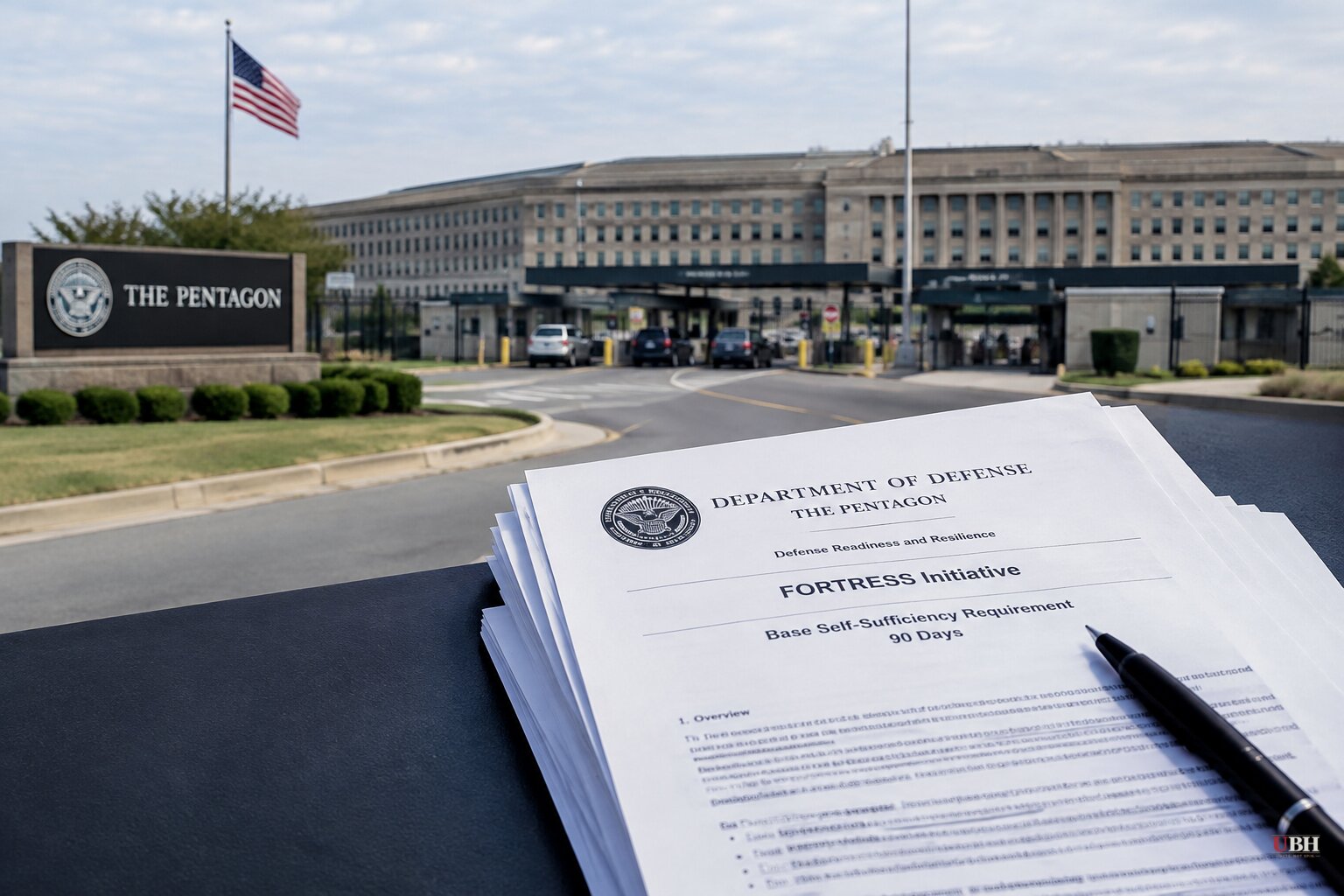
The Pentagon wants its bases to keep fighting if the American grid goes dark.
Under an initiative called FORTRESS, every major military installation in the continental United States would be expected to sustain essential operations independently for at least 90 days, according to documents reviewed by Fox News Digital. That means electricity, water, fuel and communications, even if the civilian infrastructure around the base fails.
What FORTRESS is
Hegseth unveiled FORTRESS America in his State of the Force address at Marine Corps Base Quantico on Sept. 30, 2026. The acronym stands for Federal Operations for Resilience, Troop Resources, Energy, Supply and Survivability.
The public rollout lists five pillars: energy independence, resilience across supply chains and the defense industrial base, strategic reserves, installation hardening and cyber resilience, and resilience in space and spectrum.
Pentagon chief spokesperson Sean Parnell laid out the reasoning to Fox News Digital. "We don't want to rely on standard civilian municipal infrastructure to run our national defense. We just simply can't. It's an intolerable risk," he said.
"Power is combat now. Without electricity, you lose communications, water, logistics, assembly lines and just basic military command structures," Parnell added.
He also said the old homeland-defense model rested on "the antiquated assumption that two oceans would protect us," and pointed to Golden Dome and a renewed focus on the Western Hemisphere as part of the new thinking.
The hardware and the supply chain
The documents describe portable nuclear reactors, large-scale battery storage and microgrids that would let bases disconnect from the civilian grid during a prolonged disruption. Other options named in the public rollout include geothermal, solar and natural gas. The right mix will depend on each site.
The plan also calls for strategic reserves of munitions, fuel, critical minerals, electronics, spare parts and medical supplies. Critical defense requirements would need at least two qualified supply or production pathways, so no single supplier becomes a point of failure.
Through a Civil Reserve Manufacturing Network, the Pentagon plans to identify civilian factories that could switch to defense production in a crisis.
Parnell said the next major conflict could involve multiple fronts and break global supply chains, making it hard to replace equipment and materials.
Microreactors are already moving
The nuclear piece is not hypothetical. Radiant, a California company, announced that the Navy selected its Kaleidos microreactor for Naval Weapons Station Crane in Indiana. Kaleidos is a factory-built, 1-megawatt unit the company says can move by land, sea or air.
Mike Dodd, Assistant Secretary of War for Critical Technologies, said the department is "actively breaking down the barriers that have prevented deployment of nuclear reactors." Vice Adm. Brad Collins, head of Navy Installations Command, said the investment gives shore infrastructure "the resources needed to sustain the mission."
Radiant says it is the only nuclear company partnered with the Army, Navy and Air Force.
The broader federal nuclear push is also running. A Congressional Research Service report says the administration signed four executive orders on May 23, 2025, and that four reactors met the Department of Energy's July 4, 2026 criticality goal, according to a DOE announcement.
The same report cites EIA estimates that new nuclear generation coming online in 2031 would cost 8.8 cents per kilowatt-hour including tax credits, against 5.7 cents for onshore wind and 5.8 cents for solar. Those figures reflect commercial grid power, not military resilience, and the report notes they depend on fuel costs, regional resources and tax incentives.
Scope, cost and timing
The war framing comes from Fox's reporting. The public FORTRESS announcement describes a broader resilience strategy and does not name global war as its only trigger.
The 90-day figure is a reported requirement. Nothing published shows that any base meets it today.
At a Defense Writers Group roundtable on Oct. 20, a senior defense official said the Pentagon was assessing energy requirements and costs across about 500 installations in the continental United States. No program-wide completion date has been announced.
The Air Force's November 2024 Installation Infrastructure Action Plan set a fiscal 2030 microgrid target for two Space Force bases and 14 Air Force bases. That plan predates FORTRESS and does not set its timetable.
Air & Space Forces Magazine reported that FORTRESS could cost "scores of billions of dollars, if not hundreds of billions." That is the magazine's projection, not an official estimate. The Pentagon has not published a cost.
Related efforts
Fox also reported on Project Meridian, a study of future warfare led by the department's chief technology officer, Emil Michael, and co-led by Elon Musk, Palmer Luckey and Newt Gingrich. The group has 120 days to submit findings on future battlefield technologies.
Separately, the Pentagon is reportedly expanding a secretive effort to keep foreign adversaries from developing technologies that could erode American military superiority, according to an investigation by POLITICO.
What comes next
The installation-by-installation assessment of roughly 500 sites is the next concrete step, and it will produce the first real cost numbers. Until the Pentagon publishes them, the gap between a 90-day requirement and a funded plan to meet it stays open.
Sources used for this briefing
7 links from 5 independent newsrooms (syndicated copies of the same report count once)
These are the sources it draws on, linked so you can verify.


