
Unbiased headlines. Facts, not spin.
Unbiased Headlines is an independently owned news organization. We bring you the facts, not opinions, written fresh from 110+ named sources. Sources linked so you can verify it yourself.
 defense
Breaking / Critical (9/10)
Event date: October 23, 2026 ·
Eight Nations Meeting in Istanbul Urge US and Israel Not to Renew Iran Strikes as Brent Settles at $109.86
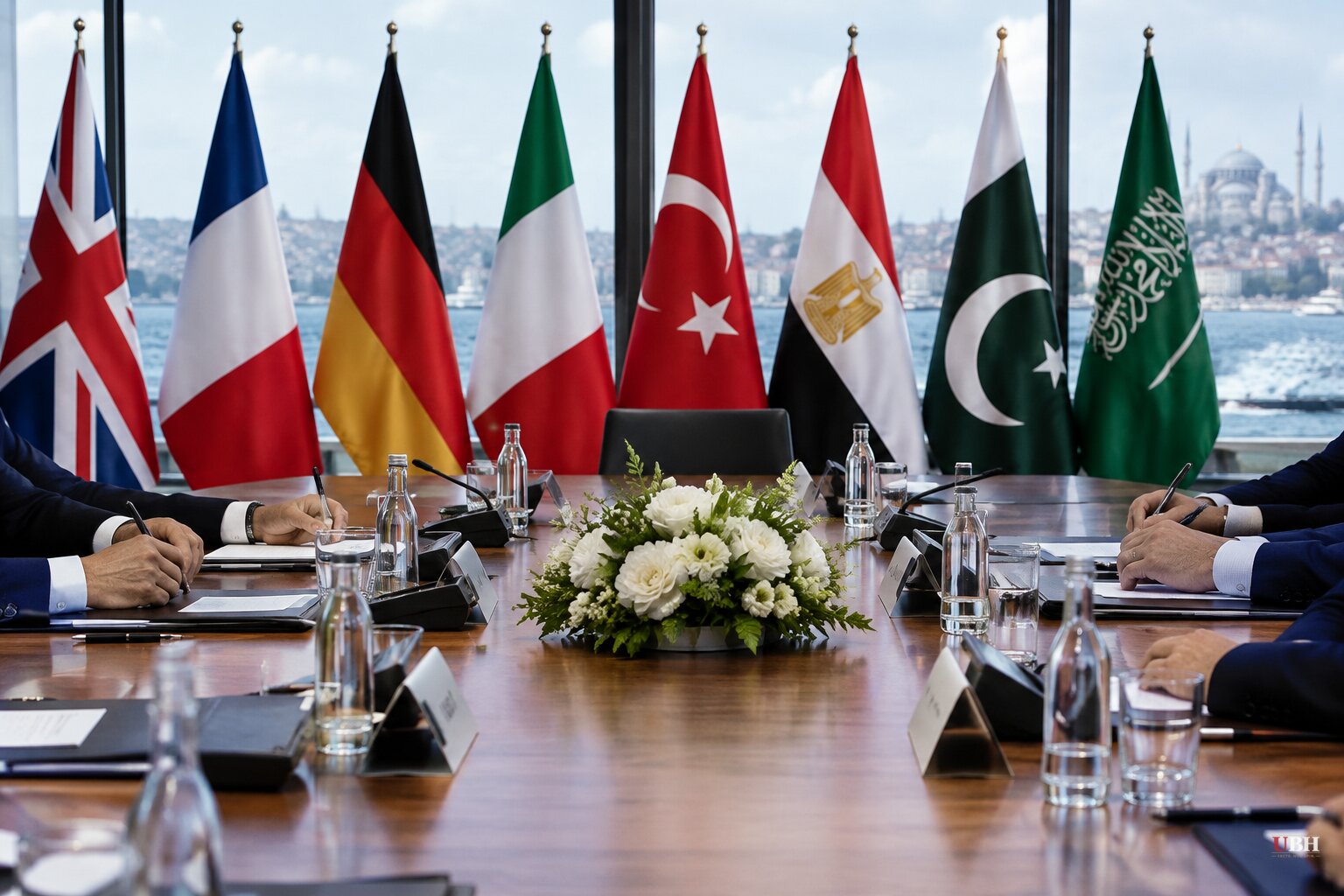
Nearly eight months into the U.S.-Israeli war on Iran, the fight over what comes next has moved from Washington to Europe's capitals. A summit in Istanbul of eight European and Middle Eastern countries has called on the U.S. and Israel not to resume attacks, warning that renewed fighting would spread the conflict and push oil higher.
The price numbers are not abstract. Brent crude settled Friday at $109.86 a barrel, up 3.7%. West Texas Intermediate finished at $101.41, up 3.5%. Brent is at its highest since May.
The Istanbul meeting
Turkey and Germany convened the talks. Turkish Foreign Minister Hakan Fidan, a joint convener, said: "Military intervention in Iran is not any kind of solution. We agreed that a new military attack would spread the war and the conflict in the region."
France's Jean-Noël Barrot said another war between Iran and the U.S. would be bad for both sides and would only worsen rising oil prices. Britain's foreign secretary, Ed Miliband, urged both sides to embrace diplomacy. Italy's Antonio Tajani also attended.
Saudi Arabia, Egypt and Pakistan were represented by Faisal bin Farhan, Badr Abdelatty and Ishaq Dar. Ministers also demanded an end to Houthi attacks on Saudi Arabia and an immediate reopening of the Strait of Hormuz, which the Guardian reports is blockaded by Iranian ships and drones.
German Foreign Minister Johann Wadephul did not criticize Washington. He accused "the Houthis and Iran of blackmailing world trade" and of choking global energy and fertiliser supplies. "We are feeling the effects of the attacks on shipping routes," he said, "whether at the petrol pump or the supermarket."
The gathering comes as U.S. talks with Tehran over its nuclear program remain deadlocked and Washington is reportedly preparing options for renewed attacks.
Washington's case
Vice President JD Vance laid out the administration's position Saturday at a CBS town hall. He said the U.S. destroyed Iran's nuclear program but conceded that Iranian attacks on commercial shipping have complicated efforts to end the war.
"In some ways we have won decisively, but they're the Iranians. You know, the enemy gets a vote here," Vance said.
He named two remaining goals: a long-term, verifiable Iranian commitment not to rebuild its nuclear capabilities, and preventing a global energy crisis. Vance credited the U.S. Navy with keeping oil and gas moving through Hormuz and claimed gasoline prices "would be three times as high" without it.
That claim sits uneasily next to the ministers' description of a strait that is blockaded. Vance did not say in his remarks how the two accounts fit together.
The bill is landing in Europe
Iran's Foreign Ministry spokesman, Esmaeil Baghaei, said Sunday that Germany's position has shifted. He pointed to Chancellor Friedrich Merz's remark during Israel's June 2025 campaign that Israel was doing "the dirty work" for everyone, and contrasted it with Berlin's recent warnings against renewed attacks.
When the war began Feb. 28, Starmer, Macron and Merz condemned Iran's retaliatory strikes on regional countries in their joint statement. They did not condemn the opening U.S.-Israeli attacks.
Protests over living costs have since filled European capitals, with winter approaching and energy prices still elevated. Reuters photographed clashes in Paris on Saturday.
Poorer countries have less room
The International Monetary Fund's deputy research director, Petya Koeva Brooks, told AFP at the Bangkok annual meetings that heavily indebted, oil-importing low-income countries face the worst of it. Many, she said, have "no other choice" but to cut spending, and those whose debt is unsustainable should seek orderly restructuring sooner rather than later.
The IMF's latest World Economic Outlook raised its 2026 global growth forecast, driven largely by AI-related investment in advanced economies, which it projects to grow 2.1%. The fund said countries outside AI supply chains and exposed to the war are lagging.
The IMF recommends narrow, targeted subsidies and rebuilding fiscal buffers. That is a polite way of saying governments should not try to spend their way out of an energy shock they did not cause.
Russian oil and the Yemen front
Supply fears are also tied to Russia. The Trump administration is weighing the economic consequences of additional sanctions on Moscow. Rep. Michael McCaul, R-Texas, urged the president on Saturday to reverse course on Russia sanctions. Trump has said a sanctions waiver is meant to keep Moscow at the negotiating table.
In a commentary, Mike Fredenburg argues that European and U.S. sanctions on Russian oil made the world more dependent on Gulf supply now under attack by Iran and the Houthis. Before 2022, Russia supplied nearly half of EU gas imports. Europe banned most Russian oil products, including diesel, starting in early 2023. McCaul and Fredenburg are arguing opposite things about what the sanctions should do now.
On Yemen, official Afrah Al-Zouba rejected an Iranian offer to mediate on Saturday. "Whoever arms a party to a war cannot be its mediator," she wrote on X, accusing Tehran of supplying the Houthis with missiles, drones and expertise.
No decision on renewed strikes has been announced. It is unclear whether Washington proceeds over the objections of the Istanbul group, whose Saudi member is the one under Houthi fire and whose European members are already flying air cover for it.
Sources used for this briefing
6 links from 6 independent newsrooms (syndicated copies of the same report count once)
These are the sources it draws on, linked so you can verify.


