
Unbiased headlines. Facts, not spin.
Unbiased Headlines is an independently owned news organization. We bring you the facts, not opinions, written fresh from 110+ named sources. Sources linked so you can verify it yourself.
 health
Major Story (7/10)
Event date: November 12, 2026 ·
Pelacarsen Cut Lp(a) 78% but Did Not Reduce Heart Events in 8,350-Patient Trial
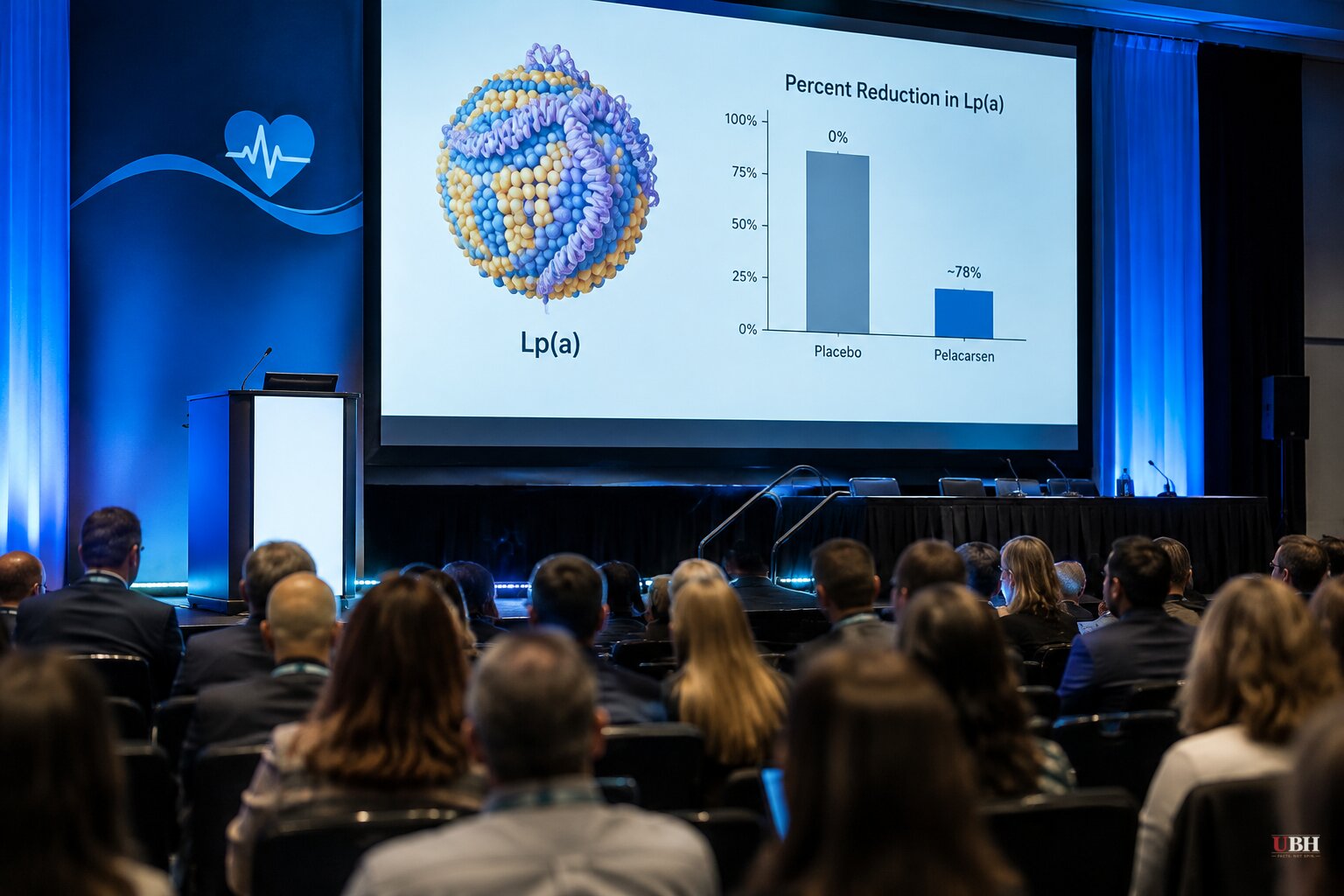
A drug built to lower a genetic heart-disease risk factor did exactly that to the blood number and failed to change what happened to patients.
Dr. Steven Nissen, a preventive cardiologist at the Cleveland Clinic, presented the pelacarsen results today, Saturday, Nov. 14, at the American Heart Association's annual meeting in Chicago. Full details were published in the New England Journal of Medicine and NEJM Evidence.
The pelacarsen trial
The study randomly assigned 8,350 adults who already had heart disease to pelacarsen or a placebo. Pelacarsen suppresses lipoprotein(a), or Lp(a), a cholesterol-carrying particle linked to heart attacks and strokes.
Lp(a) levels dropped about 78%. After five years, that drop did not translate into fewer cardiovascular complications.
"It wasn't a near miss. It just didn't have an effect on outcomes," Nissen told CNN ahead of the presentation. "I was shocked. I had high hopes for success," he told NPR.
Nissen put the scale of the problem at about 20% of the world's population, roughly a billion people, with elevated Lp(a). He said the trial targeted patients who keep cholesterol and blood pressure down, eat well, exercise and still have heart attacks and strokes. Nissen said he sees young women who have strokes in their 30s with high Lp(a) as their only risk factor.
The American Heart Association says people with the highest Lp(a) levels are two to four times more likely to have a heart attack than those with the lowest.
Novartis, which sponsored the trial, announced last month that the study missed its goals but gave no specifics. The company said the study "provides meaningful evidence" about the relationship between Lp(a) and heart disease and may "help inform future approaches to cardiovascular management." CNN reported that Novartis has decided to abandon the drug.
Nissen said he expects the audience to hold out hope for subgroup findings, such as diabetes patients, or for explanations like trial dropouts. His own read, quoted above, is that the drug simply had no effect on outcomes. The result may force cardiologists to rethink Lp(a)'s role, CNN reported, and it lands on a field where several other companies have Lp(a)-lowering drugs in development. This trial tested one of them.
A different clot-blocking approach wins FDA approval
The same news cycle brought a success. The FDA has approved Sunharbo (asundexian), a 50 mg daily pill, to reduce the risk of another stroke in adults who recently had a non-cardioembolic ischemic stroke or a transient ischemic attack. It is taken with standard antiplatelet therapy such as aspirin.
According to the FDA, it is the first medication to block factor XIa, a protein that helps clots form.
The approval followed a Phase 3 trial of 12,327 patients in 37 countries. Over 14.2 months, those on asundexian plus antiplatelet therapy had a 26% relative reduction in ischemic stroke versus placebo plus antiplatelet therapy. Stroke occurred in 6.6% of the asundexian group and 8.8% of the placebo group.
The risks are real. Overall major bleeding did not rise significantly, but gastrointestinal bleeding was more common with asundexian. Major bleeding increased among patients older than 75 during the first 90 days.
"It doesn't completely eliminate the risk of a second stroke," said Dr. Richard Kovacs, a cardiologist at Indiana University School of Medicine and chief medical officer of the American College of Cardiology.
A small oral trial in hereditary angioedema
In Phoenix, Pharvaris is scheduled to present Phase 3 CHAPTER-3 data on Saturday, Nov. 14, at the American College of Allergy, Asthma & Immunology meeting. The company released topline results Nov. 12.
The trial randomized 85 people with hereditary angioedema 2:1 to once-daily deucrictibant XR 40 mg or placebo for 24 weeks. Pharvaris said the drug cut the monthly attack rate 83% versus placebo (p<0.0001) and met the primary and all secondary efficacy endpoints. A post hoc analysis of Type 1 or 2 patients showed an 87% reduction. Pharvaris said 45% of treated participants were attack-free across all 24 weeks, with no treatment-related serious adverse events.
The company described the reductions as "in the range of those observed with injectable long-term prophylactic therapies." That comparison is Pharvaris's own. The trial is small, and the 87% figure comes from an analysis run after the fact.
Alzheimer's meeting opens Monday under a cloud
The 19th Clinical Trials on Alzheimer's Disease conference (CTAD) opens Monday, Nov. 16, at the Boston Marriott Copley Place and runs through Thursday, Nov. 19. Scheduled topics include Phase 3 data on the oral pill AR1001, a 40 Hz light-and-sound device called Spectris, and a tau-lowering drug, diranersen.
The meeting follows an April Cochrane review of 17 trials of anti-amyloid antibodies covering 20,342 participants. The authors concluded the drugs likely offer no clinically meaningful benefit and likely raise the risk of brain swelling and bleeding.
Drugmakers and the Alzheimer's Association pushed back, disputing how the data were analyzed. The disagreement is over whether the effect sizes on the Clinical Dementia Rating Sum of Boxes amount to a difference patients and families would notice.
The AR1001 readout comes first on the calendar. Whether it clears its endpoint will be known once the data are presented in Boston next week.
The pelacarsen result is a reminder that a clean biomarker win does not guarantee a clinical one: a large, well-run, five-year trial found that cutting the number did not change the outcome. Novartis's next steps for the drug have not been confirmed by the company.
Sources used for this briefing
7 links from 7 independent newsrooms (syndicated copies of the same report count once)
These are the sources it draws on, linked so you can verify.


