
Unbiased headlines. Facts, not spin.
Unbiased Headlines is an independently owned news organization. We bring you the facts, not opinions, written fresh from 110+ named sources. Sources linked so you can verify it yourself.
 health
Notable (6/10)
Event date: November 11, 2026 ·
Blood test flagged precancerous ovarian lesions in 92.3% of cases in Nature Medicine study, but it hasn't been tested prospectively
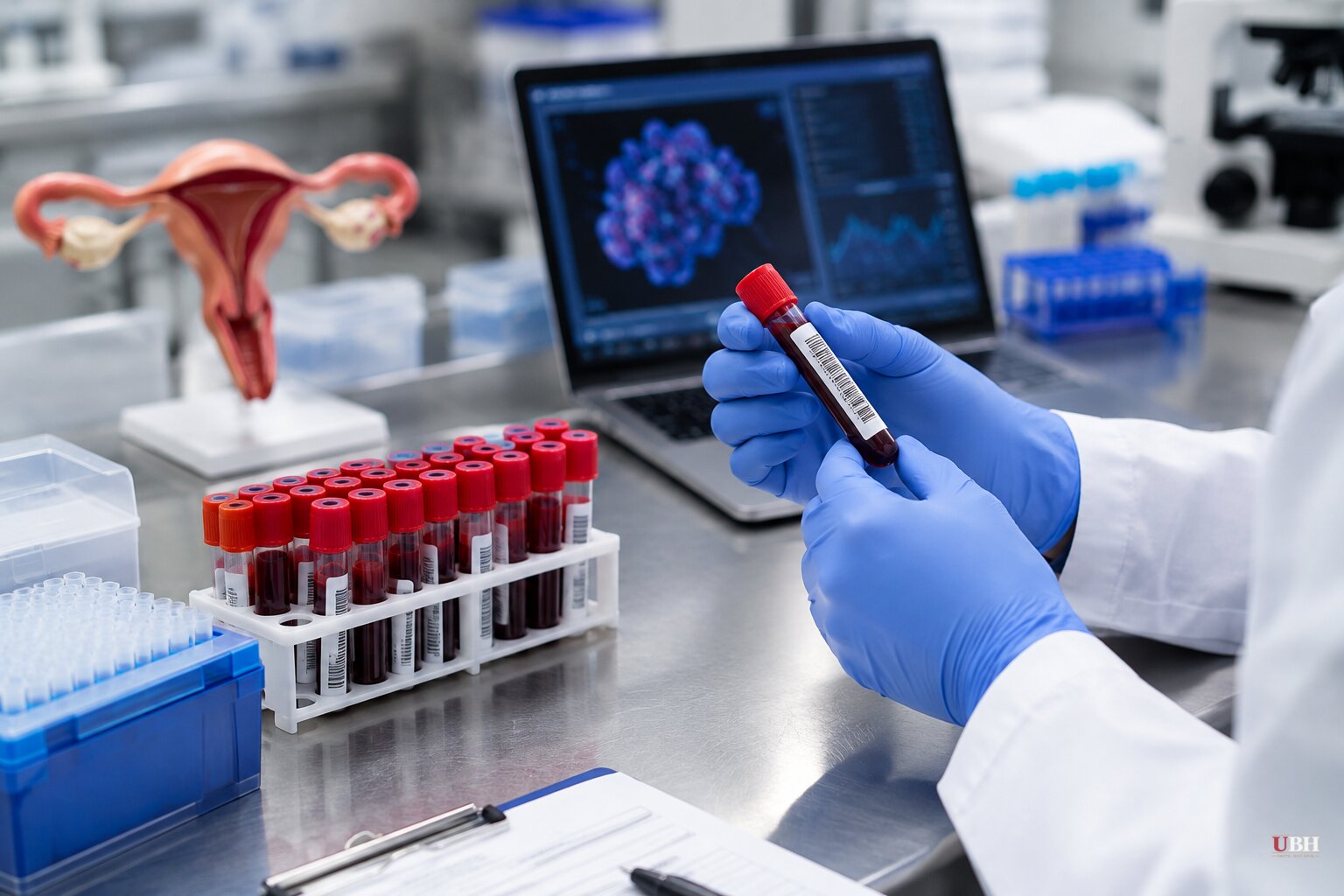
Ovarian cancer is usually found late. A team at the Hoag Family Cancer Institute in Newport Beach, California, says a blood marker could change that by catching the disease before it becomes a tumor.
The study was published Tuesday, Nov. 10, in Nature Medicine. It was led by Dr. Rajan Gogna, Hoag's director of translational research, and Dr. Esha Madan.
What the researchers found
The target is high-grade serous carcinoma, the most common type of epithelial ovarian cancer and the cause of most ovarian cancer deaths. Researchers believe it often begins in the fallopian tubes as microscopic lesions called serous tubal intraepithelial carcinoma, or STIC.
STIC causes no symptoms. It is invisible to imaging and to conventional cancer blood tests. It is typically found by accident, after surgeons remove the tubes or ovaries and a pathologist examines them.
The Hoag team found elevated blood levels of an RNA molecule they named Tu-Stroma in women with STIC and in women with early-stage high-grade serous cancer. Madan explained the biology: cancer cells can package Tu-Stroma into tiny membrane-enclosed particles called extracellular vesicles, which carry molecular messages that weaken neighboring healthy cells and make room for the cancer to grow.
The numbers
In a separate group of women used to validate the findings, the test detected STIC in 92.3% of women who had it. It correctly identified 98.2% of healthy women.
The researchers also modeled performance in a high-risk population, meaning women with genetic risk factors. In that model, approximately 72% of positive results would be accurate, and a negative result would be correct nearly 100% of the time. For a test that might inform decisions about removing organs, that gap between a positive result and a confirmed lesion matters.
Why it matters to high-risk women
Ovarian cancer kills 12,450 women in the U.S. each year. There is no universal screening program. The American Cancer Society says only around 20% of ovarian cancers are found at an early stage.
Women with BRCA1 or BRCA2 mutations or strong family histories often face a hard choice about preventive surgery to remove their fallopian tubes and ovaries.
"Today, decisions about preventive surgery are largely guided by inherited risk, without knowing whether precancerous lesions are actually present," Madan said. "Our discovery could eventually provide that missing biological information."
Gogna put it this way: "For decades, we have focused on finding smaller tumors. Then we asked a fundamentally different question: What if we could identify the earliest molecular warning signs before invasive cancer even develops?"
Dr. Ronny Drapkin, director of the Penn Ovarian Cancer Research Center at the University of Pennsylvania, was not involved in the study. He told Newsweek the findings are "very exciting and potentially transformative," and said Tu-stroma "appears to be detectable at the very earliest recognizable stages of ovarian cancer development."
The limits
This was not a prospective trial. The analysis used previously collected blood samples from women with confirmed diagnoses. Hoag calls the discovery a world first.
The study ran eight years and drew on scientists and clinical samples from multiple countries. Hoag says that is how the test was developed and validated, but the test is not yet clinically validated, and researchers still need to follow participants over time to see how reliably it works.
The broader field has had sobering results. Ovarian Cancer Action, a UK charity, pointed to the NHS Galleri trial, where a multi-cancer blood test failed to significantly reduce the number of ovarian cancers diagnosed at stages III and IV. The charity says there is "still much to learn" about such tests for ovarian cancer.
That group also welcomed a separate government-funded NHS trial, STRIDE-RCT, led by the University of Birmingham. It will test blood tests on over 20,000 patients aged 45 and over in at least 200 GP surgeries in England. Those patients are experiencing abdominal symptoms, which makes it a different question from Hoag's. The charity says the "holy grail" is a test that finds ovarian cancer before symptoms appear.
What comes next
Hoag is planning prospective clinical studies with women from Hoag and the broader community, both with and without elevated genetic risk. Researchers will collect blood samples and follow participants over time.
They want to learn how early the signal can be detected, how reliably it identifies women with precursor disease, and whether it can help guide clinical decisions. The stated long-term goal is a clinically validated blood test for ovarian cancer surveillance and prevention.
Hoag has not announced a start date or enrollment size for those studies. Until they report results, the open question is whether a positive Tu-Stroma result can tell a woman and her surgeon that preventive surgery is warranted, and whether a negative one can safely delay it.
Sources used for this briefing
7 links from 7 independent newsrooms (syndicated copies of the same report count once)
These are the sources it draws on, linked so you can verify.


