
Unbiased headlines. Facts, not spin.
Unbiased Headlines is an independently owned news organization. We bring you the facts, not opinions, written fresh from 110+ named sources. Sources linked so you can verify it yourself.
 politics
Major Story (8/10)
Partial Israeli Count Puts Netanyahu Bloc at 56 Seats to Eisenkot's 48, Still Short of 61
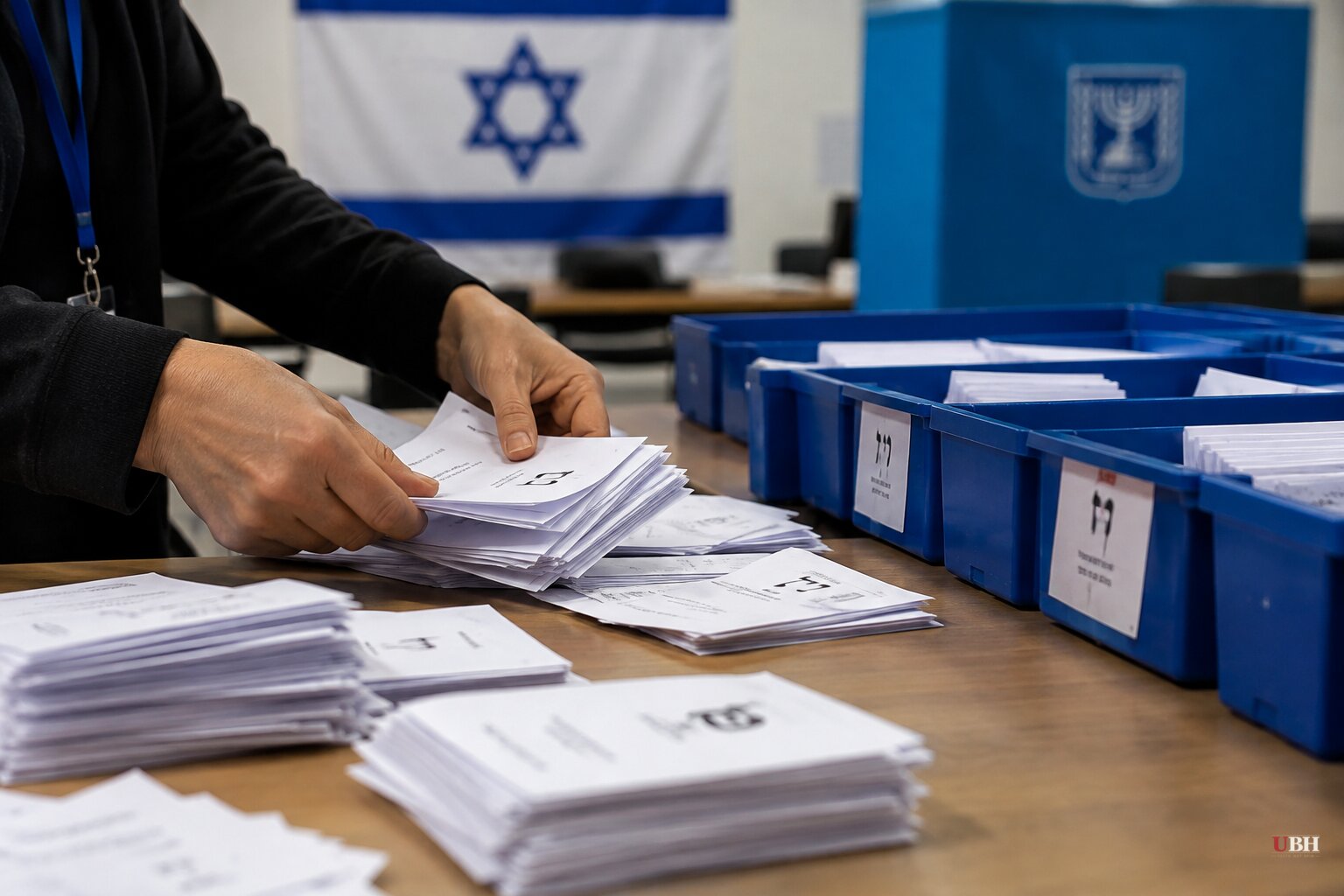
Since Israel's polls closed at 10 p.m. on Oct. 27 and exit polls showed Gadi Eisenkot's bloc narrowly ahead, the actual count has moved toward Prime Minister Benjamin Netanyahu. It has not moved far enough to give him a government.
With 60.2% of votes counted, about 3.4 million ballots, Netanyahu's right-wing and religious bloc is projected at 56 seats, five short of the 61 needed in the 120-seat Knesset, according to the Central Elections Committee count. Eisenkot's opposition bloc stands at 48. The predominantly Arab parties hold 16.
That is a reversal of the main television exit polls. Kan 11 and Channel 13 had Netanyahu at 50 and Eisenkot at 53, with Channel 12 at 50 to 52. An updated Channel 12 exit poll at 3:30 a.m. Israel time put Netanyahu at 53, the opposition at 49 and Arab parties at 19.
The seat count so far
Likud is the largest party with 28 projected seats. Eisenkot's Yashar has 21. The Joint List is at 12, and former Prime Minister Naftali Bennett's Beyachad party is at 11.
The Democrats, United Torah Judaism and Avigdor Liberman's Yisrael Beytenu are projected at eight seats each. Shas and Itamar Ben-Gvir's Otzma Yehudit have seven each. The Religious Zionism-Zehut alliance has six, and the Islamist Ra'am party has four.
The numbers are still moving. In the latest count Likud and Otzma Yehudit each gained a seat at the expense of the Democrats and United Torah Judaism. At the 50% mark, the Netanyahu bloc was at 56, the opposition at 49 and Arab parties at 15. Partial results are expected to change as more ballots are tallied.
Two sides, two readings
Netanyahu's camp is already arguing the count supports its claim. Speaking at Likud headquarters in Jerusalem, Netanyahu said the actual results would arrive "over the next day or two" and that "Likud is the largest party in Israel." He called for "a strong national right-wing government" and warned against one dependent on Arab parties.
Foreign Minister Gideon Saar called the opposition's victory statements "premature."
The opposition made its case on election night. Eisenkot called the first projections a "complete lack of confidence in Netanyahu and the October 7 government." Former Prime Minister Yair Lapid said the Netanyahu bloc "has suffered a crushing defeat." Eisenkot has since called on Netanyahu to accept the results and step aside.
Much of the rhetoric on both sides predates the count. On Tuesday, Netanyahu wrote on X that "Muslim Brotherhood supporters are raiding the polling stations and stealing the elections." Likud had announced earlier this month it would send religious Jewish observers to polling sites in Arab communities to "prevent fraud." Critics accused the party of trying to intimidate Arab voters. Eisenkot's Yashar party charged that Netanyahu was laying the groundwork to challenge the results. No evidence of fraud has been presented in these accounts.
The math that decides it
Even if the opposition bloc's numbers hold, Eisenkot has a problem. His 48 seats plus the Arab parties' 16 would total 64. But Eisenkot said during the campaign he would not govern with Arab lawmakers.
Ra'am leader Mansour Abbas said he believes the right "suffered a major loss" and is open to working with Eisenkot. Yair Golan, the left-wing Democrats leader, called for a government backed by Arab parties. Arab lawmakers could back Eisenkot in parliamentary votes to sustain a minority government without joining it.
The far-right Ben-Gvir, projected at seven seats, warned Netanyahu that a unity government with Eisenkot "would be a terrible mistake." Netanyahu has also suggested a government relying on Arab votes would lack legitimacy.
Party leaders have up to 42 days to assemble a coalition of 61. If that fails, President Isaac Herzog can hand the mandate to another lawmaker for 28 more days. If that fails too, Israel goes to another election.
Netanyahu could still be tasked with forming a government even without a majority, and he could remain in office in a caretaker capacity during the talks.
Threshold fights
Several small parties are fighting over the electoral threshold, and a few thousand votes could shift the seat math. The Reservists-Economic party, led by Yoaz Hendel and Yaron Zelekha, was 19,803 votes short of the threshold at the 60.2% mark. Ofer Winter's Amcha Israel was 54,888 votes short.
Ra'am is above the line with four seats, but by only about 6,000 votes. If Ra'am drops out, the Arab bloc shrinks, and so does the pool of votes either side could count on.
The Central Elections Committee has not given a timetable for the final tally. The unresolved question is whether the remaining 40% of ballots moves either bloc closer to 61, or whether the real decision comes in Herzog's office and in whether Eisenkot's pledge to avoid Arab parties survives the arithmetic.
Sources used for this briefing
8 links from 8 independent newsrooms (syndicated copies of the same report count once)
These are the sources it draws on, linked so you can verify.


