
Unbiased headlines. Facts, not spin.
Unbiased Headlines is an independently owned news organization. We bring you the facts, not opinions, written fresh from 110+ named sources. Sources linked so you can verify it yourself.
 politics
Notable (6/10)
Event date: October 19, 2026 ·
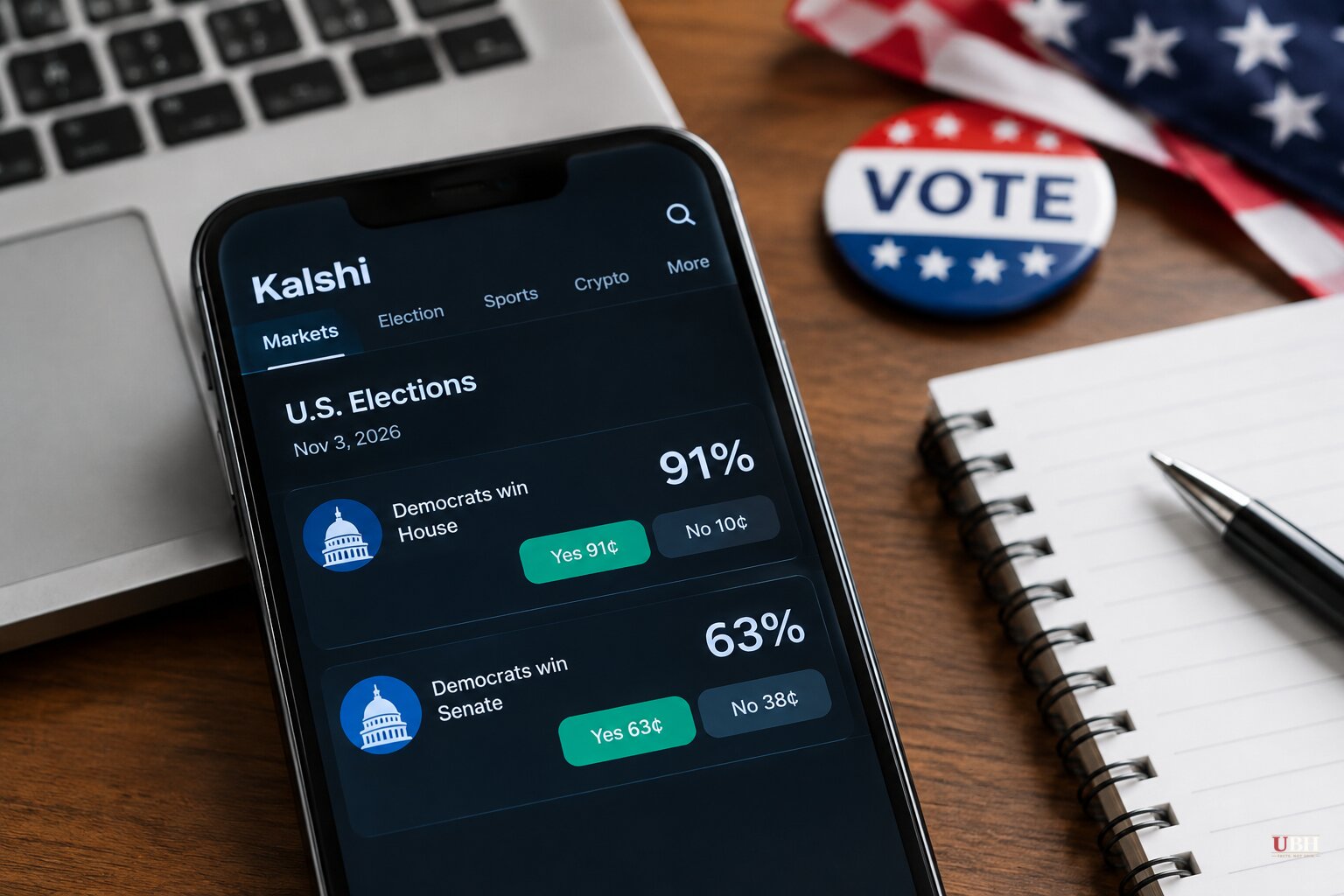
Kalshi Puts Democrats' House Odds at 91% and Senate at 63% One Week Before Midterms
Seven days out, the money says Republicans are in trouble.
As of Oct. 26, Kalshi put Democrats' chances of winning the House at 91%, versus 9% for Republicans. Polymarket showed 92%. On the Senate, Kalshi had Democrats at 63% and Polymarket at 66%.
Kalshi's projected Democratic House seat count has also climbed, from about 226 in May to 238 on Oct. 26. A majority takes 218.
The House math
All 435 House seats are on the ballot Nov. 3. Republicans hold the chamber narrowly, and midterms have rarely favored the president's party. Harvard's forecast gives Democrats a 93% chance of flipping it.
The national polling backs the markets. ING's economists, led by James Knightley, put the Democratic lead at around eight points nationally and say President Trump's approval rating has hit new lows.
A citizen-forecasting survey by researcher Brian Phelan Thompson Collart for the London School of Economics found 39% of Americans expect Democrats to win both chambers, up 12 points from a year earlier. That method asks voters who they think will win, not who they plan to vote for.
Why the map moved
The analysts who track this point to the cost of living. ING cites motor fuel prices and the war with Iran, along with worries about AI and job security. DIY Investor's analysis says the Iran war sent gasoline and diesel prices soaring and left mortgages less affordable than at any time in a quarter of a century.
That shift matters most in the Senate. Republicans hold a 53-47 majority, and Democrats need a net gain of four seats. Of the 35 seats up this year, the Cook Political Report rates 12 as competitive and seven as toss-ups.
Democrats' best targets are Maine, Ohio and North Carolina. Republicans see openings in New Hampshire, Michigan and Georgia.
The Senate is not settled. Citadel's analysis, as summarized by DIY Investor, projects Republicans will hold it, which puts that firm at odds with the prediction markets.
If Republicans do hold both chambers, ING expects Trump to treat it as a mandate for his America First agenda. That would mean more deportations, tariffs aimed at pulling trading partners into line with U.S. foreign policy, and heavier pressure on NATO allies for defense spending.
The betting itself is under scrutiny
The platforms posting these odds are dealing with an integrity problem of their own. Beyond who wins, they list narrow markets on things campaigns know in advance: endorsements, candidate withdrawals, where Trump will hold events, what candidates will say at rallies and debates, and which states will redraw House districts.
The nonpartisan Anti-Corruption Data Collective counted more than $20 million in trading volume on those midterm side markets. It found an average of 44 granular markets per race.
"This is legal, and that's part of the problem," said Michael Hornsby, the group's co-director. "All of these things are knowable by the candidates, their campaigns, and by people close to them." He argues the platforms are "creating an incentive for future public servants to trade on inside information."
The problem is not hypothetical. CNN reported that a White House teleprompter operator traded on Kalshi markets tied to Trump's speeches this summer and settled a civil probe with federal regulators by paying a $65,000 fine.
Kalshi has suspended at least six 2026 candidates for betting on their own races, and in April banned and fined a handful of political candidates for the same thing. NPR reported in May that campaign staffers made "thousands" using inside polling data to bet on their own candidates on Polymarket and PredictIt.
What the platforms say
The companies say they do not tolerate it. Shana Bautista, Polymarket's head of global intelligence and investigations and a former FBI official, told NPR her 16-person team has investigated "dozens" of election-related bets.
"If you have information that you have a duty to protect, don't trade on it," Bautista said. "If you decide that you are smarter and can do it, we will find you."
She said Polymarket's surveillance system draws on social media, Federal Election Commission data, crypto firms, banking partners and public records, and sends her "hundreds of alerts a day." She also said crypto trades are rarely fully anonymous. Polymarket's international arm is essentially unregulated and allows anonymous, crypto-based trading.
A person familiar with the probes told NPR that at least two Polymarket investigations have been referred to the Commodity Futures Trading Commission. The agency has announced no charges tied to midterm betting.
The rules are still moving
The legal backdrop has swung. The Biden administration tried to ban election-outcome markets, and a federal appeals court struck that effort down in October 2024. According to CNN, the Trump administration has embraced prediction companies and is finalizing federal regulations that would let election markets continue.
The platforms also face legal challenges from states, and some lawmakers argue betting on elections endangers the democratic process, NPR reported.
The LSE survey adds one more caution. Collart cites a recent study suggesting prediction markets are vulnerable to manipulation, an argument for treating the odds as one signal among several.
The real test comes Nov. 3, when voters settle what the markets can only price. Whether the CFTC acts on the referrals, and what the final federal rules say about contracts on endorsements and speeches, are still open.
Sources used for this briefing
7 links from 7 independent newsrooms (syndicated copies of the same report count once)
These are the sources it draws on, linked so you can verify.


