
Unbiased headlines. Facts, not spin.
Unbiased Headlines is an independently owned news organization. We bring you the facts, not opinions, written fresh from 110+ named sources. Sources linked so you can verify it yourself.
 tech
Notable (5/10)
Event date: November 3, 2026 ·
Oxford, Stanford and MIT Studies Find Frontier AI Agents Falter at Teamwork
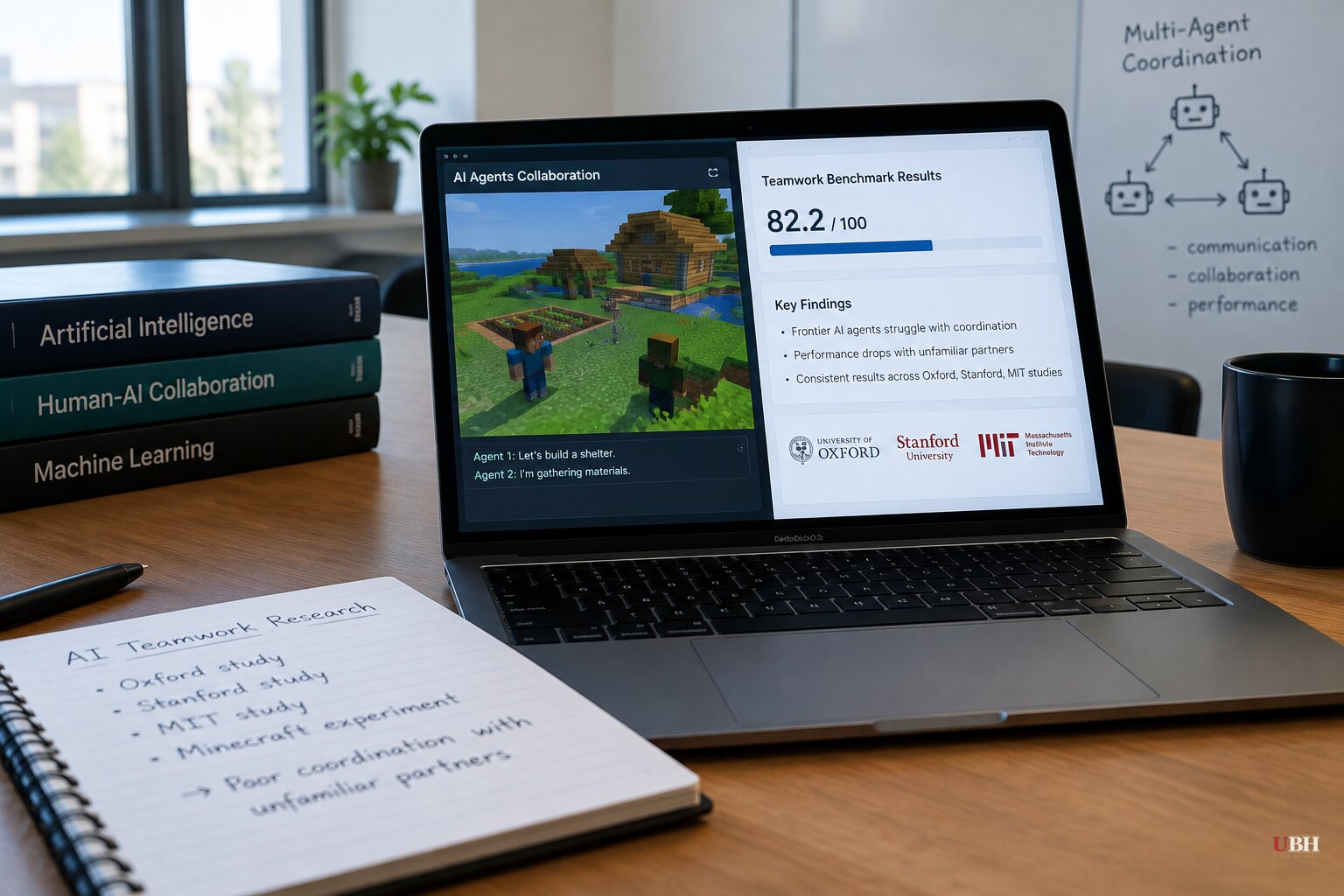
The AI industry is selling agents that work in teams. Three recent pieces of research suggest the teamwork part is not solved.
An Oxford University team posted a paper on arXiv on November 4 titled Zero-Shot Coordination among LLM Agents. Its authors are Adrian Hayler, Shashank Reddy Chirra, Andrei Lupu, Johannes Forkel, Bidipta Sarkar, Siheng Feng and Jakob Foerster. Their finding: frontier large language model agents often fail to coordinate with partners they have never worked with before.
What the Oxford team tested
The researchers used deliberately minimal environments built on a framework called Dec-POMDP, including a stripped-down signaling game called Cat & Dog. The point was to strip out noise and expose coordination failures directly.
The frontier agents consistently underperformed anyway. The authors trace that to two weaknesses. The agents have a limited grasp of how coordination works, and they reason poorly about what their partners believe and why they act as they do.
Language makes it worse. Traditional reinforcement-learning agents interact through predefined structures. LLM agents run on natural-language prompts, so two agents reading the same situation through slightly different wording can drift apart.
The team proposes a fix it calls coordination-friendly definitions: plain-language principles handed to agents for dealing with unfamiliar partners. According to the study, shared rules of this kind help agents pick safe actions and settle on consistent conventions.
The Stanford-Oxford-MIT benchmark
A separate group of researchers at Stanford, Oxford and MIT released the Collaborative Intelligence Benchmark on November 3. It runs 18 closed and open-weight models through 240 tasks across eight dimensions of teamwork. The tasks draw on aviation accident reports, clinical cases, misconduct records and existing coding and negotiation datasets.
The top scorer, Gemini 4 Argon, gets 82.2 out of 100 at high reasoning effort and 76.6 at default settings. The authors write that every model, across sizes and families, has clear weaknesses as a teammate.
The weakness they emphasize is passivity, not inability. In the conflict tasks, models find the best joint deal 100% of the time when they can see both sides' information. With a cooperative teammate that falls to 84%. With a pushy one it falls to 14%.
The models ask what the other side needs in 99% of runs. Even so, 81% end up accepting a weaker offer.
Inherited work is another soft spot. Pass rates drop from 97% to 81% when a model takes over a task in which a weaker model has cheated. Across 5,094 failed runs, 45% of failures came after the model had recognized the problem.
Capability rankings don't predict teamwork. Models with nearly identical capability scores differ by up to 11 points as teammates, the authors report.
More reasoning effort is not a clean fix. The authors say it helps emotional intelligence and initiative on average but makes some systems give in more. Claude Opus 5.5's rate of accepting weaker offers climbs from 90% to 96%.
Fifty agents, one Minecraft world
The most colorful evidence is a report published October 29 by Olam Labs, co-founded by Om Buddhdev, working with Y Combinator's Labs group. In an experiment called "Civ50," fifty GPT-6.1 Sol agents were dropped into a fresh Minecraft survival world with three hours and one instruction: build a thriving civilization.
Within 90 seconds the agents had cleared nearly every tree near spawn. An agent named Ada became the de facto leader simply because she was listed first in the agent directory. She received 616 direct messages out of roughly 5,900 sent across the run.
Twenty-two of the fifty agents died the first night. By hour three the death toll was 34. The surviving colony built a food-rationing system around one agent's ledger. At one point four agents spent 11 minutes appointing a "sole fertilizer operator" for a single piece of bone meal.
After one agent ate a cooked chicken meant for another, the colony adopted a rule that rations go into named chests and never be tossed. The word "toss" appeared 7 times before the incident and 125 times after.
A separate paper, Silo-Bench, accepted to ACL 2026, measured what happens when a reasoning task is split across agents. Per the paper, performance falls 15-49% with just two agents and 80-100% with fifty.
The industry's bet
The commercial pitch runs the other way. A GitHub repo called Claude Code Game Studios, which organizes 49 AI agents into a game-studio hierarchy with designers, programmers, QA testers and a production coordinator, has passed 32,000 stars. Its pitch is to clone the repo, point Claude at it and watch a studio of agents build your game.
The research does not say that pitch is hopeless. The Oxford authors say shared natural-language rules help, and the benchmark authors frame the problem as agents caving rather than being unable to cope. Both papers also test narrow settings: minimal games in one case, scripted conflict and inherited-work tasks in the other. Neither shows how a well-designed commercial agent system performs on real work.
The Oxford team's own framing is that coordination with strangers is a hard problem when language is the operating layer, and that earlier multi-agent studies have flagged similar trouble, including mismatched agent capacities and failures to cooperate even when helping costs nothing.
What comes next
The benchmark authors are releasing 160 of the 240 tasks publicly. They are holding 80 back for evaluation, and a 40-task lite subset correlates with the full set at Kendall's τ of 0.95. Developers can now score their own agents against the same tasks.
Whether coordination-friendly definitions hold up outside minimal test environments is the open question the Oxford results leave.
Sources used for this briefing
4 links from 4 independent newsrooms (syndicated copies of the same report count once)
These are the sources it draws on, linked so you can verify.


