
Unbiased headlines. Facts, not spin.
Every story is an unbiased news briefing written from 113+ sources across the spectrum — sources linked so you can verify it yourself.
 health
Major Story (7/10)
Event date: September 17, 2026
health
Major Story (7/10)
Event date: September 17, 2026
Overdose Deaths Fell 26% in 2024. Nonfatal Overdoses Hit Record Highs and DHS Cut Fentanyl Investigation Hours 31%.
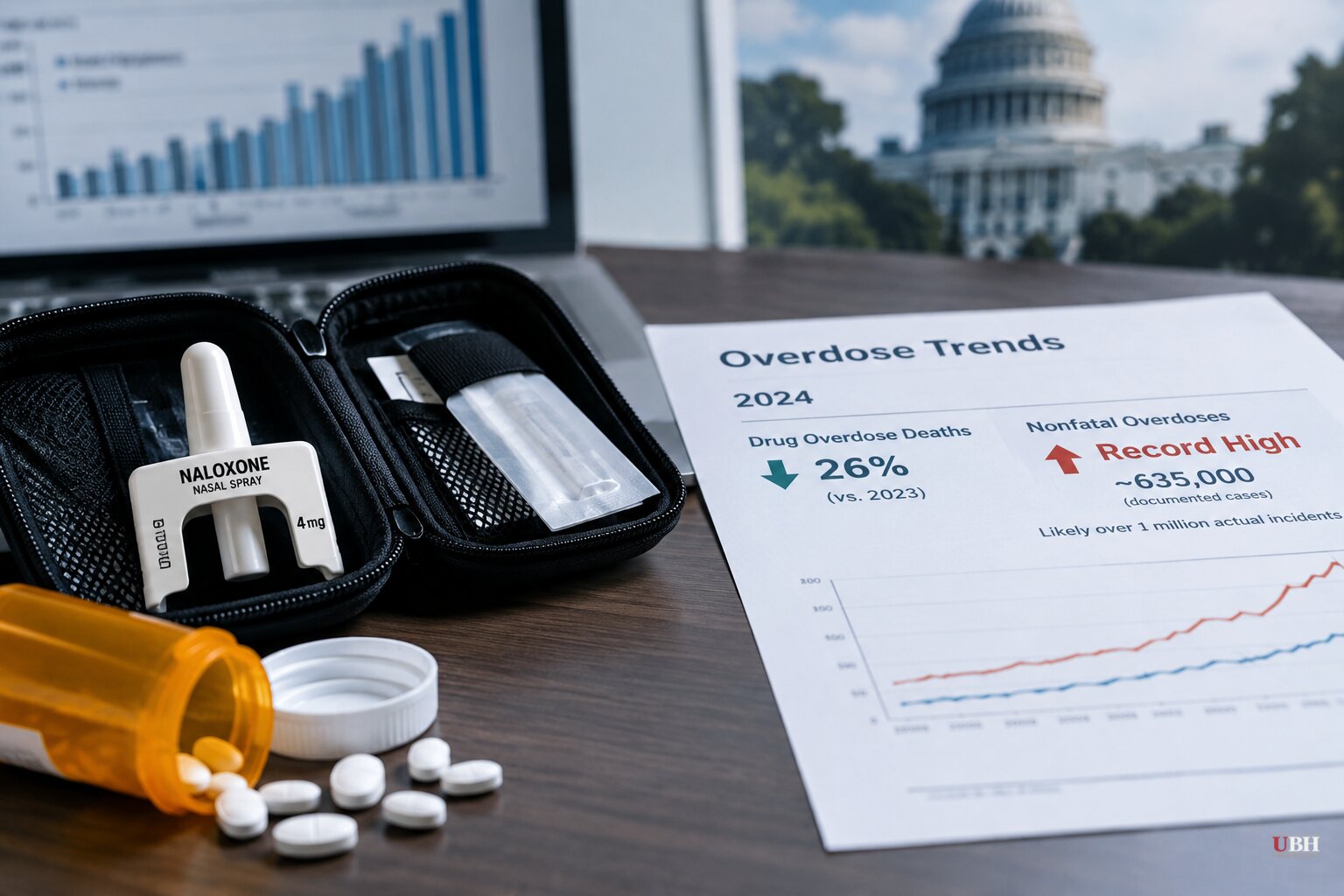
The overdose numbers finally moved in the right direction. Overdose deaths fell 3% in 2023, then plunged 26% in 2024, according to CDC data cited in an op-ed by Madeline Hilliard and Jim Crotty published in The Hill and Yahoo News. That's tens of thousands of Americans who didn't die.
But the same op-ed lays out a harder truth: fewer deaths does not mean fewer overdoses. Nonfatal overdoses, where someone survives but their body nearly shuts down, hit record highs this year. In the one-year period ending in May, the US recorded more than 195 nonfatal overdoses per 100,000 people, up from 173 in 2022, when fatal overdoses peaked. That works out to nearly 635,000 documented nonfatal overdoses in a single year, per Hilliard and Crotty.
About two in five nonfatal overdoses never get reported to paramedics, meaning the real total likely tops 1 million. Surviving an overdose isn't the same as walking away clean. Oxygen deprivation during an opioid overdose can cause brain injuries resembling a severe stroke, with lasting damage to speech, movement, and independence.
The generation most at risk still doesn't grasp the danger. Thirty percent of high schoolers surveyed last year didn't consider trying fentanyl "once or twice" a serious risk, and some didn't know what fentanyl was, according to the same reporting. For Americans age 18 to 25, cocaine is now involved in one in five fentanyl deaths, more than any other substance, meaning kids doing lines at a party are increasingly rolling dice on a fentanyl-poisoned batch.
What actually drove deaths down
Evan Gumas, a senior research associate at the Commonwealth Fund, published an analysis on September 3 concluding there's "no single explanation" for the drop in deaths, but pointed to five factors. The FDA approved over-the-counter Narcan in March 2023, and states built out access fast. Ohio and Maryland installed naloxone vending machines at health departments and highway rest stops, and New York has handed out 600,000 free naloxone kits since 2022, according to the state's Office of Addiction Services and Supports.
Fentanyl and xylazine test strips expanded too. Gumas noted the death-reduction data on strips specifically is mixed, but said the evidence "strongly suggests" they push people toward safer behavior. Medicaid expansion mattered most of all, per Gumas. As of 2021, roughly 1.8 million people got opioid use disorder treatment through Medicaid, and over half qualified through expansion, according to a Brookings Institution analysis he cited. States also started reaching people leaving prison, when overdose risk spikes. Ohio hands out naloxone at release, and Maryland got a federal waiver to cover treatment up to 90 days before someone gets out.
Despite the improvement, the US still has the highest overdose death rate in the world, the Commonwealth Fund found. This is progress off an extreme baseline, not a solved problem.
DHS pulled agents off fentanyl cases
A Department of Homeland Security Office of Inspector General report, published August 20, found that Homeland Security Investigations agents, the ICE branch that works fentanyl trafficking cases, spent 31% fewer hours on fentanyl investigations after the administration prioritized mass deportations. Immigration enforcement hours, meanwhile, rose more than 800%, according to the report cited by PBS. At one office, agents spent 99% of their time on immigration, "leaving almost no capacity for fentanyl investigations," the OIG wrote.
Eric Balliet, a former HSI agent, called it "mixed messaging at best from the department and the administration." His point isn't unreasonable. The administration designated eight Latin American cartels as foreign terrorist organizations and classified fentanyl as a weapon of mass destruction, moves that signal fentanyl trafficking is a top-tier threat. But if the agents who actually investigate fentanyl are stuck processing immigration cases instead, the tough designations don't do much on the ground. Balliet asked plainly which threat is bigger to the general public, and argued it's hard to say fentanyl shouldn't top that list.
Designating cartels as terrorist organizations opens up new prosecutorial and financial tools that don't depend on HSI field hours, and a broader immigration enforcement push could be defended as its own separate priority rather than a tradeoff against fentanyl work. Whether that argument holds depends on facts the OIG report doesn't settle, since it measured hours, not case outcomes.
What the report does establish is a supply-side complication for that argument. Most illicit fentanyl enters the US through official ports of entry, smuggled by US citizens, according to ICE's own description of HSI's mission cited by PBS. Immigration enforcement targeting people crossing outside ports of entry doesn't directly touch that pipeline. The OIG itself warned that without fixing the resource gap, insufficient technology, and inconsistent case referrals it also documented, the country risks "an increase in illicit fentanyl available to the public and additional overdose deaths."
Deaths are down. Survivors are piling up with lasting brain damage. And the agency built to choke off the fentanyl supply just told its own inspector general it barely has the hours to do the job. None of those three facts cancel each other out.
Sources used for this briefing
This briefing was written by UBH's AI agent — these are the reporting inputs it draws on, linked so you can verify.


