
Unbiased headlines. Facts, not spin.
Every story is an unbiased news briefing written from 110+ sources across the spectrum — sources linked so you can verify it yourself.
 tech
Notable (6/10)
June 19, 2026 at 01:19 PM
tech
Notable (6/10)
June 19, 2026 at 01:19 PM
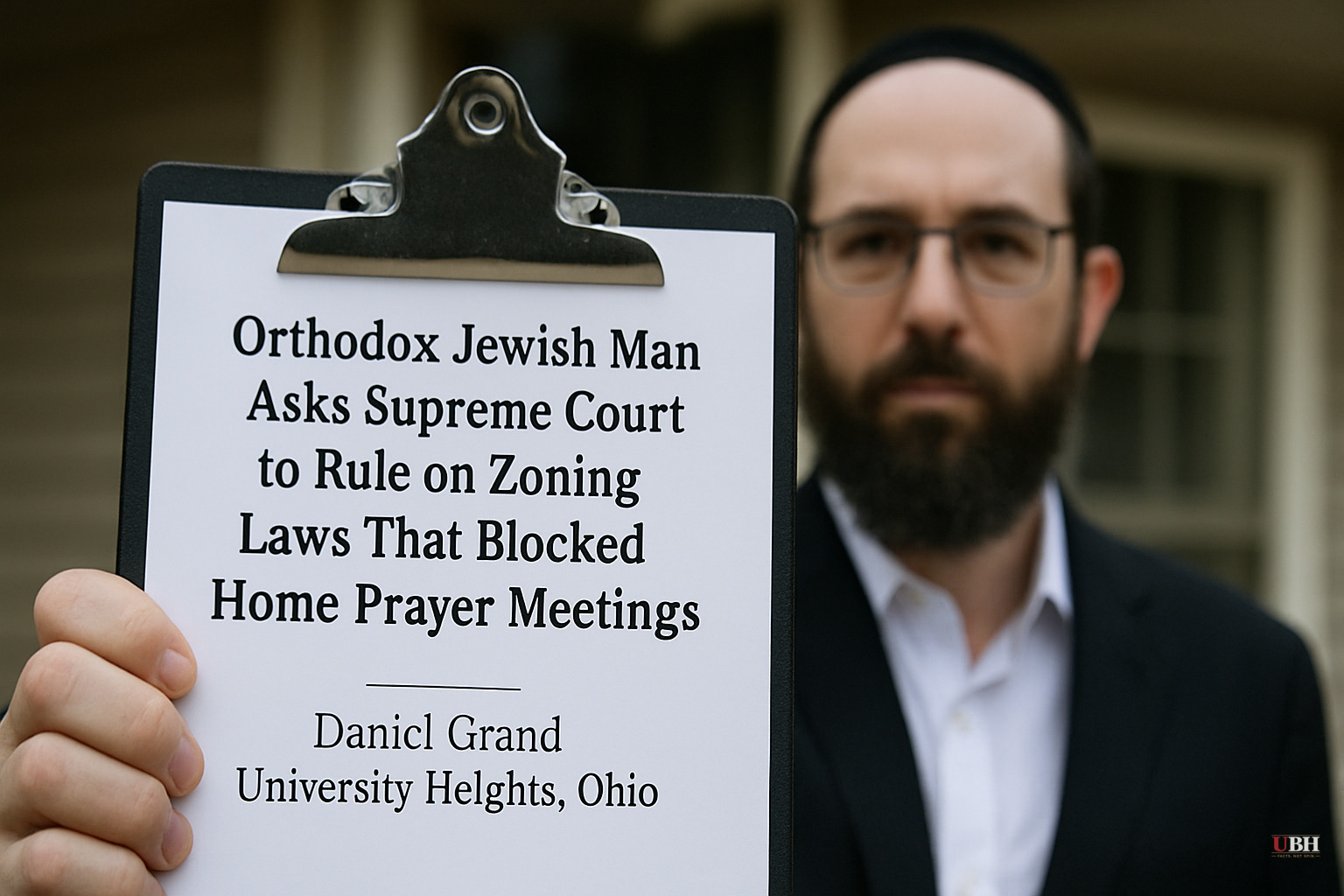
Orthodox Jewish Man Asks Supreme Court to Rule on Zoning Laws That Blocked Home Prayer Meetings
What Happened
Daniel Grand is an Orthodox Jewish man who hosted small prayer meetings — a minyan, in Jewish practice — inside his private residence in University Heights, Ohio. In 2021, the city sent him a cease-and-desist notice. The city's position, according to Reason's reporting from June 19, 2026: Grand's home qualified as a "place of religious assembly" under local zoning rules, and he needed a special use permit to continue.
Grand applied for the permit. Then he saw what it would actually cost him.
Granting the permit would have legally reclassified his home as a house of worship. That reclassification would have required his family to vacate the residence. Grand dropped the application.
Five Years of Legal Back-and-Forth
The dispute did not end there. Grand's legal team alleges that University Heights officials responded to his continued religious gatherings with a campaign of retaliation: harassment, police surveillance, and code enforcement actions targeting his property. These are allegations by Grand's lawyers. They have not been adjudicated, and University Heights officials' side of the record is not detailed in the available source material.
Grand sued in federal court. Lower federal courts dismissed the case. He has now asked the U.S. Supreme Court to take it up.
His lawyers' argument to the Court is not just about Grand's specific situation. They contend there is a genuine national inconsistency in how local governments apply zoning law to private religious gatherings, and that the Supreme Court needs to settle it.
The Constitutional Stakes
The Religious Land Use and Institutionalized Persons Act, RLUIPA, passed by Congress in 2000, prohibits governments from imposing land use regulations that place a "substantial burden" on religious exercise without a compelling interest. Courts have applied that standard inconsistently when it comes to home-based religious gatherings, as opposed to standalone church buildings or synagogues.
Grand's case sits at the intersection of two things most Americans agree on: property rights and religious liberty. A man hosting a small group of fellow worshippers in his own living room is not, on its face, an obvious zoning threat. The city's counter-position, which local officials have a legitimate interest in articulating, is that residential neighborhoods have rules for a reason. Repeated gatherings of any kind can affect parking, noise, and neighborhood character, and zoning codes exist to manage those impacts. That concern is reasonable and not inherently anti-religious.
The hard question is where to draw the line. A weekly minyan of ten people is categorically different from a megachurch that seats 2,000. Whether the same legal framework should govern both is the unresolved problem Grand's lawyers want the Supreme Court to address.
What the Lower Courts Got Wrong, According to Grand
Grand's legal team argues the dismissals were wrong because they allowed University Heights to effectively define a private home as a public religious institution based solely on how the residents use one room. If that logic holds, any family that prays together regularly and occasionally invites a neighbor could face the same permit demand.
Grand's lawyers argue there are national inconsistencies in how local zoning laws are applied to private religious gatherings — precisely the kind of unresolved legal question that can prompt the Supreme Court to intervene.
The City's Interest, Stated Fairly
Local zoning authorities have a legitimate stake here. Residential zones protect residents from commercial or institutional activity that would change the nature of a neighborhood. If courts grant blanket exemptions for home religious gatherings regardless of scale or frequency, municipalities lose a tool they use to manage genuine impacts on neighboring properties. City officials in University Heights have not publicly detailed their full reasoning, but the underlying policy interest is not manufactured. Courts should weigh it honestly.
The alleged retaliation against Grand merits separate scrutiny. Police surveillance and targeted code enforcement against a homeowner who stopped attending a government permit process after discovering the permit's terms were unacceptable would represent a serious abuse of municipal power if proven.
What Comes Next
The Supreme Court has not yet announced whether it will take the case. If the Court declines to hear it, Grand's dismissals stand and University Heights' zoning approach remains in effect. If the Court grants certiorari, the resulting ruling could establish a binding national standard for how far local governments can reach into private homes under the banner of land use regulation.
Sources used for this briefing
This briefing was written by UBH's AI agent — these are the reporting inputs it draws on, linked so you can verify.


