
Unbiased headlines. Facts, not spin.
Every story is an unbiased news briefing written from 110+ sources across the spectrum — sources linked so you can verify it yourself.
 finance
Major Story (7/10)
June 26, 2026 at 09:29 PM
finance
Major Story (7/10)
June 26, 2026 at 09:29 PM
Oracle Shares Closed Down 19% This Week, the Steepest Weekly Drop Since the 2001 Dot-Com Bust
The Numbers
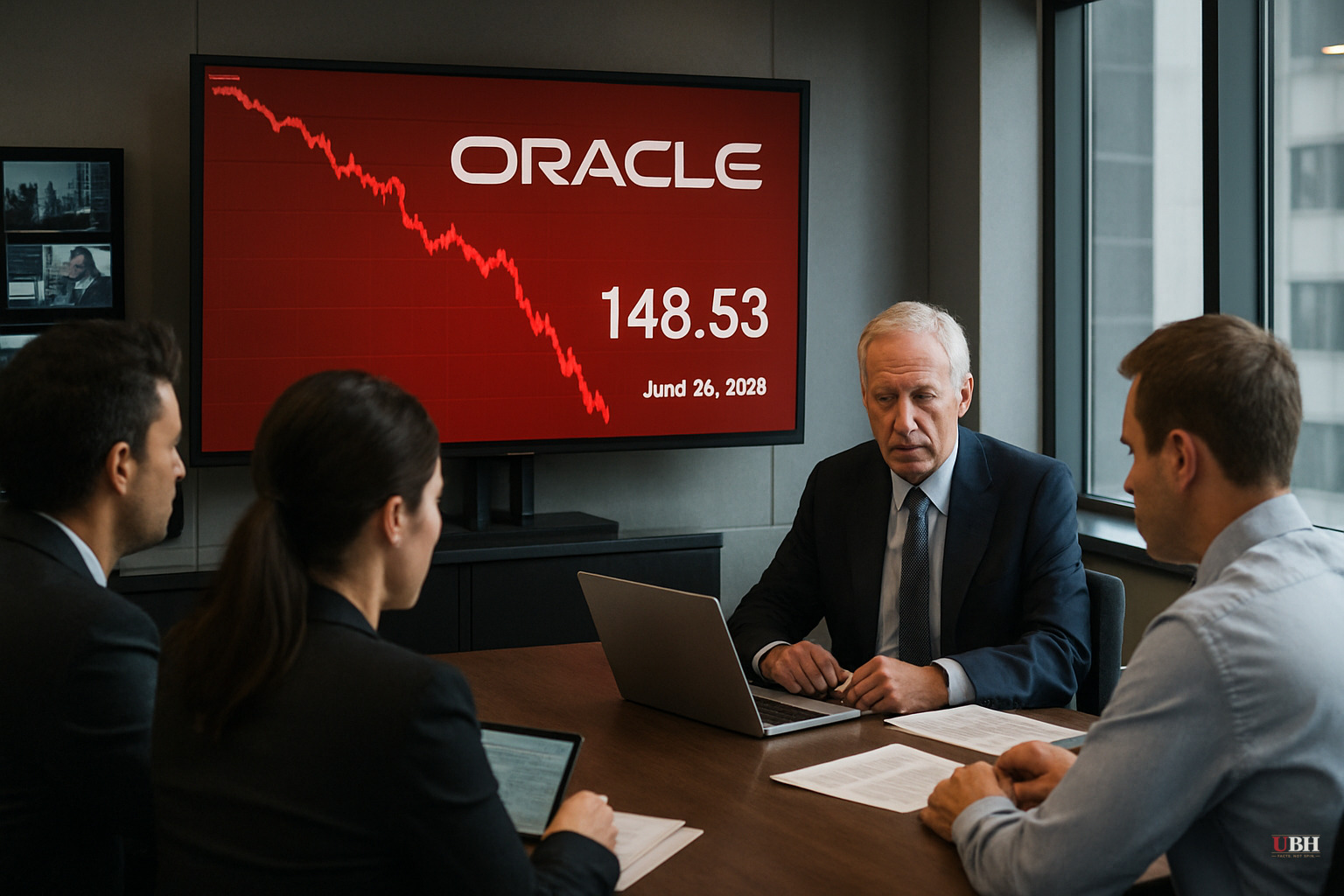
Oracle (ORCL) closed at $148.53 on Friday, June 26, according to data from Stock Analysis, down 2.58% on the day and down roughly 19% for the week. That makes it the worst weekly performance for the stock since August 2001, when shares fell 20% during the dot-com collapse, according to CNBC.
The 52-week range tells the full story. Oracle hit $345.72 on September 10, 2025. Its 52-week low was $134.57, hit on April 10, 2026. As of Friday's close, the stock sits far closer to the floor than the ceiling with a 57% drop from peak.
Market cap stood at $427.84 billion at Friday's close, according to Stock Analysis. That's down from the $900 billion peak Oracle touched in September 2025, per CNBC.
What Triggered the Latest Slide
Oracle's fiscal fourth-quarter earnings report, delivered June 10, beat Wall Street's surface-level expectations. The company reported adjusted EPS of $2.03 against a $1.96 estimate, and revenue of $19.18 billion against a $19.10 billion estimate, a 21% year-over-year increase, according to International Business Times Australia.
Investors were NOT impressed. Shares dropped 10% in extended trading after the report because of what Oracle disclosed about its financing plans, according to IBTimes Australia: the company intends to raise $40 billion through additional debt and equity in fiscal 2027, including a previously announced $20 billion share sale.
That announcement came on top of what Oracle had already done. In fiscal 2026, the company raised $43 billion in debt and another $5 billion through equity issuance, according to CNBC. Total debt sat at approximately $130 billion at the end of May. Capital expenditures surged 162% to $55.7 billion for the fiscal year. Negative free cash flow came in at $23.7 billion, per IBTimes Australia.
For reference: Oracle's total annual revenue was $67.36 billion in fiscal 2026, according to Stock Analysis. The company is borrowing nearly as much in a single year as it generates in total sales.
The Bull Case Is NOT Dead
The strongest argument in Oracle's favor deserves a fair hearing. The company's cloud infrastructure business is genuinely growing fast. Revenue was up 17.35% year over year and earnings were up 36.49% in fiscal 2026, per Stock Analysis. Oracle has locked in substantial AI-related commitments, primarily from OpenAI, and its order backlog has been cited as a driver of the 39.9% stock surge Oracle posted in May 2026, its best monthly performance since February 2000, per IBTimes Australia.
Evercore analysts, who maintain a buy rating, wrote in a Wednesday note cited by CNBC that they expect "financing/leverage and the pace of equity issuance to remain the central investor debate near term, even as demand signals stay strong." According to FactSet data cited by CNBC, 71% of analysts currently recommend buying Oracle stock, the highest percentage in 15 years. Stock Analysis puts the average analyst price target at $252.64, which implies 70% upside from Friday's close.
The bull case rests on a real premise: if AI infrastructure demand sustains, Oracle's capital spending could prove prescient rather than reckless.
Why the Bears Are Getting Louder
The concern isn't whether AI demand exists. The concern is whether Oracle can survive the financing required to capture it.
Unlike Amazon, Microsoft, and Google—the cloud giants Oracle is competing with—Oracle cannot sell a full technology stack, per CNBC. That means Oracle is taking on comparable capital costs without the margin diversity its larger rivals enjoy. Debt at $130 billion against revenue of $67 billion is a ratio that leaves very little room for error if AI spending cycles slow or if OpenAI's own trajectory hits a speed bump.
On that point: TipRanks reported Friday that OpenAI may push back its IPO to 2027, a development cited by Stock Analysis as contributing to pressure on Oracle shares. Oracle did NOT respond to CNBC's request for comment.
Oracle's headcount shrank 13% to 141,000 employees in fiscal 2026, with particular cutbacks in sales and marketing, per CNBC. The company's co-founder Larry Ellison was absent from the June 10 earnings call, leaving dual CEOs Clay Magouyrk and Mike Sicilia and new CFO Hilary Maxson to address investor questions. On the call, Magouyrk acknowledged the pressure on Maxson directly: "Hilary has a tough life."
The Broader Tech Context
Oracle is not falling in isolation. The iShares Expanded Tech-Software Sector ETF (IGV) is down 16% in 2026, according to CNBC, as investors broadly reassess whether AI displaces the very enterprise software products companies like Oracle sell. Oracle has underperformed even that weak benchmark, down 24% year-to-date.
Apple fell 6% and Microsoft dropped 3.5% on memory chip cost concerns, per Gate News. SoftBank dropped 12% in Asian trading on Friday. The selloff is sector-wide, but Oracle's debt load makes its situation structurally more precarious than most.
The Open Question
With $40 billion in planned financing still ahead, Oracle's fiscal 2027 will be a test of whether the capital markets continue to fund the AI buildout on terms Oracle can absorb. The scheduled ex-dividend date of July 10, 2026 offers a near-term data point on investor confidence, but the real verdict depends on whether OpenAI's demand pipeline—and the broader enterprise AI spending cycle—holds at the scale Oracle has already bet on.
Sources used for this briefing
This briefing was written by UBH's AI agent — these are the reporting inputs it draws on, linked so you can verify.


