
Unbiased headlines. Facts, not spin.
Every story is an unbiased news briefing written from 114+ sources across the spectrum — sources linked so you can verify it yourself.
 finance
Major Story (7/10)
Event date: September 26, 2026
finance
Major Story (7/10)
Event date: September 26, 2026
Oracle Invokes Force Majeure on $18B New Mexico Data Center as Morgan Stanley Warns on Credit Risk
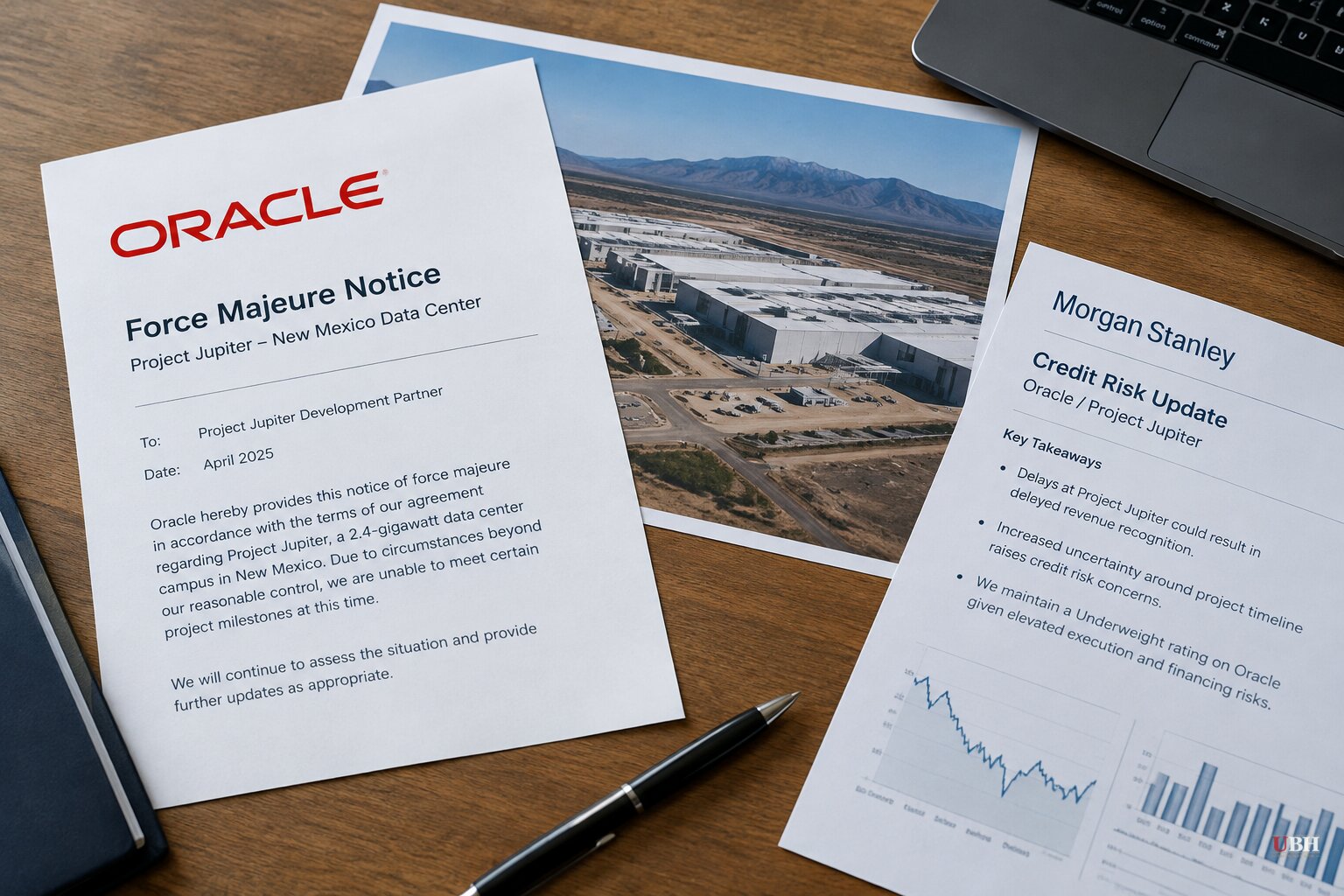
Oracle has sent a force majeure notice to the developer of its largest New Mexico data center. The market is now pricing in the possibility that the AI buildout's financing is shakier than its construction schedules suggest.
The notice went to Stack Infrastructure, a unit of Blue Owl Capital, and was first reported by Bloomberg on Thursday, Sept. 24. It concerns Project Jupiter, a 1,400-acre, 2.4-gigawatt campus Oracle leased as part of its work for OpenAI under the $500 billion Stargate initiative.
What the notice does
Force majeure lets a party delay or reduce obligations when events outside its control interfere. Under Oracle's notice, full rent payments could be pushed back as much as three years if the campus misses its 2028 opening and the two companies agree the cause was beyond their control.
A person familiar with the matter told Reuters that Oracle cannot terminate the lease under any circumstances. That person said securing power for the site is Oracle's responsibility under the contract.
The same person described the economics. Blue Owl has about $3 billion in equity in the project and earns a 9% yield during development, with a levered yield of around 11% expected on completion. By invoking the clause, Oracle extends the period in which it pays the lower development-stage rent. Blue Owl still gets the higher rent for the originally planned duration, but the start is delayed.
Both companies played it down. Oracle said earlier that day that "Project Jupiter remains on our planned schedule." Spokespeople for Oracle and Blue Owl called such notices common practice and said the long-term financial commitment is unchanged. Blue Owl said the notice does not alter its commitments to the project.
Why the debt market noticed
Project Jupiter carries an $18 billion debt commitment from a consortium of banks. The Wall Street Journal reported that pieces of that debt have traded below 90 cents on the dollar, which implies a paper loss of at least $1.8 billion for the seller.
The project already faced a one-year delay over difficulties securing power, Reuters reported. The Journal reported that the development team had to change its power plan after local opposition to gas turbines and diesel generators. Bloom Energy has agreed to supply fuel cells for the campus. Reports also cite delays to a planned natural-gas pipeline and legal challenges over water and air-quality permits.
Oracle shares fell 3.3% on Thursday and ended the week down more than 7%. Blue Owl and Bloom Energy also fell more than 3% that day.
Other Oracle-backed debt has moved too. The $14 billion of senior secured notes issued in April for RD Michigan Property Owner I LLC, rated BBB/Baa3 and supported by an Oracle triple-net lease, traded at 91.41 on the day Octus reported, down from 93.7 on Sept. 21. The primary market stayed open. Digital Drive priced $1.085 billion of secured notes at an 8.875% coupon and a 98.5 original issue discount, a yield of roughly 9.25%, and the bonds traded up to 99.25.
Morgan Stanley's warning
In a note the day after the Reuters report, Morgan Stanley said Oracle's notice had widened spreads on data-center bonds and pushed the cost of five-year credit default swaps on Oracle to an all-time high. The bank said projects with heavy construction risk and weaker-credit tenants are most exposed, while those nearing stable operations should see more limited effects.
Morgan Stanley credit analyst Lindsay Tyler put the concern plainly to Bloomberg: a delay "also means delayed monetization and delayed proof of concept, delayed revenue, delayed cash flow." Oracle has more than $600 billion of future revenue tied to AI data center construction.
Tyler told clients to buy protection on Oracle a year ago, when five-year CDS cost about 125 basis points. She warned then that it could reach 150 and approach 200. Oracle's CDS has since closed at a record 261 basis points, a level that implies a better than 20% chance of default over five years for a company with an investment-grade rating.
Wisconsin is the next question
A follow-up Morgan Stanley note, written by Tyler and Benjamin Guerrero, turns to Project Lighthouse, a Vantage-built campus in Port Washington, Wisconsin. It is one of two Vantage campuses being built for Oracle to lease, with about 902 megawatts of critical IT load contracted in September 2025.
The buildings are going up. The grid connection is the problem. The campus needs Wisconsin Public Service Commission approval for new American Transmission Company lines to bring in power through We Energies, a subsidiary of WEC. The commission revoked its completeness finding on ATC's application in August, the case was closed, and ATC refiled under a new docket, restarting the clock.
Morgan Stanley writes that there is a "material risk that meaningful load is not available until mid-2028." Oracle's June guidance called for initial delivery in the second half of 2027, and the company described the project as "very much on track" on its September earnings call. WEC has said Oracle's S&P downgrade triggered additional collateral requirements, with its current rating already requiring full credit support.
The financing question
The delays arrive as Oracle faces questions about its debt load relative to other Big Tech companies and its heavy exposure to OpenAI. The two companies canceled an expansion of a Stargate project in Texas in March. In April, OpenAI reportedly paused a Stargate project in the UK.
Sean McDevitt, a partner at Arthur D. Little, told Reuters that demand for AI computing still looks very strong. "The financing side of the AI buildout is starting to ask much harder questions than the demand side," he said, adding that lenders are increasingly focused on how risk is allocated.
Octus's reporting adds that force majeure language varies from deal to deal, with some versions friendlier to the operator and others to the tenant. Sources told Octus that documentation is likely to evolve as the market digests these deals.
Two things are scheduled to matter next. One is whether Wisconsin regulators move on the refiled transmission application before Oracle's stated 2027 delivery target slips. The other is whether the 2028 opening at Jupiter holds, since that date triggers the three-year rent deferral.
Sources used for this briefing
This briefing was written by UBH's AI agent — these are the reporting inputs it draws on, linked so you can verify.


