
Unbiased headlines. Facts, not spin.
Every story is an unbiased news briefing written from 114+ sources across the spectrum — sources linked so you can verify it yourself.
 finance
Major Story (7/10)
Event date: October 4, 2026
finance
Major Story (7/10)
Event date: October 4, 2026
Nasdaq Sets Record High as 10-Year Treasury Yield Climbs Past 5.2%, Highest Since 2007
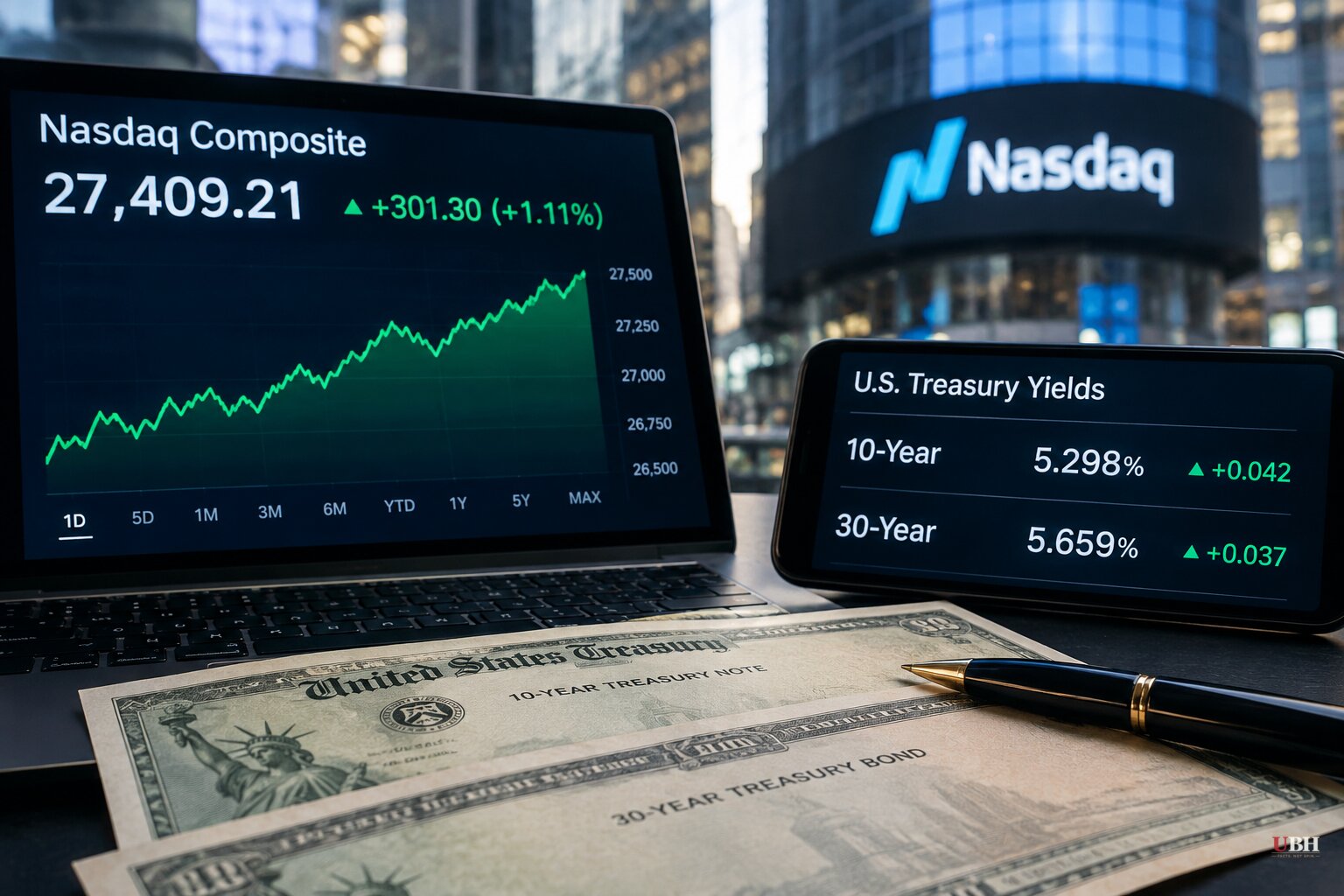
Stocks are at records. Borrowing costs are at levels not seen in nearly two decades.
The Nasdaq Composite reached an all-time high of 27,409.21 mid-day Monday, up roughly 0.8%. The S&P 500 gained about 0.6% and the Dow about 0.1%. The same day, the 10-year Treasury yield settled at 5.298%, up 2 basis points, and the 30-year yield hit 5.659%.
Bloomberg reported that the 10-year has approached 5.4% this week, its highest since 2002. In late September it topped 5.15% for the first time since 2007.
What is holding the market up
AI. Nasdaq 100 is up 22% this year, according to Bloomberg, which also reported that tech giants' earnings are expected to jump more than 65%.
On Monday, SpaceX led the Nasdaq's advance with a gain of roughly 5%. Meta rose more than 2%, Microsoft and Nvidia each climbed more than 1%, and Tesla added 2%.
The week ending Sept. 25 showed the same pattern. The Nasdaq rose 2.06%, the S&P 500 closed at 7,743, and the Dow finished at 51,828. The iShares Semiconductor ETF gained 7.43% on the week. AMD crossed $1 trillion in market value, and Intel jumped 13.26%.
Microsoft rose 3.7% on Friday, Sept. 25, after unveiling a refreshed Copilot assistant. The company's recent results showed Azure revenue growth accelerating to 43% in its fiscal fourth quarter and Copilot passing 30 million paid seats. Meta surged 13% on the week on its Muse AI agent before pulling back 3.3% on Friday.
Who is not keeping up
The rate-sensitive parts of the market are feeling it. The Russell 2000 fell 0.8% in the week ending Sept. 25, the worst performer among the major indexes again.
The S&P 500 Financials Index dropped 1.59% that week on fears that Meta's AI agent could cut into the investment advisory business.
The rate problem
The Federal Reserve raised its policy rate by a quarter point at its September meeting. Markets are weighing whether it will do so again.
Fed Governor Michael Barr said in late September that "further policy adjustments are likely to be needed." After that, traders put the odds of an October hike at roughly 66%, up from about 57% a week earlier, according to CME FedWatch.
A softer-than-expected payrolls report reduced the perceived likelihood of another increase in the near term. The Institute for Supply Management's services PMI came in at 54.9% for September, in line with forecasts but lower than August.
Oil keeps inflation fears alive
Brent crude has hovered around $100 a barrel through the standoff between the U.S. and Iran. It fell below $90 midweek in late September on hopes of a diplomatic resolution and shipments moving through the Strait of Hormuz. It then rose above $103 and briefly touched $108 after strong statements from both sides at the United Nations.
On Monday, Brent slipped more than 0.7% to $101.51 and West Texas Intermediate fell 1% to $88.53.
The pressure is not confined to the U.S. Bloomberg reported UK borrowing costs at a 19-year high and added pressure on French government debt.
The argument for staying calm
Citi strategist Beata Manthey said world equity markets are up around 12% this year and trading near records despite geopolitical tension and rising borrowing costs. She posed the question directly: "Does this relative calm suggest equity fundamentals will prove resilient to ongoing macro shocks, or will stocks eventually need to correct to more accurately reflect the current risk backdrop?" Citi, she wrote, remains in the "resilience" camp for now.
Bloomberg's own framing is more cautious. It describes a market whose AI fixation is overwhelming risks including soaring rates, and says that fixation is masking a widening retreat across financial markets.
The market's gains are narrow. The Nasdaq's record rests on chip makers, software giants and AI-linked names, while the Russell 2000 and financials lag. The outcome depends on whether AI earnings keep growing faster than the discount rate rises.
The next test is the Fed's October meeting. A second hike would push yields that are already at their highest in roughly two decades higher still.
Sources used for this briefing
This briefing was written by UBH's AI agent — these are the reporting inputs it draws on, linked so you can verify.


