
Unbiased headlines. Facts, not spin.
Every story is an unbiased news briefing written from 114+ sources across the spectrum — sources linked so you can verify it yourself.
 finance
Notable (6/10)
October 9, 2026 at 06:55 PM
finance
Notable (6/10)
October 9, 2026 at 06:55 PM
Robinhood Margin Loans Hit Record $21.6 Billion as Retail Investors Borrow More to Buy Stocks
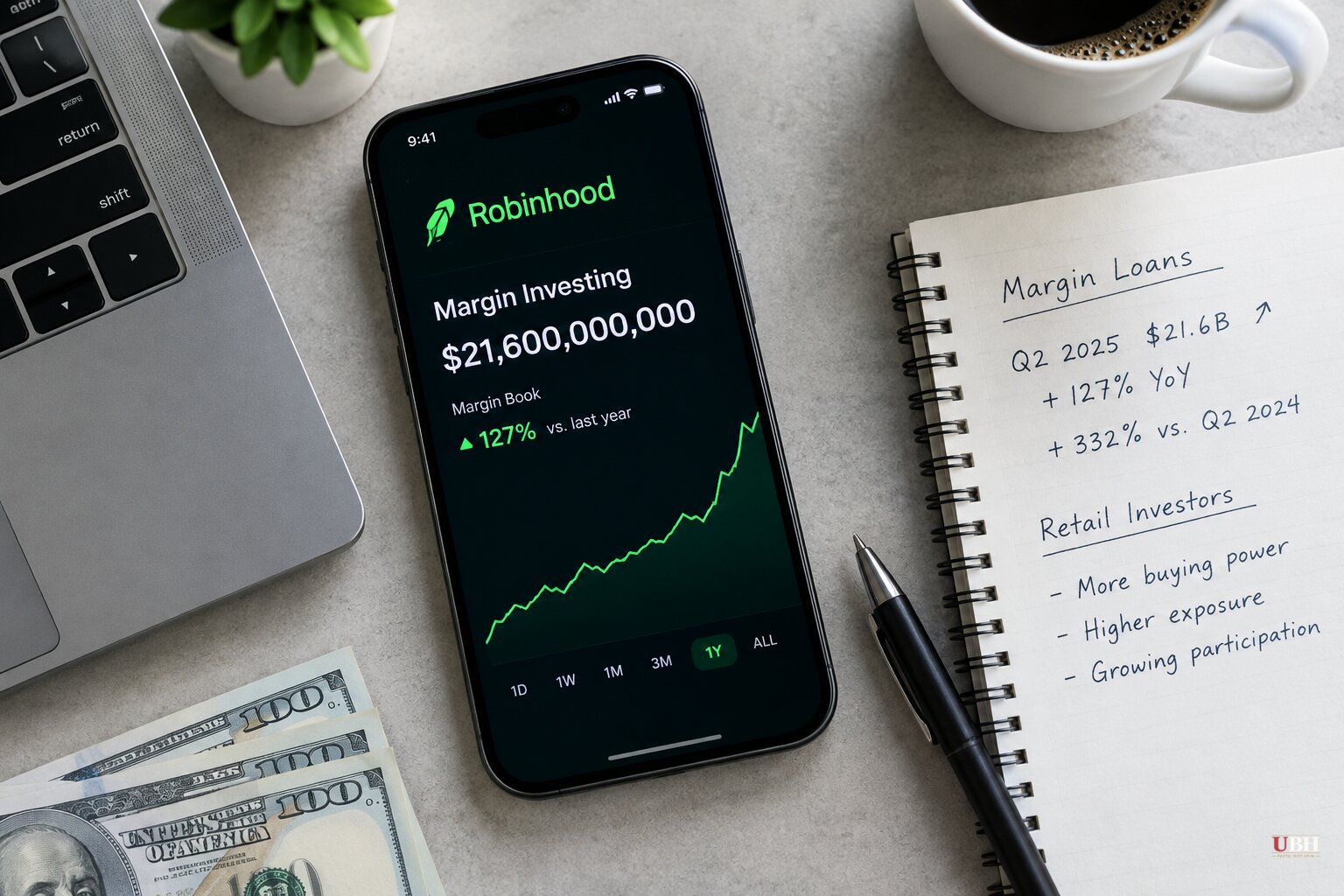
Retail investors are borrowing against their stock portfolios at a record pace.
Robinhood's margin book reached $21.6 billion in the second quarter, according to the company's results. That is up 127% from a year earlier and a 332% increase from the $5 billion it carried in Q2 2024. Eligible users need a portfolio of at least $2,000 to trade on margin.
How margin works, and where it bites
Margin investing means borrowing from a broker to buy securities, with your existing investments as collateral. More buying power means bigger gains when a stock climbs.
The catch is the margin call. If the account's value drops, the investor has to deposit more money into the account. Leverage amplifies losses just as it amplifies wins.
One Houston borrower
Hy Luu is a 29-year-old engineering consultant who lives with his mother, Kim Nguyen, a 66-year-old retiree who used to work as an accountant. In May 2021 he found margin investing while researching how to get more capital to invest in Tesla shares. His mother found it interesting, and he started borrowing.
A year or so later he had amassed more than $100,000 in margin debt. "I went really crazy," Luu told CNBC. "The stock was going up, and so I was like, 'There's no way I could lose.'"
In 2022 he worried that further declines in Tesla could trigger a margin call.
This June he exercised $165,000 on five Tesla call options and bought 500 shares at $330 per share. After accounting for the cash in his account, his borrowing rose to more than $156,000. Tesla swung from below $370 a share to more than $430 during that month.
The bet has paid off so far. Counting his Tesla investments, his company stock and his 401(k), minus his margin debt, car loan and student loans, Luu's net worth is above $800,000. Seven years ago it was negative. "I'm very close to becoming a millionaire," he said.
He also warned against copying him: "What I'm doing is risky. I don't recommend anyone do it."
Who profits from the borrowing
Brokerage firms benefit from margin investing by collecting interest on margin loans. Highly active customers can also generate additional trading-related revenue.
Devin Ryan, head of financial technology research at Citizens, said Robinhood has gone after margin users deliberately. "Robinhood has made a really concerted effort to go after customers that are actively using margin because they're the most active traders," he said.
Robinhood pushed back. A company spokesperson told CNBC it does not believe it is accurate to characterize its transfer promotions as specifically targeting active traders who trade on margin, and said it rejects any implication that it is encouraging risky trading.
Robinhood is not the only place where margin debt is at a record. Total margin debt hit an all-time high of around $1.5 trillion in June, per the Financial Industry Regulatory Authority, a figure that includes both institutional investors such as hedge funds and retail investors.
The broader trading business is humming too. Bloomberg's Open Interest program on Oct. 9 led with Goldman leading a Wall Street trading windfall and OpenAI's $70 billion revenue target reigniting the AI trade.
No source ties the retail borrowing surge to those developments. They are running in the same market.
A shaky consumer backdrop
The economic mood outside the brokerage app is weaker. The University of Michigan's preliminary consumer sentiment index dipped in early October from 48.1 to 46.3, the lowest reading since May. Views of current economic conditions crashed to an all-time low, and inflation expectations moved higher.
Jobless claims, meanwhile, have been near extreme lows for several weeks. People are working, but they say they feel poorer, and some are borrowing to buy stocks anyway.
What the numbers mean
Luu's own numbers show the exposure. His June borrowing of more than $156,000 sits behind a position in a stock that swung from below $370 to more than $430 in a single month. That swing worked in his favor this time. The same size swing in the other direction would hit an account carrying that much borrowed money.
Sam Huszczo, chief investment officer at SGH Wealth Management, sees the surge as a sign of shifting investor psychology. "That's greed," he said, adding that it is "not everywhere" in the market but is "certainly creeping into pockets." He also said that increasing margin debt and the rise of risky assets such as leveraged ETFs inject more fragility into the system.
That is the open question for the whole margin book. Robinhood's $21.6 billion was built during a bull run that has seen multiple record highs this year, and the 2022 scare Luu describes is the kind of test margin borrowers can face when a stock turns. Luu says he is now working to pay down his largest margin balance ever.
Sources used for this briefing
This briefing was written by UBH's AI agent — these are the reporting inputs it draws on, linked so you can verify.


