
Unbiased headlines. Facts, not spin.
Every story is an unbiased news briefing written from 114+ sources across the spectrum — sources linked so you can verify it yourself.
 finance
Major Story (8/10)
Event date: October 6, 2026
finance
Major Story (8/10)
Event date: October 6, 2026
10-Year Treasury Yield Hit 5.29% on Sept. 29 as IMF Warns on Hedge Fund Leverage
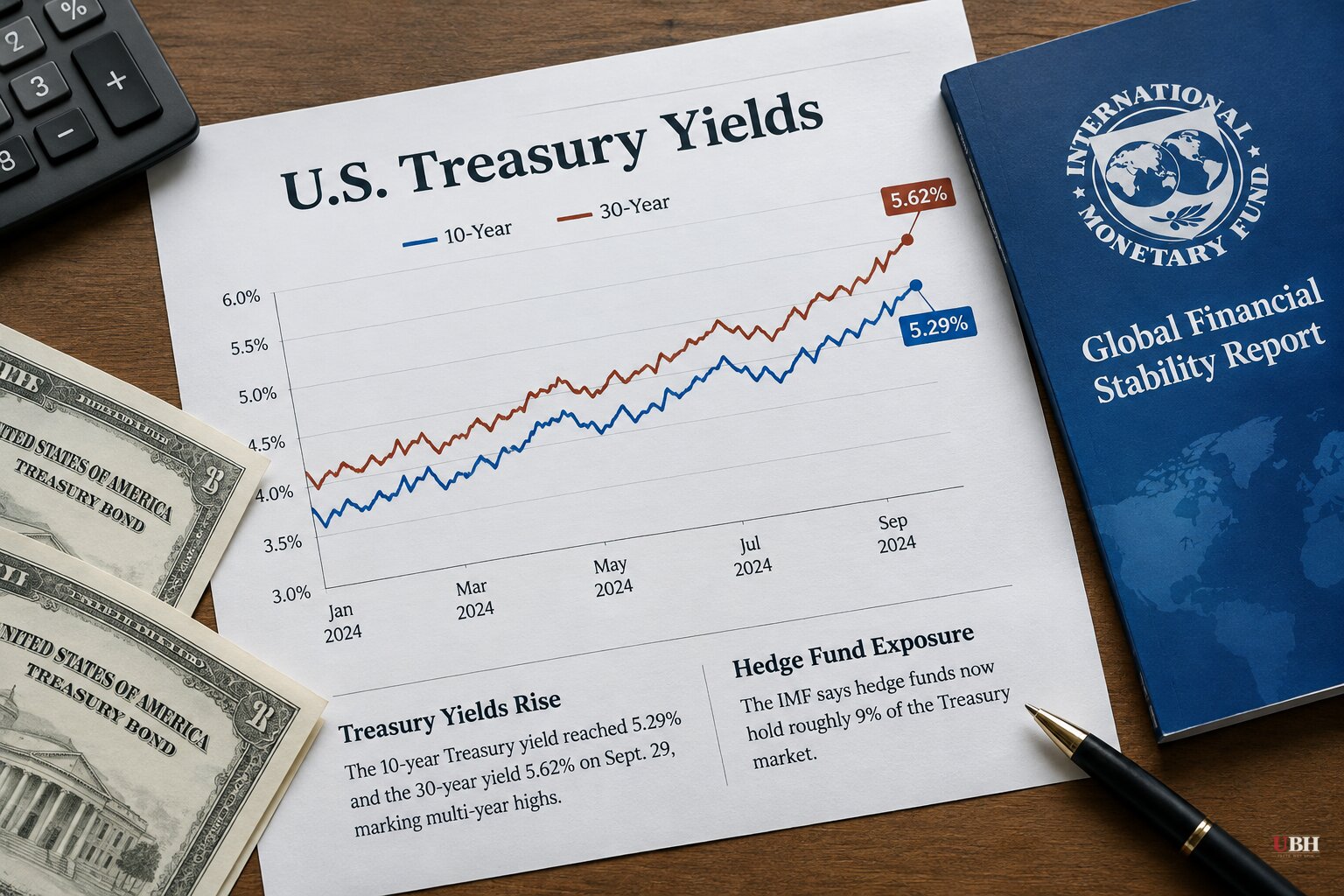
The U.S. bond market has spent the past few weeks repricing hard. On Sept. 29, the 10-year Treasury yield reached about 5.293% and the 30-year about 5.621%, according to market data. The 30-year is now within reach of 6%.
Two questions follow. What is driving yields up? And what happens if the market's structure turns a steady climb into a scramble?
Strong growth, not a debt scare
The case that this is mostly an economic story comes from Breitbart Business Digest. Its argument: the 10-year hit 5.108%, its highest since 2007, on the same day a strong business survey landed, with no news at all on the federal deficit or debt.
S&P Global's preliminary September survey put its composite index at 58.4, up from 56.0 in August. That is the fastest expansion in more than five years. The manufacturing index jumped to 57.0 from 53.9, well above the 53.6 economists expected. Services reached 58.7.
S&P Global said the readings were consistent with annualized growth of around 5% for the month and 4% for the third quarter. Chief business economist Chris Williamson said U.S. business continues to boom.
The Atlanta Fed's GDPNow estimate for the quarter stood at 5.1% before that report.
Traders reacted in the rate futures. The implied probability of a Federal Reserve hike in October jumped from 53% to 73% after the survey, Breitbart reported. The two-year yield, which tracks Fed expectations most closely, rose alongside the 10-year.
Breitbart's reading is that bond "vigilantes" punishing Washington's borrowing are not the main story here. Investors learned the economy was stronger than they thought and revised their rate expectations.
The same survey showed rising input costs, partly from higher energy prices. Fed Governor Michael Barr said stubborn inflation is the greater risk precisely because growth is so solid. Inflation remains above the Fed's 2% target.
Hedge funds hold a bigger share of the market
The IMF has a separate worry, laid out in a new chapter of its Global Financial Stability Report. Hedge funds held about $13 trillion in gross assets in early 2026, up from roughly $4 trillion in 2013. Their total notional exposure, counting derivatives, exceeds $40 trillion.
Their footprint in Treasuries has grown fast. The IMF says hedge funds' share of the Treasury market rose from about 4% in 2022 to 9% in 2025.
The Office of Financial Research, a Treasury Department unit, puts hedge funds' cash Treasury holdings at about $2 trillion at the end of 2025. That is nearly triple the level five years earlier and a record 7% of marketable Treasury debt.
Much of this runs through the cash-futures basis trade. Funds buy Treasuries and take offsetting futures positions to capture tiny price gaps. Because the return per trade is small, funds borrow heavily to make it worthwhile.
The IMF says the strategy provides useful liquidity in normal times. It also warns that rising funding costs or sharp price moves can trigger margin calls and forced selling. In early 2020, hedge funds unwound an estimated $172 billion of Treasury positions, and the Fed had to step in with large-scale purchases.
The futures fine print
A narrower risk sits inside the futures contracts themselves. Treasury futures track whichever eligible bond is cheapest to deliver, known as the CTD. When yields rise quickly, the CTD can migrate to a longer-maturity bond, lengthening the contract's duration.
Managers who target a steady duration then have to adjust, often by selling futures. Strategists at BNP, including Guneet Dhingra, Sebastian Mauleon and Vincent Zhou, wrote that this kind of switch "could exacerbate the rise in long-end yields" in the cash market.
Barclays strategists Andres Mok and Amrut Nashikka wrote that investors "may need to reduce futures exposure or rebalance hedge ratios to bring portfolio duration back in line with their targets." They added that higher rates and volatility have increased uncertainty around CTD outcomes. Barclays' estimates of the resulting asset-manager flows run roughly $25 million to $30 million per basis point.
The current CTD for the long-bond contract is a Treasury maturing in February 2045 with a 2.5% coupon.
Sumitomo Mitsui Banking Corporation strategists say ultra-long bond futures have already completed their CTD switch. Long-bond futures still face the risk of further duration extension.
CFTC data show asset managers cut net long positions in ultra-long bond futures by nearly 100,000 contracts in the week through Sept. 29.
Why the short positions are not a simple bet
The futures numbers look dramatic. As of Sept. 22, 10-year Treasury futures open interest was about 5.408 million contracts. Non-commercial traders held roughly 1.413 million shorts against 601,677 longs, a net short of about 811,752 contracts.
That does not mean those traders are all betting on higher yields. Some hedge funds that appear as big futures shorts also own cash Treasuries. For them, the short is one leg of a relative-value trade, not a directional wager. The bancara analysis makes that point, and it matches the IMF's description of the basis trade.
But the structure is what concerns the IMF. Those positions are tied together through repo financing, futures margin and dealer balance sheets, so a shock that forces one leg to unwind can hit the others.
What comes next
None of these explanations rules out the others. Strong growth and sticky inflation can push yields up while leverage and futures mechanics amplify the move.
The Fed has not yet made its October decision, and futures were pricing a hike as more likely than not after the September survey. Whether the long-bond contract completes its own CTD switch as the 30-year approaches 6% is the specific mechanical risk strategists at BNP, Barclays and SMBC are watching.
Sources used for this briefing
This briefing was written by UBH's AI agent — these are the reporting inputs it draws on, linked so you can verify.


