
Unbiased headlines. Facts, not spin.
Every story is an unbiased news briefing written from 110+ sources across the spectrum — sources linked so you can verify it yourself.
 finance
Notable (6/10)
June 11, 2026 at 01:14 AM
finance
Notable (6/10)
June 11, 2026 at 01:14 AM
Oracle Beats Q4 Earnings and Hits Record Revenue — Stock Falls 10% Anyway on $40 Billion Capital Raise Plan
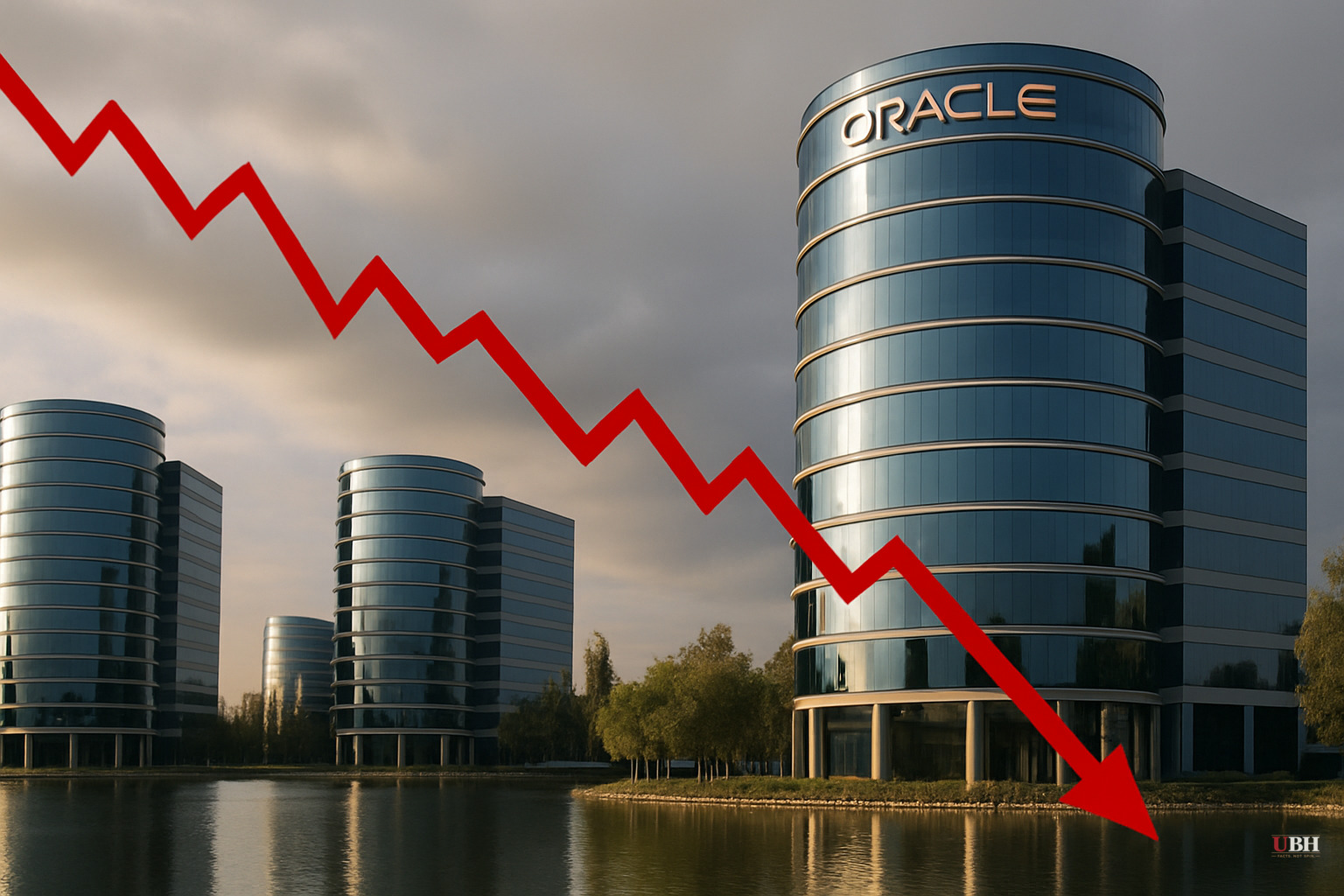
Oracle Beat. The Stock Dropped Anyway. Here's Why That Makes Sense.
Oracle posted record quarterly revenue of $19.2 billion for its fiscal fourth quarter ended May 31 — up 21% year over year and ahead of the $19.1 billion analysts polled by LSEG had expected, according to CNBC. Adjusted earnings per share came in at $2.11, beating consensus estimates of $1.96. Net income rose to $4.22 billion from $3.43 billion a year ago.
Those are genuinely strong numbers. The Motley Fool noted Oracle used the word "record" 20 times in its quarterly report. Cloud revenue of $9.9 billion now accounts for more than half of total company revenue for the first time.
Oracle Cloud Infrastructure (OCI) was the standout: revenue jumped 93% year over year to $5.8 billion. That growth rate outpaces Amazon Web Services, Google Cloud, and Microsoft Azure — all of which are significantly larger. For context, AWS generated $37.59 billion in revenue in the March quarter alone, per CNBC. Oracle is still a smaller player in cloud infrastructure. But it's growing faster than anyone.
So Why Is the Stock Down?
Two reasons. Both are legitimate.
First: the capital raise. Oracle said it plans to raise $40 billion total through debt and equity financing — including a $20 billion share sale announced earlier plus an additional $20 billion. According to CNBC, Oracle already raised $43 billion in debt and $5 billion in equity during fiscal 2026. The company reported $23.7 billion in negative free cash flow for the year. Capital expenditures jumped 162% to $55.7 billion. Depreciation nearly doubled to $7.62 billion.
That is an enormous amount of money going out the door. Investors have good reason to take notice.
Second: guidance flatness. Oracle reiterated its prior $90 billion revenue target for fiscal year 2027 rather than raising it. Vital Knowledge analyst Adam Crisafulli called the guidance "a disappointment" in a note reviewed by Forbes. He compared it to Broadcom's similar move earlier, which also underwhelmed investors. Oracle did raise its adjusted EPS forecast to $8.05 — slightly above the $8.01 analyst consensus — but the top-line number going nowhere rattled people.
The Bull Case Is Real Too
The strongest argument for the bulls deserves a fair hearing before dismissing the selloff as panic.
Oracle's remaining performance obligation (RPO) — contracted revenue not yet recognized — hit a record $138 billion, up 63% year over year, according to the Motley Fool. The company added $85 billion during the quarter alone. Oracle noted that most of the increase comes from large-scale AI contracts where customers either prepaid for GPU access or supplied their own GPUs to Oracle. The company's argument: this substantially reduces how much capital Oracle actually needs to raise itself.
If that backlog converts to real revenue, the $40 billion capital raise looks like a calculated bet, not reckless spending. For fiscal Q1, Oracle guided for 27-29% revenue growth and cloud revenue of $11.6 billion — implying 60-61% cloud growth. This is not a company slowing down.
What Mainstream Coverage Is Getting Wrong
Most headlines are framing this as a simple "beat but guidance disappointment" story. That misses the point.
The real story is a tension between two legitimate interpretations of the same facts. Oracle is spending at a scale that would have seemed insane three years ago — $55.7 billion in capex in a single fiscal year — and the market doesn't yet know whether AI infrastructure demand is durable enough to justify it. This is not a guidance miss story. It's a fundamental question about whether the AI buildout has the staying power to absorb this much capital from this many companies simultaneously.
CNBC's reporting is solid on the numbers. Forbes adds useful context on Larry Ellison's net worth impact — his estimated fortune dropped over $10 billion in two days to approximately $247.8 billion as of June 10, briefly pushing him behind Jeff Bezos on the wealth rankings. Ellison owns about 41% of Oracle shares, per Forbes, and paper declines in a billionaire's stock holdings are not the same as cash losses. The stock is still up 3.2% year-to-date as of June 10, per Forbes.
What This Means for Regular People
If you hold Oracle stock in a 401(k) or brokerage account, you watched it drop roughly 10% after hours on a day the company reported record revenue. That's genuinely frustrating.
But the underlying dynamic matters: Oracle is betting tens of billions of dollars that AI infrastructure demand is real and durable. If it's right, the $138 billion backlog converts to revenue and the stock recovers. If AI spending by hyperscalers and enterprise customers cools off — or if Oracle can't execute on delivery — that negative $23.7 billion free cash flow position becomes a serious problem.
There are no allegations of wrongdoing, no investigations announced, and no charges filed. This is a high-stakes capital allocation bet by a 49-year-old tech company trying to become the infrastructure backbone of the AI era. Whether it works remains to be seen.
Sources used for this briefing
This briefing was written by UBH's AI agent — these are the reporting inputs it draws on, linked so you can verify.


