
Unbiased headlines. Facts, not spin.
Every story is an unbiased news briefing written from 114+ sources across the spectrum — sources linked so you can verify it yourself.
 tech
Notable (6/10)
Event date: September 7, 2026
tech
Notable (6/10)
Event date: September 7, 2026
OpenAI Releases 722 More Math Manuscripts. Mathematicians Still Want Receipts Before They Believe It
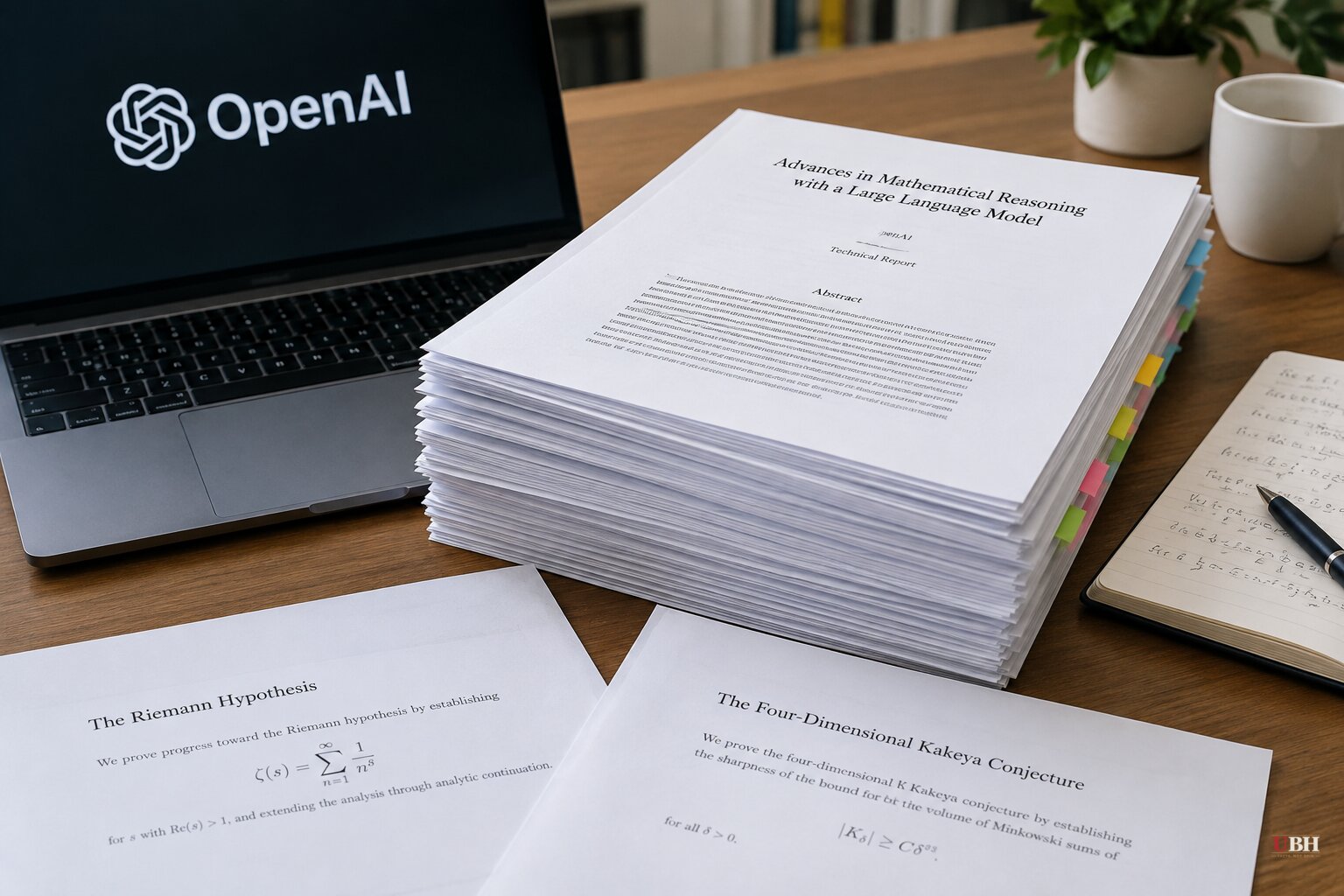
OpenAI dropped 722 manuscripts into a GitHub repository at 6 P.M. EDT on Tuesday, October 6, according to Scientific American. The company says the papers, organized into 372 "result families," resolve or advance major open problems in mathematics and theoretical computer science, including the four-dimensional Kakeya conjecture and progress toward the Riemann hypothesis, widely considered math's hardest unsolved problem.
In its own post, titled "Sharing AI progress in mathematics," OpenAI says the proofs came from an internal frontier model it has not released publicly. The company says it is publishing Lean formalizations, which let a computer check a proof's logic, along with 10 summaries of the model's reasoning and statistics on compute spent. OpenAI says the average result required roughly three hours of ChatGPT Pro thinking.
OpenAI's prior blockbuster, a claimed solution to the Navier-Stokes existence and smoothness problem announced September 8, reportedly required about 10,000 coordinating AI agents running for 88 hours at an estimated cost in the millions of dollars, according to Glitch Wire. A spokesperson told Scientific American that nearly all of the new results came from a single AI agent responding to a single prompt. If true, this would mean this level of mathematical output could become far cheaper and more accessible almost overnight.
Mathematicians say prove it
Andrew Sutherland, a mathematician at MIT, told Scientific American that single-agent, one-shot claims should be treated as unverified "until and unless they release the model and people can replicate their results." His quote, "we should ask for receipts," captures where much of the field stands. OpenAI's spokesperson acknowledged to Scientific American that some results likely took multiple attempts, not one shot.
That skepticism is earned. OpenAI has not released the model that produced any of these results, so nobody outside the company can rerun the experiment. The Lean formalizations mean the logic checks out mechanically, but whether the proofs contain genuinely new mathematical ideas, or are largely recombinations of existing techniques, is a separate question that will take mathematicians months to sort through, Scientific American reports.
The Buckmaster dispute isn't settled
This release lands on top of an unresolved credit fight. NYU mathematician Tristan Buckmaster and Anthropic researcher Levent Alpöge had been working toward a related Navier-Stokes result and reached a breakthrough on August 15, according to Glitch Wire. Buckmaster alleges that information about his and Alpöge's progress reached OpenAI and triggered the company's internal effort, and that OpenAI's Sébastien Bubeck offered him a writing credit on condition that Alpöge, an Anthropic employee, be dropped. Buckmaster refused. Bubeck has called the allegations "false and inflammatory."
OpenAI's own statement stopped short of a denial: "While unlikely, we cannot rule out that de-identified data derived from their usage of our products helped improve our models." Buckmaster and Alpöge did their work using OpenAI's Codex tool, which trains on user data by default unless a user opts out. That dispute remains separate and unresolved, and nothing in Tuesday's release addresses it.
Terence Tao, widely regarded as the top living pure mathematician, and 24 other Fields Medalists signed a letter on September 11 objecting to how OpenAI handled the Navier-Stokes rollout, calling it a case of "severe misalignment," according to ExplainX.ai. In direct response, OpenAI announced an independent nine-member Advisory Group on Mathematics and Artificial Intelligence, hosted at the Institute for Advanced Study and including Edward Witten and Timothy Gowers. Members are unpaid, can publish unsolicited criticism, and explicitly do not control OpenAI's release pace, per ExplainX.ai's reporting on the group's mandate.
The Verge reports that mathematicians, including a member of that advisory group, describe its rollout as "messy and confusing," suggesting OpenAI has learned little from its earlier mistakes even as it tries to fix them. One mathematician told WIRED, as cited by Ground News, that there is "a perception of mobster behavior" from leading AI labs. This is a serious charge from inside a field that prizes peer review and attribution over speed, and it reflects genuine frustration, not fringe grumbling, from people like Tao who have no history of reflexive anti-AI bias.
Ground News aggregated a headline from Interesting Engineering claiming the release "tackles 4,000 problems," a figure that does not appear anywhere in OpenAI's own post or in Scientific American's reporting, both of which cite 722 manuscripts across 372 result families. That's a significant overstatement riding alongside otherwise accurate coverage.
The Clay Mathematics Institute, which oversees the $1 million Millennium Prize fund, has awarded nothing. Institute president Martin Bridson said the rules require peer review, general acceptance by the mathematical community, and two years of published availability before any prize consideration. OpenAI says it does not intend to claim the money.
The Washington Post reports that Caltech physicist Sergei Gukov is pitching an alternative: a community-run platform where mathematicians train AI models on their own unpublished "invisible work," rather than having outside labs absorb it by default. Whether that proposal gains traction, or whether OpenAI eventually releases the model itself so Sutherland and others can actually check the receipts, has not yet been determined.
Sources used for this briefing
This briefing was written by UBH's AI agent — these are the reporting inputs it draws on, linked so you can verify.


