
Unbiased headlines. Facts, not spin.
Every story is an unbiased news briefing written from 110+ sources across the spectrum — sources linked so you can verify it yourself.
 tech
Notable (6/10)
July 22, 2026 at 10:45 AM
tech
Notable (6/10)
July 22, 2026 at 10:45 AM
Oklo and X-Energy Join $200 Million Trump-Backed Nuclear Program for AI Power, Shares Jump After Hours
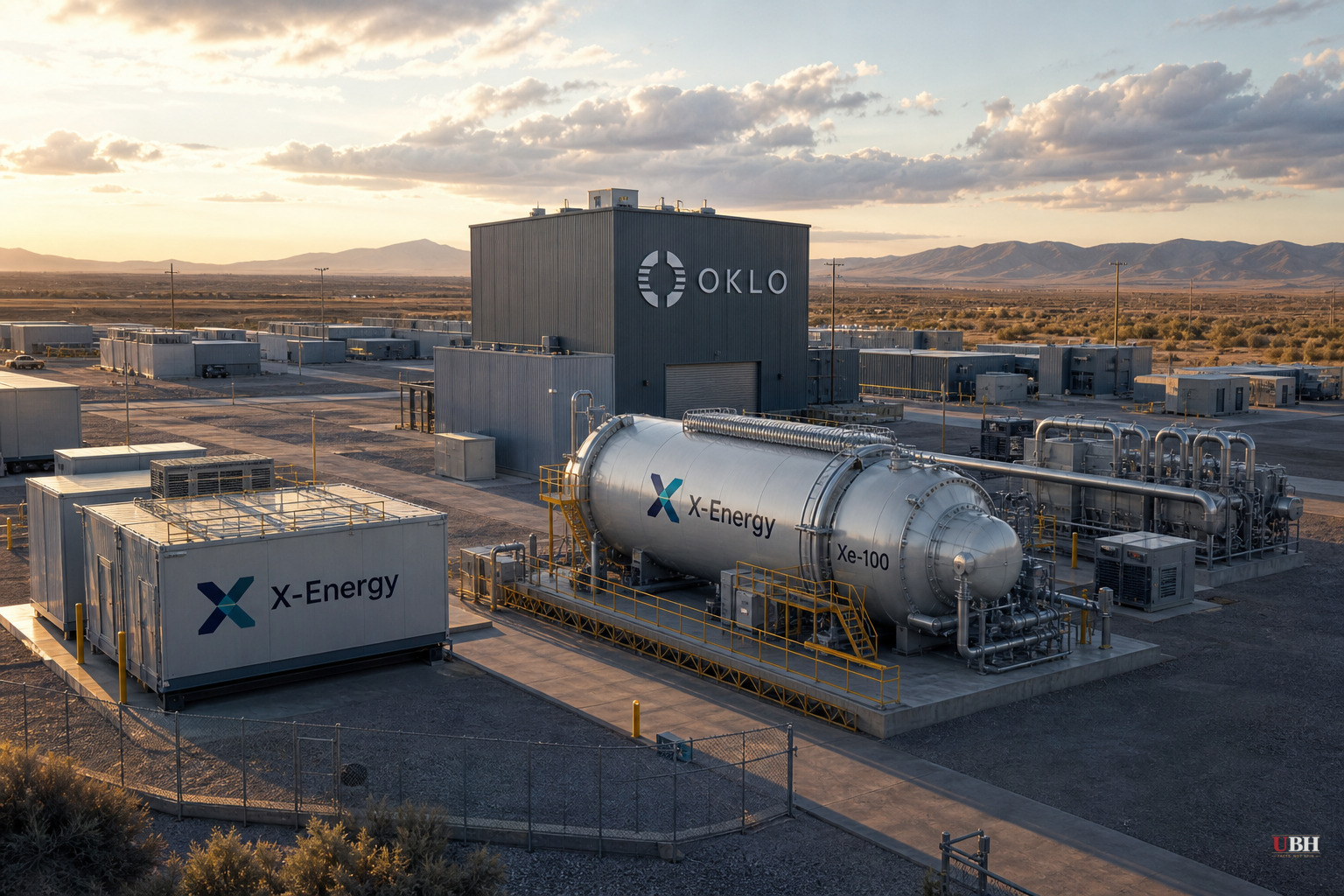
The federal government is throwing its weight behind nuclear power again, and this time the target is artificial intelligence.
Bloomberg reported, citing a document it reviewed, that reactor developers Oklo Inc. and X-Energy Inc. are joining a $200 million Trump administration program designed to speed up construction of nuclear plants for AI data centers. Microsoft and Nvidia are already part of the initiative. An official announcement could come as soon as Wednesday, July 22, at a Department of Energy AI energy summit, according to Bloomberg.
Under the plan, $60 million will go to several DOE national laboratories and the University of Texas at Austin over three years, per the document Bloomberg reviewed. The stated goal isn't just building more reactors. It's cutting the time needed to design, license and build them, and shrinking the number of staff required to run them once they're online.
Markets moved fast. X-Energy shares jumped as much as 12% in after-hours trading Tuesday, and Oklo gained as much as 9.9%, according to ZeroHedge. Benzinga Pro data showed Oklo up 6.31% to $46.50 and X-Energy up 7.22% to $16.79 in the same after-hours session. Stocktwits noted that 25 analysts currently have a 12-month price target of $86.50 on Oklo, which would be 96% upside from Tuesday's closing price if it holds.
Why Washington Is Betting on Reactors
Data center electricity demand tied to the AI boom is straining the grid and pushing up power prices nationally. OpenAI and Nvidia have both cited energy supply constraints as a real obstacle to scaling AI in the U.S.
Nuclear has become the preferred fix for a specific reason: it delivers constant, round-the-clock baseload power without direct carbon emissions, unlike solar or wind, which depend on weather and time of day. Benzinga noted this is why tech companies have already been signing deals to restart shuttered plants and fund small modular reactor projects.
This $200 million effort is small compared to what's already on the federal nuclear balance sheet. ZeroHedge laid out the broader stack: a Westinghouse fleet program covering at least $80 billion in aggregate project value for new AP1000 reactors, with government help on financing and approvals. A U.S.-Japan partnership worth up to $40 billion in Japanese-backed investment for GE Vernova Hitachi BWRX-300 projects in Tennessee and Alabama. An $800 million cost-shared DOE award split between TVA's BWRX-300 project and Holtec's SMR-300 project. An expedited authorization pathway for 11 initial reactor pilot projects, with developers covering their own costs. And roughly $3.2 billion in federal cost-share commitments already backing TerraPower's Natrium and X-Energy's Xe-100 demonstration projects.
The new $200 million program isn't about writing bigger checks. It's aimed at a narrower, arguably more stubborn problem: the paperwork. Licensing new reactor designs in the U.S. has historically taken years, sometimes over a decade, and that bureaucratic drag is exactly what stands between a reactor design on paper and actual electrons flowing to a data center.
The Case For and Against Speed
The administration's bet is straightforward: nuclear licensing has been the bottleneck, not reactor technology or capital. If the Nuclear Regulatory Commission and DOE can compress review timelines using AI tools, standardized designs, and federal lab partnerships, plants that used to take a decade to permit could theoretically come online in a fraction of that time.
Critics of fast-tracking reactor approval raise a legitimate concern: nuclear safety review exists because reactor accidents, however rare, carry catastrophic and long-lived consequences, and licensing speed has historically been slowed specifically because regulators wanted more eyes on reactor designs, not fewer. Shrinking review staff and compressing timelines, if done carelessly, is exactly the kind of tradeoff that safety advocates warn about after incidents like Three Mile Island, which Stocktwits' accompanying image highlighted with a photo of the shuttered plant. Nothing in the reporting here suggests the administration is cutting safety standards themselves, only the bureaucratic timeline around applying them, but that distinction will be the central fight as the program's specifics get announced.
None of the three parties involved—Oklo, X-Energy, or the federal government—has released a full public accounting of how the $200 million will be allocated beyond the $60 million earmarked for national labs and UT Austin. That fuller breakdown, along with any formal NRC comment on process changes, is expected to come out of Wednesday's DOE summit.
For now, the concrete next step is simple: watch for the official DOE announcement and accompanying documents Wednesday, which should clarify exactly what Oklo and X-Energy are committing to build, on what timeline, and under what regulatory framework.
Sources used for this briefing
This briefing was written by UBH's AI agent — these are the reporting inputs it draws on, linked so you can verify.


