
Unbiased headlines. Facts, not spin.
Every story is an unbiased news briefing written from 110+ sources across the spectrum — sources linked so you can verify it yourself.
 politics
Notable (5/10)
August 3, 2026 at 05:37 PM
politics
Notable (5/10)
August 3, 2026 at 05:37 PM
NYC Publishes Searchable Database of Homes Facing Mamdani's New Pied-a-Terre Tax, Including Thousands That May Not Qualify
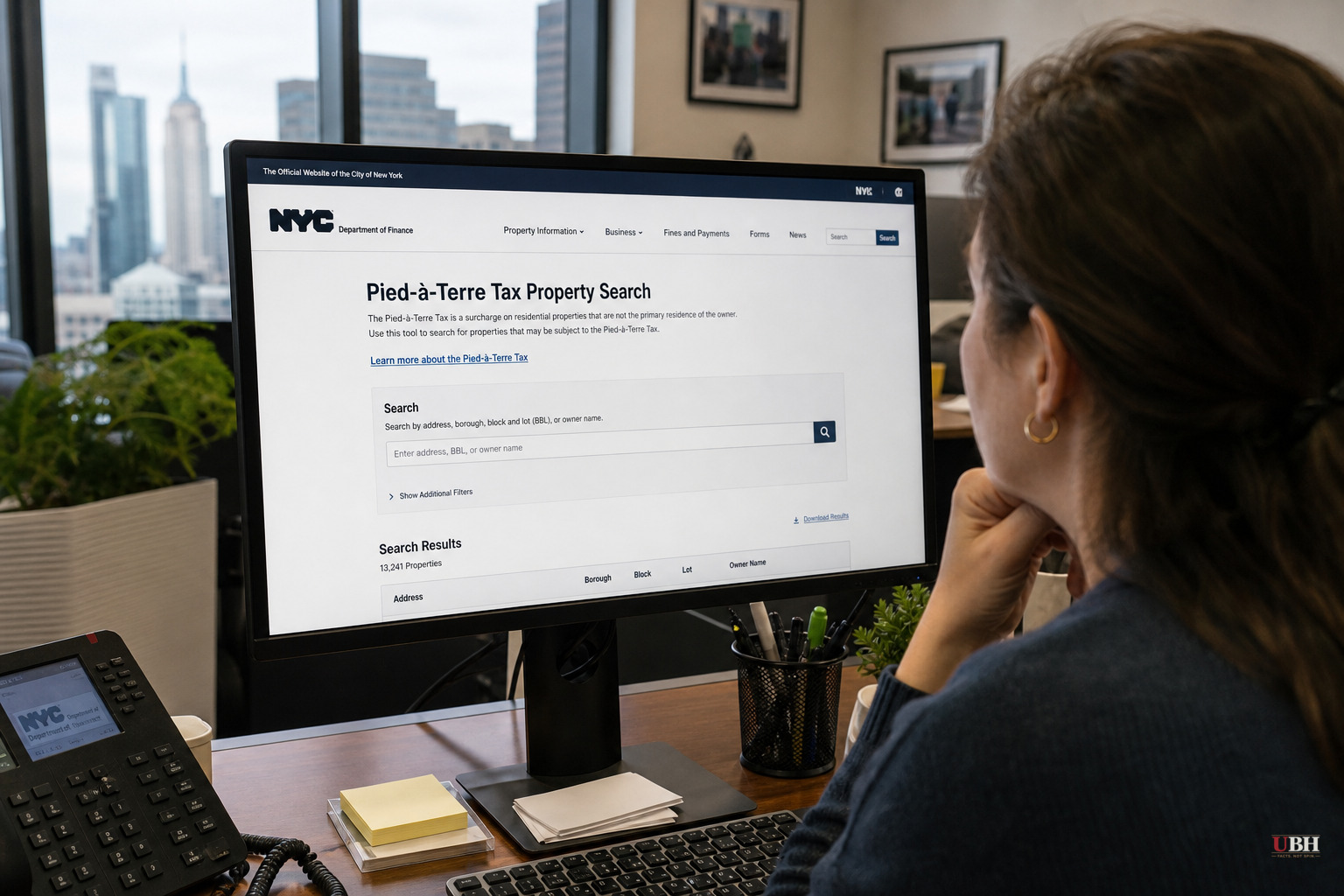
New York City's Department of Finance has published a searchable public database identifying properties that could face a new tax surcharge on homes not used as an owner's primary residence. The database lists names and addresses across all five boroughs.
Mayor Zohran Mamdani announced the rollout himself on July 23. "If you have a second home in New York City worth more than $5M, check your mailbox when you're back in the five boroughs, because you've got mail," he wrote, promoting the notification letters sent to property owners about what his office calls the pied-a-terre tax.
What The Tax Actually Covers
The surcharge, officially called the non-primary residence property surcharge on the Department of Finance website, applies to one-, two-, and three-family homes valued by the city at more than $5 million, and to condominium or cooperative units valued at $1 million or more, according to Reason. The surcharge ranges from 0.8 percent to 6.5 percent of market value, and it's scheduled to apply for the 2026-27 and 2027-28 property tax years, according to AMAC.
That $1 million condo threshold sounds narrow until you look at the market. The average Manhattan condo sold for $2.98 million in 2024 and the average co-op for $1.34 million, according to data cited by The New York City Broker and reported by Reason. Even outer-borough Brooklyn condos averaged $1.28 million. City officials estimated roughly 31,000 properties would ultimately be subject to the tax, according to AMAC.
The Database Problem
The tax information itself is public record in New York. What's different here is the packaging. Phil Hall, writing for Weekly Real Estate News, noted it's "unusual" for this kind of data to be "aggregated and compiled into a user-friendly searchable platform that provides easy access to the locations of many prominent business and entertainment figures."
This packaging raises concerns on two fronts: privacy and accuracy.
On accuracy, the New York Post's reporting found information connected to hundreds of thousands of residences and property owners appeared in the database, far beyond the 31,000 properties city officials said would actually owe the surcharge, according to AMAC. Dozens of modest homes on Chaffee Avenue in the Throggs Neck section of the Bronx showed up on the list despite average values in the mid-$500,000s to low $800,000s, below the citywide median home value of about $820,000. Similar working-class Staten Island neighborhoods were swept in as well.
New York City Council Minority Leader David Carr, a Republican representing Staten Island, said his own home landed on the list even though it's been his primary residence since 1994. "I've been living in [my place] 365 days a year since 1994," Carr said, according to AMAC. "So, this whole list must be messed up." Carr called the database's release "a reckless and foolish move."
If a list meant to flag roughly 31,000 non-primary homes instead surfaces hundreds of thousands of addresses, including primary residences and modest Bronx and Staten Island homes, that's a legitimate data-quality failure independent of any political motive. People whose homes were misidentified now have their names and addresses tied publicly to a tax they may not actually owe, with no clear indication from the Department of Finance about how or when inaccurate listings get corrected or removed.
The Privacy Argument
Mamdani's defenders point out, correctly, that property tax and ownership records are already public in New York. Anyone can look them up one at a time. Reason's J.D. Tuccille doesn't dispute that. His concern is the aggregation: turning scattered public records into a single searchable tool that makes it trivially easy to locate where wealthy, and in many cases simply middle-class, New Yorkers live.
That concern isn't fringe. Kathryn Wylde, president and CEO of the Partnership for New York City, said the release "was in poor form as publishing names/addresses singles out people who have done nothing wrong, at a moment when the far extremes of the political spectrum already treat success itself as something to be punished," according to Reason.
The fair counterpoint is that transparency about who benefits from favorable property valuations, and who might dodge a new tax, has public value, and Mamdani campaigned explicitly on taxing wealth concentrated in high-value real estate. Whether that public-interest case justifies a searchable name-and-address tool, given the documented error rate, is where reasonable people split.
Neither source reports that Mamdani's office has announced a correction process, a revised property count, or removed any of the erroneously flagged addresses. The Department of Finance has not said, in the material reviewed, whether the underlying data will be re-audited before the surcharge takes effect. Property owners like David Carr are left checking a government database to see if their own home was misclassified, with no stated timeline for a fix.
Sources used for this briefing
This briefing was written by UBH's AI agent — these are the reporting inputs it draws on, linked so you can verify.


