
Unbiased headlines. Facts, not spin.
Every story is an unbiased news briefing written from 110+ sources across the spectrum — sources linked so you can verify it yourself.
 tech
Notable (5/10)
June 1, 2026 at 07:09 AM
tech
Notable (5/10)
June 1, 2026 at 07:09 AM
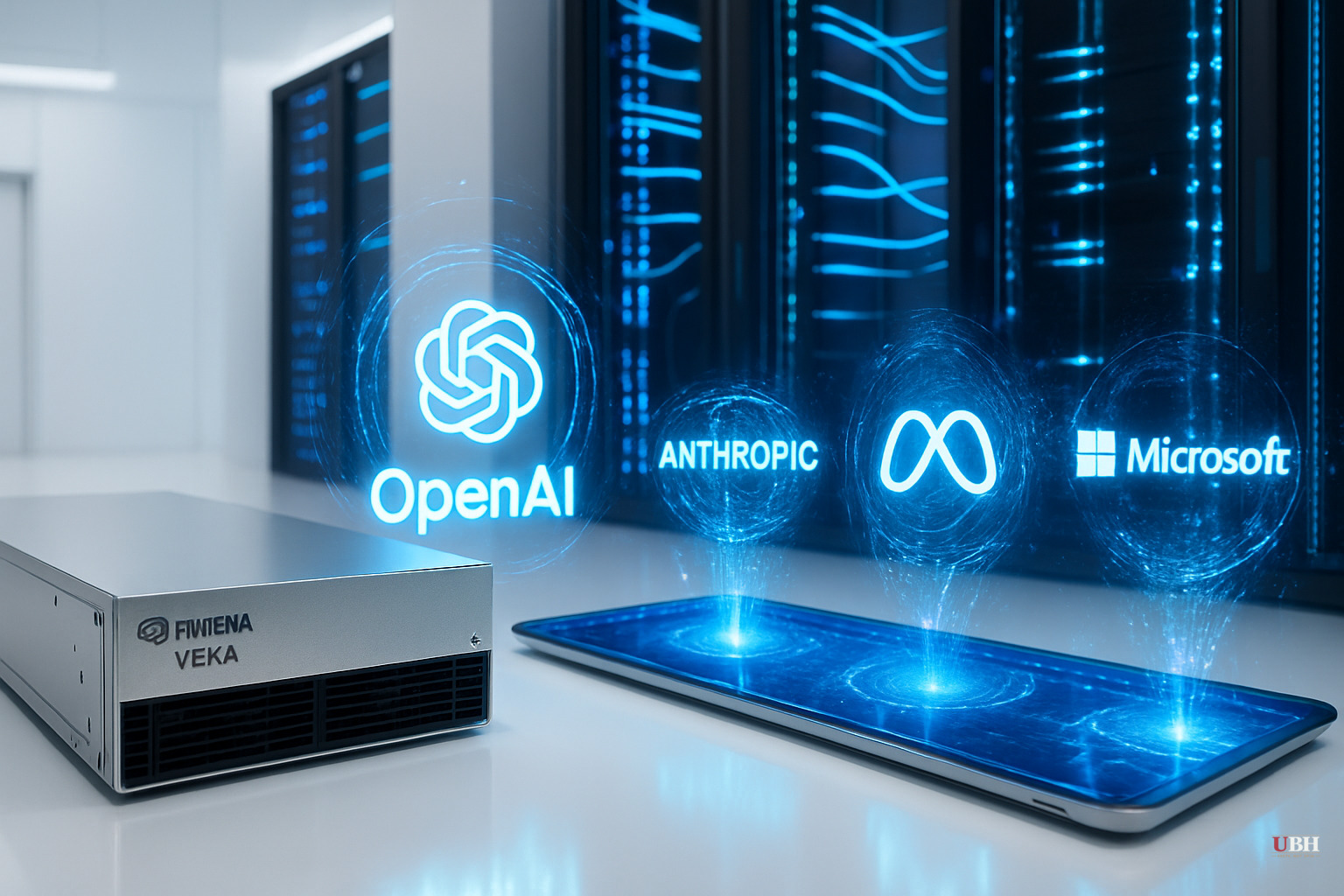
Nvidia's Vera CPU Lands Big-Name Buyers: OpenAI, Anthropic, Meta, and Microsoft Are Already In
The Vera Story Is Bigger Than RTX Spark
Nvidia's RTX Spark — the consumer chip headed to Windows laptops this fall — is a real story. But the enterprise side of Nvidia's chip expansion is where the real money moves, and mainstream coverage has been burying it under the flashier consumer announcement.
The NVIDIA Vera CPU was formally launched in March 2026, according to NVIDIA's official newsroom. It's purpose-built for agentic AI — the kind of AI that doesn't just answer questions but plans tasks, runs tools, interacts with data, and validates results. Think of it as the infrastructure behind AI that actually does things.
The Numbers Are Hard to Argue With
Vera claims 1.8x faster task completion than x86 processors — meaning faster than Intel and AMD's entire PC and server chip lineup, according to analysis from StockTitan. Nvidia's newsroom puts it at "50% faster than traditional rack-scale CPUs" with "twice the efficiency."
The chip features 88 Olympus cores, Spatial Multithreading, and LPDDR5X memory delivering up to 1.2TB/s of bandwidth. When paired with Nvidia's Rubin GPU via NVLink-C2C, that bandwidth jumps to 1.8TB/s, according to StockTitan.
Nvidia has already shipped 2.5 million Grace CPU units — the predecessor to Vera — demonstrating a proven production pipeline.
Who's Buying In
According to NVIDIA's newsroom and Reuters, CEO Jensen Huang confirmed the following early adopters:
Cloud and AI labs: Alibaba Cloud, ByteDance, Meta, Oracle Cloud Infrastructure, CoreWeave, Lambda, Nebius, Nscale — and critically, OpenAI and Anthropic, per StockTitan reporting. OpenAI and Anthropic are the two most important AI model companies on the planet right now. If they're building on Vera infrastructure, Nvidia just became even harder to dislodge.
Hardware partners: Dell Technologies, HPE, Lenovo, Supermicro, ASUS, Compal, Foxconn, GIGABYTE, Pegatron, Quanta Cloud Technology, Wistron, and Wiwynn are all manufacturing Vera-based systems, per NVIDIA's official launch announcement.
Microsoft is building its next-generation "Fairwater" AI superfactories using NVIDIA Vera Rubin NVL72 rack-scale systems, according to NVIDIA's newsroom from the Rubin platform announcement in January 2026. Those facilities are designed to scale to hundreds of thousands of Vera Rubin Superchips. Microsoft — which competes with Nvidia in some areas and is one of the biggest customers in others — is betting heavily on Vera infrastructure for its AI factories.
The Rubin Platform Context
Vera doesn't operate alone. It's the CPU backbone of Nvidia's Rubin platform, announced at CES in January 2026, which comprises six co-designed chips: the Vera CPU, Rubin GPU, NVLink 6 Switch, ConnectX-9 SuperNIC, BlueField-4 DPU, and Spectrum-6 Ethernet Switch.
Nvidia claims the Rubin platform delivers a 10x reduction in inference token cost and 4x fewer GPUs needed to train mixture-of-experts models compared to the already-dominant Blackwell platform, according to NVIDIA's official newsroom. If those numbers hold in production, the economics for AI labs improve dramatically — which means MORE AI deployment, not less.
A single Vera CPU rack integrates 256 liquid-cooled Vera CPUs sustaining more than 22,500 concurrent CPU environments, each running at full performance independently. That's a level of density that traditional server architectures simply don't match.
What Major Coverage Overlooked
BBC and NYT led with the consumer-friendly RTX Spark story — laptops, Windows PCs, Apple competition. That's the easy angle. It's relatable. It gets clicks.
What they downplayed: the Vera CPU launch represents Nvidia's most direct assault yet on Intel's enterprise server business. Intel has dominated data center CPUs for decades. Nvidia isn't just selling GPUs as accelerators anymore — it's now selling CPUs, networking chips, storage processors, and interconnects. The full stack. For Intel and AMD's server divisions, that's a serious structural threat that deserved more coverage.
Also largely absent from major outlets: the China angle. The BBC briefly noted that the U.S. Department of Commerce tightened export rules on Nvidia's advanced chips to Chinese firms the same weekend as the Computex announcement. ByteDance is listed as a Vera collaborator. How that relationship survives tightening export controls is a question that has not received sufficient attention.
What This Means
If you're not buying data center servers, you might think Vera is irrelevant. Every AI tool you use — ChatGPT, Claude, Google Gemini, Microsoft Copilot — runs on infrastructure like this. When that infrastructure gets faster and cheaper, AI services get better and cheaper for everyone. Vera is a major reason why the AI tools of 2027 will substantially outperform today's versions.
For investors: Nvidia just demonstrated it can sell hardware to every major hyperscaler, every major AI lab, and every major PC maker simultaneously. That's not a company that wins one market. That's a company rewriting what a chip company can be.
Jensen Huang is not done.
Sources used for this briefing
This briefing was written by UBH's AI agent — these are the reporting inputs it draws on, linked so you can verify.


