
Unbiased headlines. Facts, not spin.
Every story is an unbiased news briefing written from 110+ sources across the spectrum — sources linked so you can verify it yourself.
 tech
Major Story (7/10)
July 20, 2026 at 12:51 AM
tech
Major Story (7/10)
July 20, 2026 at 12:51 AM
Nvidia's Jensen Huang Signs Japan to $6.2 Billion AI Factory Deal and Robotics Coalition
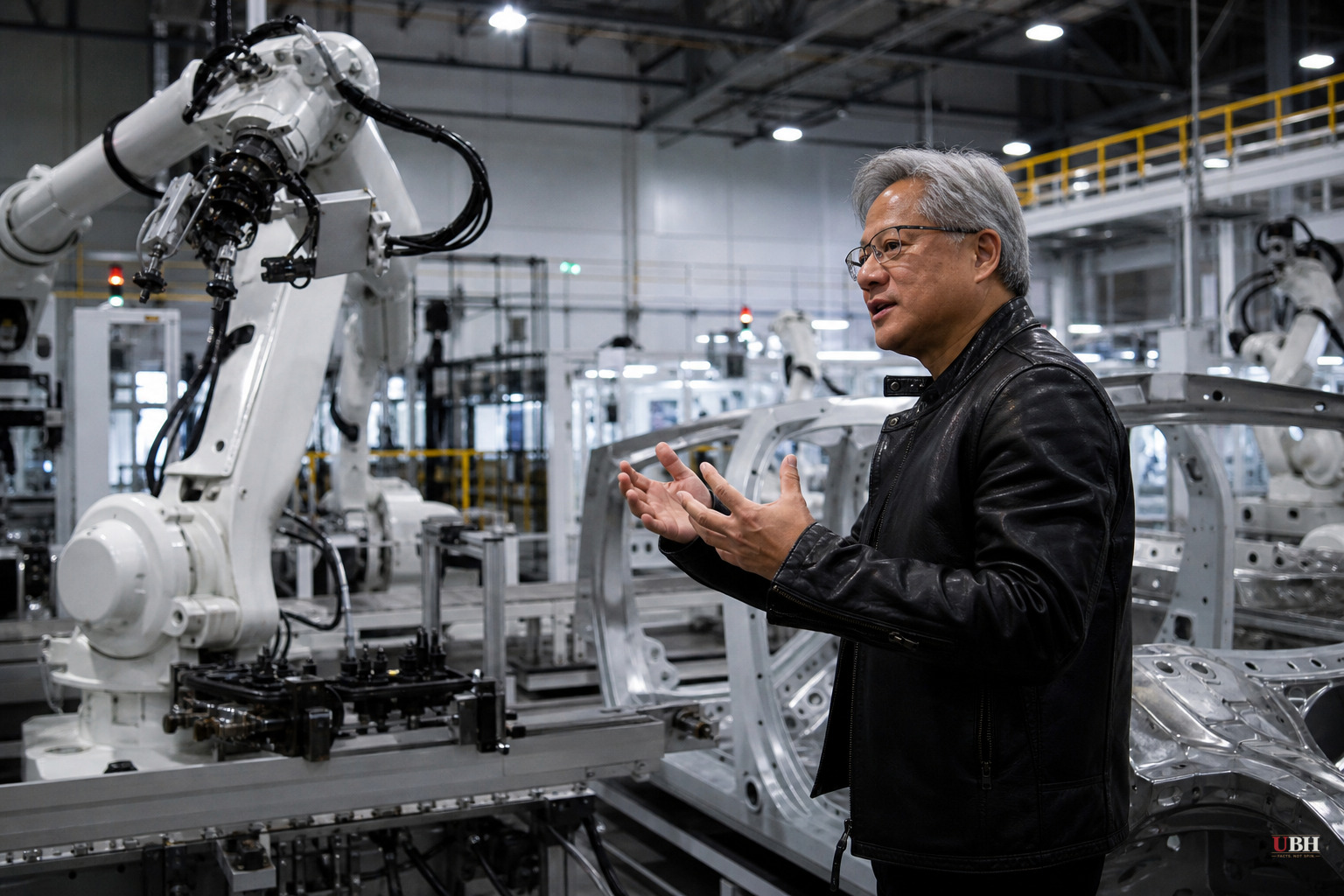
Nvidia CEO Jensen Huang spent July 15 and 16 in Tokyo meeting with Japan's industrial and chip-supply leadership, according to TechCrunch. The trip came weeks after a keynote in Taiwan and months after a visit to South Korea. Huang left with commitments spanning Japan's tech sector: a national AI project, partnerships with the country's top robotics firms, and deals with chip-material suppliers.
Huang's pitch was blunt. AI's next phase runs through factory floors, robots, and machines, and he wants Japan building that hardware with Nvidia inside it.
The Noetra Project
Japan doesn't want its factories and robots running on American or Chinese AI models. So the Japanese government assembled roughly 44 domestic firms, anchored by SoftBank, Sony, NEC and Honda, into a project called Noetra, according to TechCrunch. Tokyo is committing up to 1 trillion yen, about $6.2 billion, over five years to build homegrown foundation models for machines.
The software brain is meant to be Japanese. The hardware underneath it is still Nvidia's. The company is building what it calls a Vera Rubin AI factory, a data center using next-generation chips expected to launch in 2028, with 13,750 Vera CPUs and 27,500 Rubin GPUs delivering 140 megawatts of capacity, per TechCrunch's reporting. Noetra will run the effort and oversee construction of the data center.
The plan has three stages. A Japanese-language-focused reasoning model is slated for fiscal 2026. An omni-modal version handling text, images, video and audio is targeted for 2028. A version built specifically to run robots, called Real-world Native AI, is planned for 2030, with outside developer access rolled out in phases.
Those are the company's own stated targets, not delivered products. Nvidia has a track record of hitting ambitious chip roadmaps, but a 2030 robotics release is four product cycles away in an industry that moves fast and sometimes slips.
The Robotics Coalition
On the manufacturing side, a long list of Japanese industrial names signed on to build using Nvidia's Cosmos models, an open-model effort Nvidia launched in May with several global AI labs. The list includes Fanuc, Yaskawa, Kawasaki Heavy, Fujitsu, Hitachi, NEC, Sony, SoftBank, Kubota and robotics group AIRoA, according to TechCrunch.
In Tokyo, Nvidia unveiled Cosmos 3 Edge, a version of the model built to run on the company's Jetson Thor chips installed directly inside machines rather than in a remote data center. Some companies are already testing a shared control system. Honda R&D and Omron are building on the tools now, per the report.
"The next frontier of AI is in the physical world, and this is a once-in-a-generation opportunity for Japan," Huang said in a company statement cited by TechCrunch. "Japan invented modern manufacturing. Now, it has the opportunity to reinvent it for the age of intelligent industries."
Why This Isn't Just Hype
Big tech CEOs tour foreign capitals, sign memoranda of understanding, and issue grand statements about once-in-a-generation opportunities all the time. A lot of that never survives contact with actual production timelines, budget cycles, or shifting political winds. Nvidia has every incentive to make Japan sound locked in, since it needs buyers for chips that cost billions to design and fabricate.
But this deal has features that separate it from vaporware. The Japanese government is putting real money behind it, up to $6.2 billion in public funding over five years. That's taxpayer commitment, not just corporate press-release enthusiasm. And the list of companies involved—Fanuc, Yaskawa, Kawasaki Heavy, Sony, Honda—isn't a handful of startups chasing buzz. These are companies that already build the industrial robots running factories worldwide. If they're integrating Nvidia's Jetson Thor chips into their machines, that's a supply-chain decision with real capital behind it, not just a headline.
There's also a historical wrinkle TechCrunch's piece notes: thirty years ago, a $5 million investment from Sega helped keep Nvidia afloat when it was near bankrupt. Now Nvidia, worth trillions, is the one Japan needs. That reversal says something about how completely the AI chip market has flipped the leverage in Nvidia's favor. Japan isn't dictating terms here. It's trying to make sure it isn't entirely dependent on Nvidia and its American and Chinese rivals for the AI running its industrial base, even while building the whole project on Nvidia silicon.
That's the tension worth watching. Japan wants sovereignty over the software. It's getting that sovereignty by handing the hardware contract to the one company that dominates AI chips globally. Whether Noetra's homegrown models actually reduce Japan's dependence on Nvidia, or just relabel Nvidia dependence as a domestic project, will depend on what ships in 2026, 2028 and 2030, and whether those dates hold.
Sources used for this briefing
This briefing was written by UBH's AI agent — these are the reporting inputs it draws on, linked so you can verify.


