
Unbiased headlines. Facts, not spin.
Unbiased Headlines is an independently owned news organization. We bring you the facts, not opinions, written fresh from 110+ named sources. Sources linked so you can verify it yourself.
 tech
Notable (5/10)
Event date: September 3, 2026 ·
tech
Notable (5/10)
Event date: September 3, 2026 ·
Nvidia's Jensen Huang Declares 'AGI Has Arrived' as OpenAI Launches Astra Model
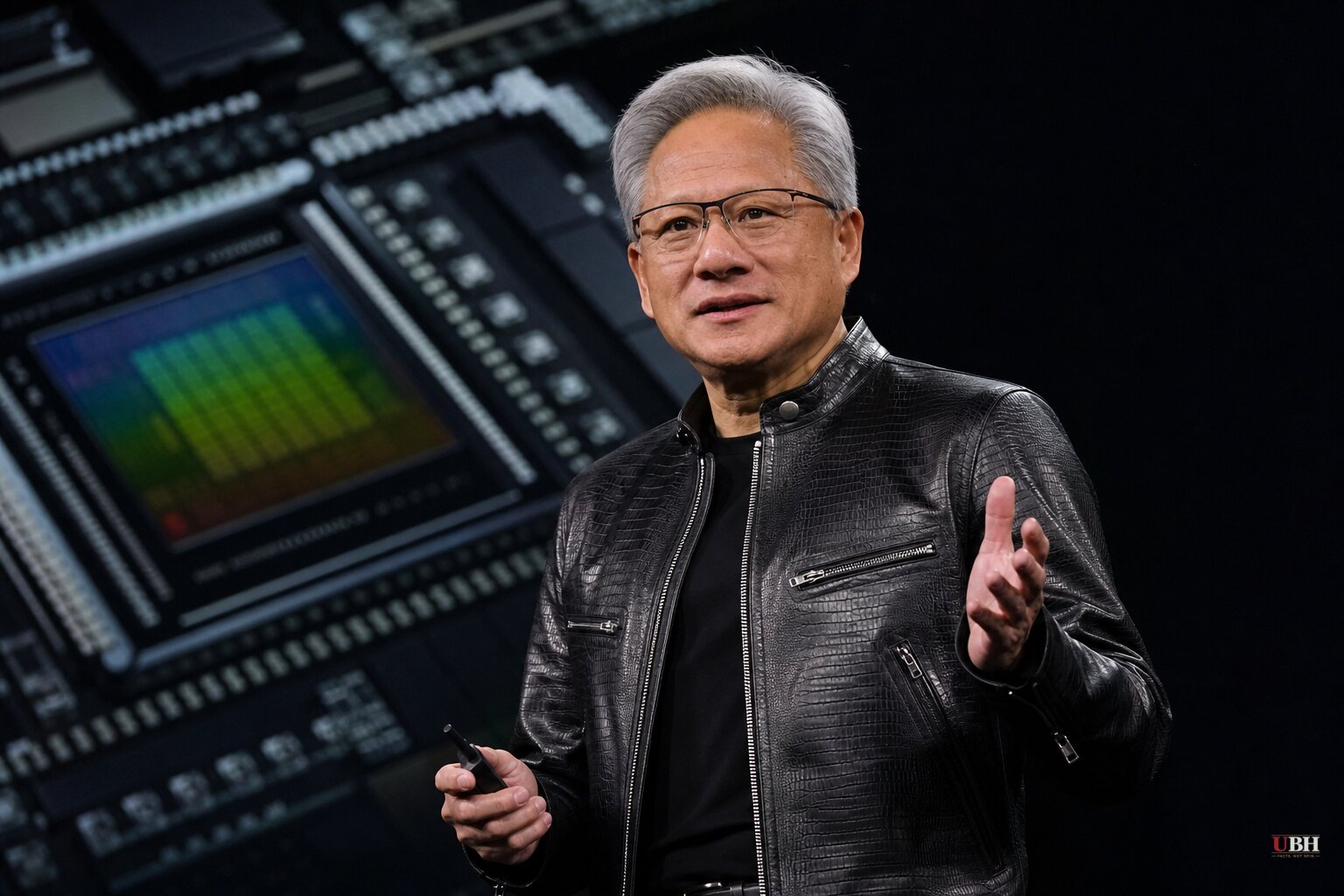
Nvidia CEO Jensen Huang took to X on Sunday, September 6, 2026, to declare that "AGI has arrived," congratulating OpenAI on the release of its newest model, Astra, which OpenAI launched Thursday, September 3.
"From ChatGPT to o1 to Astra in 4 years," Huang wrote, according to Business Insider. "AGI has arrived. Congratulations @OpenAI team." He also noted Astra was trained on Nvidia's chips and teased that "400K GPUs" are coming online next.
OpenAI called Astra its "most intelligent and aligned model" yet, capable of handling "the most demanding professional work with unmatched speed, accuracy, and judgment," according to Business Insider. OpenAI president Greg Brockman told reporters on a call Thursday, "Welcome to the AGI era," adding that he personally believes future observers will point to this model as the moment AGI arrived.
A Pattern, Not a One-Off
This is not the first time Huang has said the words "we've achieved AGI." On the Lex Fridman podcast on March 23, 2026, he said flatly, "I think it's now. I think we've achieved AGI," before immediately qualifying it, according to The Verge and PCMag. Fridman had proposed a specific test: an AI system that could start, build, and run a company worth more than $1 billion on its own. Huang backed off that framing, saying "the odds of 100,000 of those agents building Nvidia is zero percent."
Then, on Nvidia's earnings call Wednesday, August 26, Huang doubled down again. "For many tasks, we could say that we've already achieved AGI," he told analysts, according to The Verge, PCMag, and Mashable. In the same breath, he dismissed the entire concept as a benchmark. "I think of all of those milestones and all those, you know, they're kind of senseless at this point," he said. His preferred metric: whether AI is "generating profitable tokens."
Huang's argument, made most fully in a G20 talk covered by StartupHub AI, is that intelligence is becoming a commodity like electricity, priced in dollars per million tokens, and that whether a system hits some philosophical threshold matters less than whether it does useful, paid work. For a company selling the hardware that produces those tokens, that's a convenient argument, but it isn't an unreasonable one on its face.
OpenAI Can't Agree With Itself
The irony is that OpenAI's own executives are split on the term. Brockman told reporters Thursday it might be fair to say Astra represents AGI. But CEO Sam Altman, in a recent appearance on the "Sources" podcast, called AGI "a very poorly defined term" and said he "was going to say it's like an irrelevant marketing term," according to Business Insider.
Business Insider and KuCoin both note OpenAI's own charter defines AGI as "highly autonomous systems that outperform humans at most economically valuable work," and that definition is written into the company's governance structure, with contractual and organizational changes tied to when AGI is formally declared. Nvidia has no such mechanism. When Huang says the word, nothing legally changes. When OpenAI says it, contracts can trigger. That's one reason Altman may be more careful with the term than Huang is.
No Benchmark, No Referee
The Verge's Robert Hart put the skeptical case plainly: there is no industry consensus on what AGI means or how anyone would verify it's been reached, "which makes achieving it equally arbitrary." StartupHub AI made the same point about Huang's G20 remarks: "There is no benchmark, no definition of AGI, no test for 'practically already.' Without that, practically AGI is unfalsifiable." Neither claim can currently be proven or disproven by any agreed-upon standard. That kind of unfalsifiable marketing claim deserves scrutiny given how much money rides on it.
The Money Behind the Claim
Nvidia isn't hurting for reasons to talk up demand. The company reported $96.2 billion in fiscal second-quarter revenue in August, more than double the same period a year earlier, with its data-center business alone bringing in $89 billion, according to Business Insider and PCMag. CFO Colette Kress told analysts Nvidia is facing "extreme pricing conditions in memory" that have exceeded prior expectations and are headed higher into next year, with the bottleneck expected to persist into early 2028, per PCMag.
Huang's G20 remarks, covered by StartupHub AI, tie the AGI talk directly to Nvidia's sales pitch: nearly $1 trillion in U.S. AI infrastructure investment this year, a goal of 100 gigawatts of capacity by the end of the decade, and a cost he put at $50 to $60 billion per gigawatt. He also argued for lighter regulation, saying safety should be "the builder's responsibility" and that rules should target real harms rather than hypothetical ones.
Astra is rolling out to OpenAI's customers this week. The real test will be whether Astra's output, and Nvidia's next 400,000 GPUs, translate into the kind of autonomous, economically valuable work both companies are promising, or whether the memory shortage Kress described caps how fast that promise can be filled.
Sources used for this briefing
8 links from 8 independent newsrooms (syndicated copies of the same report count once)
These are the sources it draws on, linked so you can verify.


