
Unbiased headlines. Facts, not spin.
Unbiased Headlines is an independently owned news organization. We bring you the facts, not opinions, written fresh from 110+ named sources. Sources linked so you can verify it yourself.
 tech
Major Story (7/10)
Event date: October 19, 2026 ·
Nvidia's Huang Unveils DSX POD Modular AI Factory Design at GTC Berlin, Puts Europe Commitments Near $10 Billion
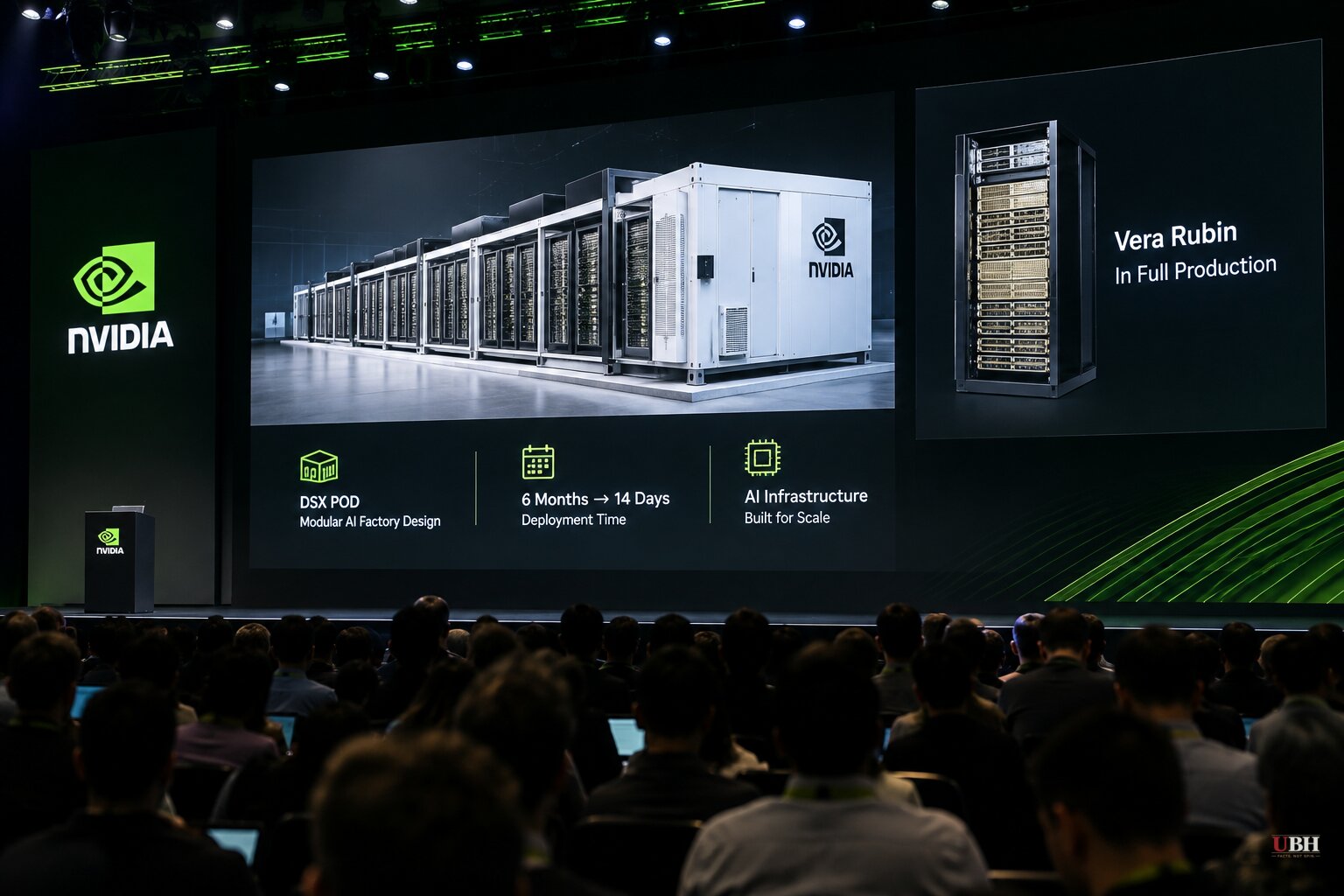
Since Jensen Huang started his European tour in Paris on Oct. 13, Nvidia's pitch has moved from startup stakes to hardware: at the GTC Berlin keynote today, Oct. 21, he introduced DSX POD, a reference design for prefab AI data centers, and said the Vera Rubin platform is in full production.
The hardware pitch
DSX POD is a reference design for complete Vera Rubin AI factories. Partners build them inside modular containers, then integrate and validate them before delivery. Nvidia says that once site utilities are ready, onsite deployment can shrink from six months to 14 days.
"This is a complete transformation of the world supply chain," Huang said. "This will change the way that people install and build data centers, and hopefully, as a result, velocity goes up."
Nvidia also says its DSX AI Factory Platform can cut water use for cooling by up to 100%. Huang showed several of the company's latest rack-scale systems and said Vera Rubin extends the platform beyond large language models to the entire AI agent.
Per the event's agenda, GTC Berlin runs Oct. 20 to 22 with more than 100 sessions on agentic AI, robotics, physical AI, open models and accelerated computing.
Europe by the numbers
Huang said the weeklong road trip through Paris, London, Stockholm and Dublin brought Nvidia's commitments to the European tech ecosystem to nearly $10 billion. The company says it works with more than 12,000 partners on the continent.
The figure combines roughly $8 billion invested over the past year with the roughly $2 billion in new deals Huang promised in Paris. Huang opened the keynote by listing European names already working with Nvidia: L'Oréal, Revolut, Spotify, Merck, Vodafone, Zara, Porsche, Nestlé and HSBC.
His argument is that Europe should produce AI, not just consume it. "To be part of this AI economy, you don't want to just be consuming the AI; you want to be producing the AI," he said. "We could do all of that here in Europe, and in fact, we've already started."
The sovereignty message is the same one he is pushing to governments worldwide. Axios reported that Huang says Nvidia will help fund countries that want to build their own AI. The catch is that the countries buying independence from foreign tech providers are mostly buying it from one American chipmaker.
Germany
On Oct. 19, the German federal government and Nvidia signed a joint declaration of intent. About 12 companies took part, including Siemens, Audi and Black Forest Labs. Nvidia also announced investments in four German startups.
That same day, Huang met Chancellor Friedrich Merz. Nvidia and Siemens showed AI deployments in production planning and circuit-board inspection.
Handelsblatt reported that Germany is expected to put up several hundred million euros in government funding for the partnership, built on Nvidia's Nemotron language models and Cosmos world models. It said a formal announcement could come this week. Neither the government nor Nvidia has published a funding figure.
The money question
Huang is selling at a moment when buyers are under strain. The South China Morning Post reported that Nvidia's customers are contending with rising borrowing costs and mounting delays in building the data centers that run its processors. DSX POD is aimed squarely at the second problem.
TradingKey's Yulia Zeng wrote in a preview that AI agents and robotics offer long-term demand, but that their short-term revenue impact is limited by long commercialization cycles and uncertain enterprise return on investment. In her analysis, those claims need proof through deployments at scale and sustained efficiency gains.
Cloud providers are central to that test. Vera Rubin shipments begin this fall, and AWS, Google Cloud, Microsoft and Oracle Cloud Infrastructure are slated to be among the first to deploy it in 2026.
Nvidia's own European spending also feeds its sales. Stakes in startups cultivate developers who build on Nvidia's platform, which widens demand for its GPUs, networking gear and AI cloud services.
What comes next
GTC Berlin continues through Oct. 22. Still unanswered are how much of the promised $2 billion has actually been allocated and what dollar figure Germany attaches to its Nvidia partnership. Both could be settled if the formal German announcement Handelsblatt anticipates lands this week.
Sources used for this briefing
7 links from 6 independent newsrooms (syndicated copies of the same report count once)
These are the sources it draws on, linked so you can verify.


