
Unbiased headlines. Facts, not spin.
Unbiased Headlines is an independently owned news organization. We bring you the facts, not opinions, written fresh from 110+ named sources. Sources linked so you can verify it yourself.
 tech
Notable (6/10)
Event date: October 15, 2026 ·
Nvidia's Huang Takes Stakes in Five UK Startups and Pledges $250 Million in Compute on European Tour
Nvidia CEO Jensen Huang is spending his way across Europe.
He started in Paris, where he met French President Emmanuel Macron and said Nvidia would announce another $2 billion in European AI deals within a week. That comes on top of roughly $8 billion the company says it has invested on the continent over the past year.
This week he was in London.
What Nvidia announced in London
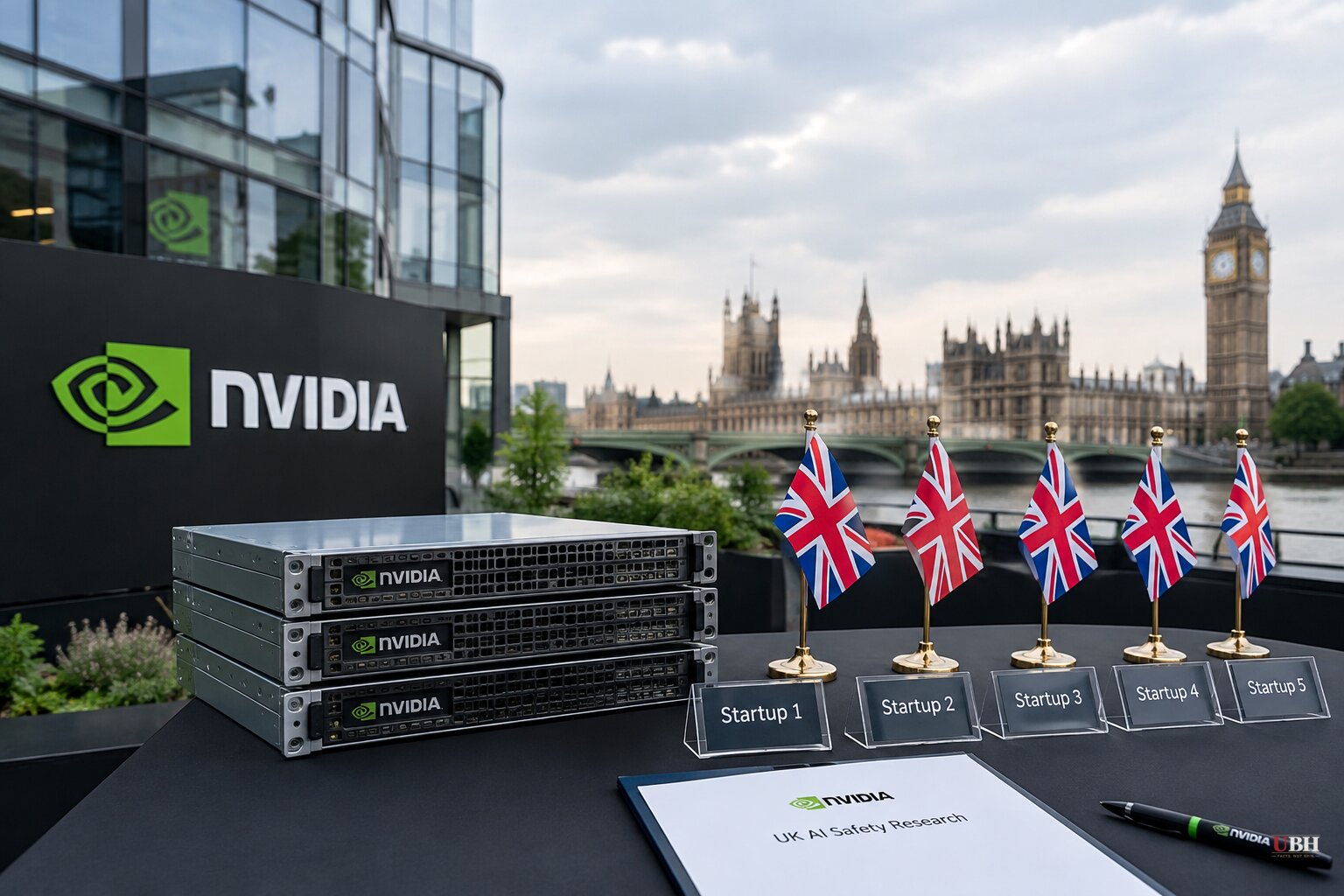
Huang said Nvidia is taking minority stakes in five UK startups. He also announced new deployments with local organizations.
Nvidia also committed $250 million worth of compute over five years to UK AI safety and security research.
The pitch came with theater. Speaking from a stage in a converted church to tech executives, venture capitalists, Nvidia staff and British politicians, Huang channeled Oprah Winfrey: "I am giving you money! And I am giving you money! And I am giving you money."
He also singled out Josh Payne, CEO of the Nvidia-backed UK cloud provider Nscale, from the stage. Huang told the crowd that Payne and his company were a "zero" before Nvidia invested and helped recruit the board. Nscale is now preparing to go public, targeting a valuation of up to $35 billion.
More announcements are expected at Nvidia's GTC Berlin event next week.
Where the money goes
The checks are large. The structure is familiar.
Startups that Nvidia backs need huge amounts of scarce, expensive computing power. Much of the money Nvidia invests is likely to return to it, either through direct GPU purchases or through AI companies renting capacity from data center operators that buy Nvidia chips in bulk. That is the analysis from Fortune's Beatrice Nolan.
The arrangement also keeps those companies building on Nvidia's chips and software. That makes them less likely to move to rivals such as Google's TPUs or Amazon Web Services' Trainium and Inferentia chips.
It also positions Nvidia as the default supplier for Europe's "sovereign AI" effort, meaning the push by governments and companies to run AI systems on their own soil and under their own control.
The sovereignty question
The tension is obvious. Fortune's reporting flags the risk for Europe that sovereignty ends up meaning dependence on a single American chipmaker.
Huang rejects that framing. He argued that sovereignty depends on who controls the data, the service and the ability to advance the technology, not simply where the chips are made.
Nvidia, he said, can enable sovereignty by letting local providers operate its full-stack AI platform themselves. "So long as you can operate the service yourself, that's the most important," Huang said.
That definition keeps Nvidia's hardware and software at the center of any European build-out. It leaves open how much independence a country has if the whole stack underneath it comes from one supplier.
Why Nvidia is doing this
Nvidia is valued at around $5 trillion. Keeping that number rising may depend on finding customers beyond the small group of U.S. hyperscalers that buy most of its chips, according to Fortune's analysis.
Axios reported that Huang is making the tour as fears of an AI bubble weigh on Wall Street, working to spread the boom beyond its current base. Axios described his goal as making Nvidia the indispensable backbone of the global AI economy.
The numbers fit that description. Eight billion dollars invested in Europe in a year, $2 billion more promised within days, five new UK stakes and a quarter-billion in research compute add up to a deliberate effort to widen the customer base.
Nvidia has not published terms for the five UK stakes in the material above, including the size of each investment or the startups' valuations. The company has also not said how much of the $2 billion in forthcoming deals will be equity investments versus commercial agreements.
What to watch
The next test is GTC Berlin next week, where more announcements are expected, and the $2 billion in European deals Huang promised in Paris. After that comes the Nscale listing, which would put a public price on the kind of Nvidia-backed company the tour is meant to multiply. Whether European governments treat those arrangements as sovereignty or as dependence will decide how far the strategy goes.
Sources used for this briefing
3 links from 1 independent newsroom (syndicated copies of the same report count once)
These are the sources it draws on, linked so you can verify.


