
Unbiased headlines. Facts, not spin.
Unbiased Headlines is an independently owned news organization. We bring you the facts, not opinions, written fresh from 110+ named sources. Sources linked so you can verify it yourself.
 tech
Major Story (7/10)
SpaceX Spent $19.6 Billion on Capex in Q3, More Than Its $14.6 Billion in Revenue
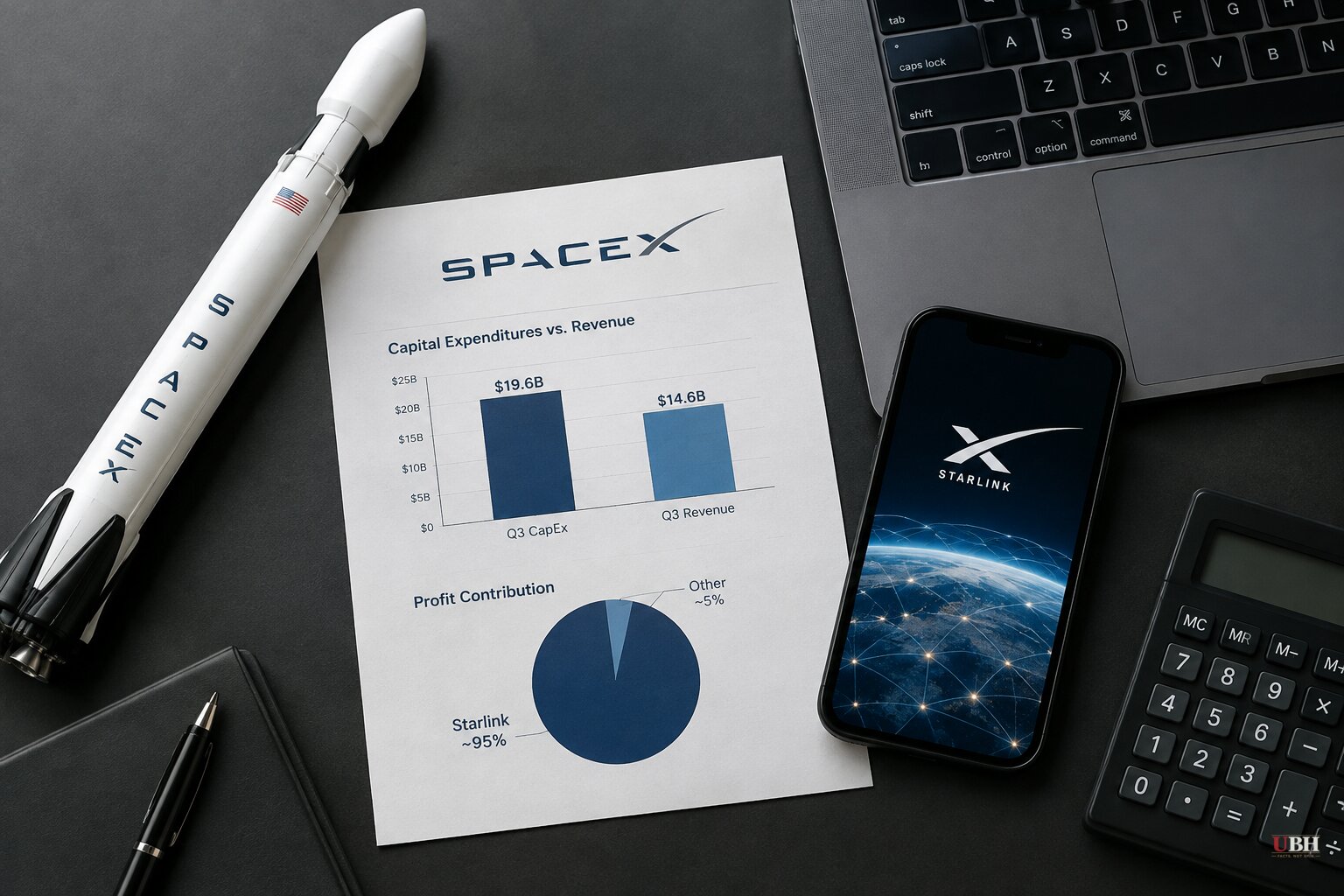
Since SpaceX listed in June under the ticker SPCX, its second earnings report has shifted the company's center of gravity. Revenue of $14.6 billion, up 161% from a year earlier, is the headline. The segment detail underneath it is where the questions are.
AI is now the biggest line, and it is mostly rented compute
SpaceX's AI unit, which the company now calls Super Intelligence, brought in $7.56 billion, up 830% from $813 million a year ago. That is about 52% of total revenue.
SpaceX attributes the jump to new cloud services agreements, the closing of its $60 billion Cursor acquisition, and rising Grok adoption among enterprises and consumers. The money is coming mainly from renting data-center capacity to Anthropic, Google and Reflection AI, a business closer to a cloud provider than to an AI lab with a breakout model.
Musk disputed the idea that Grok is lagging. "We're seeing the fastest growth of a product that I've ever seen in my life. I've never seen anything grow this fast," he said on the call, adding that Grok will soon roll out widely to enterprise customers. He also said a Grok personal agent "may end up being what uses most of our Super Intelligence's compute."
Nameplate compute stood at 1.7 gigawatts at quarter-end, up from 1.4 GW in June and 0.6 GW a year earlier. Musk said he expects 2.5 to 3 GW by the end of this year.
Starlink still pays the bills
Operating income totaled $2.8 billion. Almost all of it came from connectivity, which earned about $2.37 billion. The AI unit swung to a $431 million operating profit. The space division lost $7 million.
Connectivity revenue rose 69% to $5.25 billion, against analyst expectations of $4.84 billion. Consumer subscribers brought in $3.12 billion and government and enterprise customers $2.13 billion. Starlink added 1.6 million consumer subscribers in the quarter, reaching 13.6 million. Average revenue per user rose $3 to $69.
Launch and space revenue was $1.77 billion, up from $1.67 billion. That is roughly 6% growth for the business that built the company.
SpaceX is also moving toward a U.S. mobile network. It announced this month that it is buying 800 MHz of low-band spectrum, and the FCC has approved a 15,000-satellite constellation.
Spending outran sales
Capital expenditures came to about $19.6 billion. About $16.4 billion of that went to AI infrastructure, including continued expansion of the Colossus data centers. Spending on that scale exceeds the quarter's entire revenue.
Total costs and expenses ran about $11.8 billion, above the roughly $11.2 billion analysts expected, according to Investing Live's tally of consensus figures. Rising revenue absorbed the overrun.
The company has cautioned that its AI business will need sustained investment before it can generate consistent profits. The open question is how fast the $16.4 billion a quarter turns into durable returns. Investing Live's analysis frames the same concern: revenue beat estimates by about $1.7 billion, but heavy capex keeps "the question of payback firmly on the table."
On profit, SpaceX reported GAAP net income of $4.4 billion and adjusted EBITDA of about $8.8 billion. Analysts had expected net income near $2 billion and EBITDA of roughly $6.6 to $6.8 billion. Earnings per share were $0.35 against a consensus near $0.15. In the prior quarter, SpaceX posted a $541 million net loss on $7.8 billion in revenue.
The stock and what comes next
SPCX closed the regular session at $147.79, down 0.11%, within a 52-week range of $104.83 to $225.64. Shares rose nearly 5% in after-hours trading as of 5:56 p.m. ET. That is an extended-session move, not a close.
Musk also said Tesla and SpaceX have formed special committees to weigh a merger. He called a tie-up a "good idea," and said SpaceX will try to catch a Starship and its booster next month. He also said Starlink could eventually generate "several hundred billion dollars a year."
Starship has not yet entered commercial service. It is expected to deploy higher-bandwidth Starlink satellites and orbital AI-computing infrastructure, and the company's long-term strategy depends on making it reliably reusable.
Tesla reports its own third-quarter results after the close on Wednesday, Oct. 21. Neither company has said what terms or structure a merger would involve.
Sources used for this briefing
7 links from 7 independent newsrooms (syndicated copies of the same report count once)
These are the sources it draws on, linked so you can verify.


