
Unbiased headlines. Facts, not spin.
Unbiased Headlines is an independently owned news organization. We bring you the facts, not opinions, written fresh from 110+ named sources. Sources linked so you can verify it yourself.
 tech
Major Story (7/10)
Event date: August 21, 2026 ·
SpaceX Reports $14.6 Billion Q3 Revenue and $4.4 Billion Net Income, Guides Q1 Revenue to $33 Billion-$37 Billion
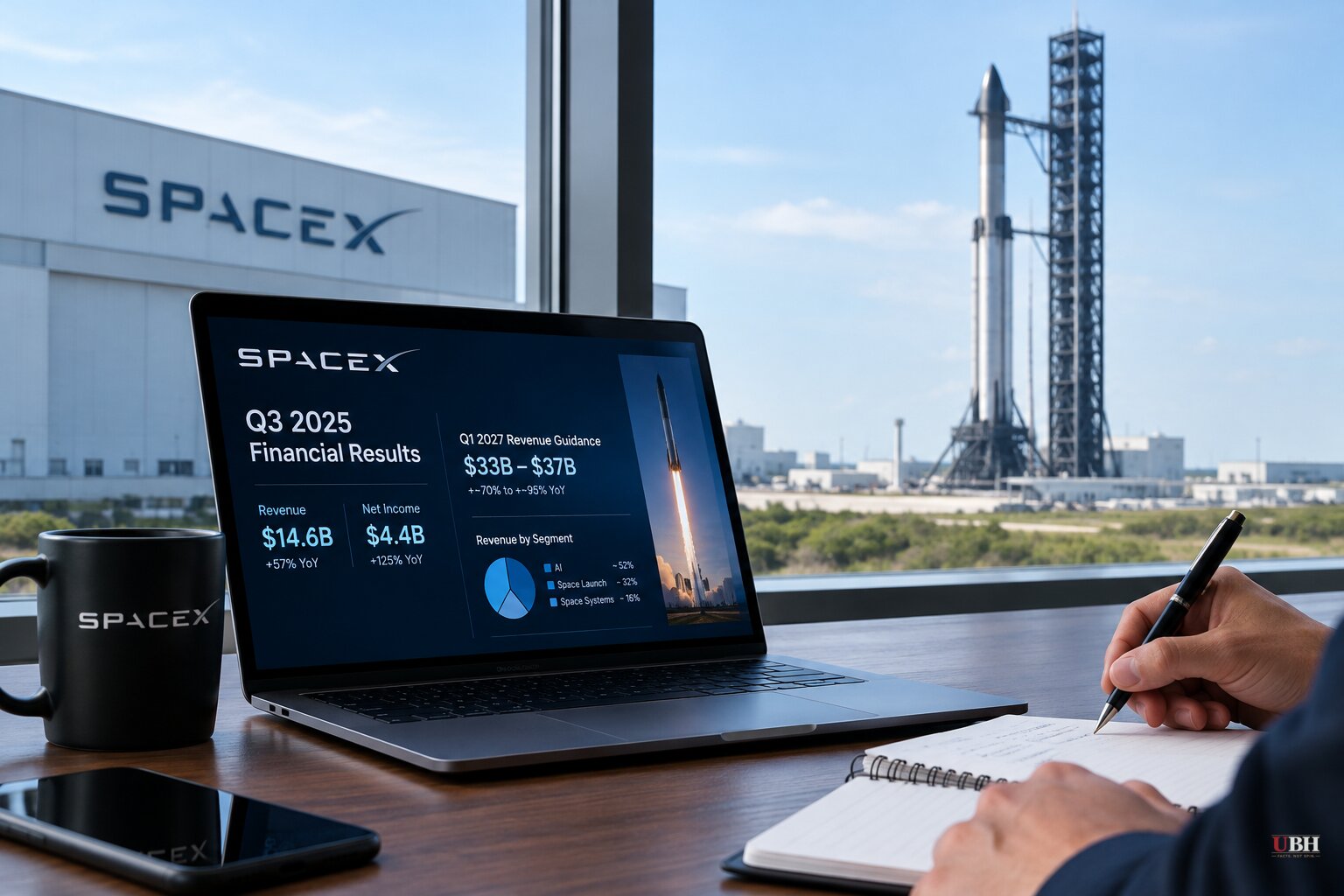
Since SpaceX listed on Nasdaq earlier this year, the market has waited to see whether a rocket-and-satellite company could carry a data-center build-out. Its Q3 results, released after the close today, Oct. 20, gave a first full answer: revenue of $14.6 billion, up 161% from $5.576 billion a year earlier, against an LSEG consensus of about $12.72 billion.
The bottom of the income statement flipped hard. Income from operations was $2.791 billion versus a $273 million operating loss a year ago. Net income was $4.404 billion versus a $1.054 billion loss. Diluted earnings per share were $0.35. Adjusted EBITDA, a non-GAAP measure, hit $8.809 billion, up 306%.
Net income came in well above operating income. ZeroHedge noted that the $4.4 billion of net income got a boost from $1 billion of "other income" and a $390 million tax benefit, though the underlying business still beat expectations: operating income was $2.8 billion versus $2.2 billion expected.
AI passes Starlink
The company now calls its AI business "Super Intelligence." It brought in $7.56 billion, up 830% from $813 million a year ago and 195% from the prior quarter. That makes it SpaceX's largest segment for the quarter.
In the prior quarter, Starlink still led, at $4.3 billion against $2.6 billion for AI, according to Stock Titan's analysis of the release. Over the first nine months of 2026, Starlink remains slightly ahead, $12.8 billion to $10.9 billion.
Most of the AI jump is infrastructure, not chatbots. SpaceX attributed $6.7 billion of year-over-year growth in that line to cloud services agreements, the Cursor acquisition and software including Grok Bot. The company has been renting out capacity to Google, Anthropic and others. The Cursor purchase, at an implied equity value of $60 billion, closed Aug. 14 and added $608 million in revenue through Sept. 30.
The AI segment posted a $431 million operating profit, versus a $1.722 billion loss a year earlier. That figure is after $1.2 billion in share-based compensation tied to Cursor. Nameplate computing capacity reached 1.7 gigawatts, up from 0.6 a year ago.
Starlink still makes the money
Connectivity revenue rose 69% to $5.25 billion, ahead of the $4.84 billion StreetAccount estimate. Consumer subscribers contributed $3.12 billion and government and enterprise customers $2.13 billion. Subscribers reached 13.6 million.
Connectivity operating income was $2.37 billion, up about 99%. Almost all of SpaceX's operating profit still comes from this unit.
Launch is the small part of the picture. Space revenue rose to $1.77 billion from $1.67 billion, and the segment lost $7 million.
The guidance and the spending
CFO Bret Johnsen told analysts on the call that Q1 2027 revenue will be $33 billion to $37 billion. The LSEG average estimate was $22.2 billion. Johnsen credited "increased visibility into our compute contract pipeline over the next six months."
The spending side is just as large. Capital expenditures totaled $19.6 billion in the quarter, and $16.4 billion of that went to AI. By Stock Titan's count, operating cash covered a little more than a quarter of the year's capital spending, with the June share sale and new borrowing covering the rest.
The company's own framing is that it is focused on capital efficiency and an investment-grade balance sheet. Ahead of the report, Deutsche Bank's checklist asked whether 2027 capex would start with a "2," and flagged data-center spending as a key focus.
The stock and the Tesla question
After hours, SpaceX stock moved higher. Reported gains ranged from about 2% to about 5%, depending on the time of the quote.
Musk has said the boards at Tesla and SpaceX formed special committees to discuss a potential merger "at the request of shareholders." Deutsche Bank has described the timing as "mainly a function of valuation differentials and politics." The two companies are already working together on the Terafab chip project.
SpaceX also announced earlier this month that it is buying 800 MHz of low-band spectrum, and the FCC approved a plan for a 15,000-satellite constellation. Both feed expectations of a U.S. mobile network, though SpaceX has not laid out its plan.
The $33 billion-$37 billion Q1 forecast will be tested when SpaceX reports next. Whether the committees reach a Tesla deal is the other open item, and no terms have been disclosed.
Sources used for this briefing
8 links from 8 independent newsrooms (syndicated copies of the same report count once)
These are the sources it draws on, linked so you can verify.


