
Unbiased headlines. Facts, not spin.
Unbiased Headlines is an independently owned news organization. We bring you the facts, not opinions, written fresh from 110+ named sources. Sources linked so you can verify it yourself.
 tech
Major Story (7/10)
SpaceX Reports Q3 Earnings After the Close Today, With Analysts Expecting About $12.8 Billion in Revenue and a Return to Profit
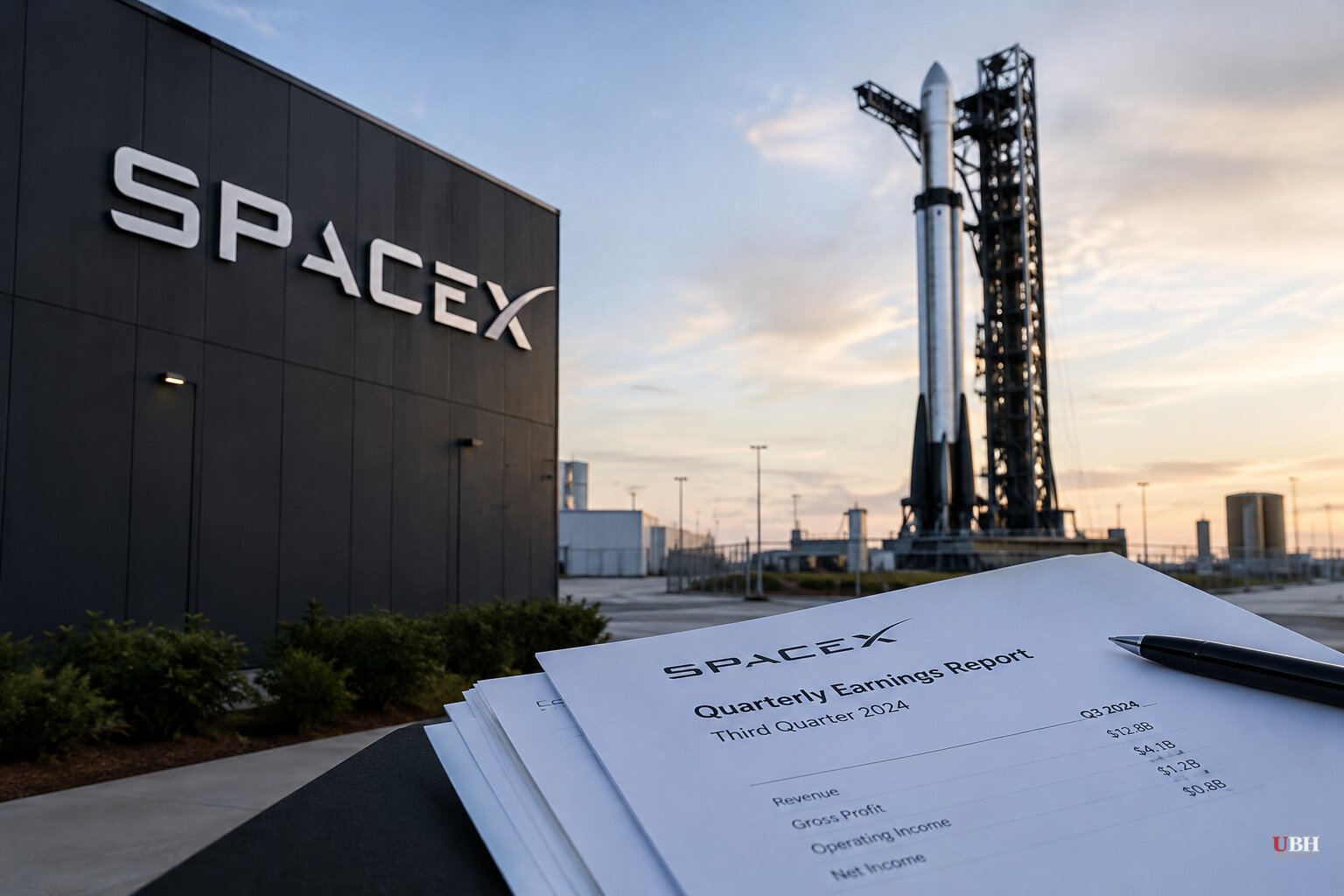
Since Musk said on Oct. 19 that he will give one SpaceX share to every U.S. child next year, the company he runs has a more immediate test: its third-quarter report, due after the market close today, Oct. 20. The webcast is set for 4:30 p.m. ET on X.
This is only SpaceX's second report since its June IPO. The Street is looking for a big jump from the second quarter, when revenue was $7.8 billion and the company posted a $541 million net loss.
What analysts expect
The estimates are close but not identical. LSEG consensus puts third-quarter revenue at about $12.74 billion and earnings at 14 cents a share. FactSet has $12.8 billion and 13 cents, against a nine-cent loss in the June quarter. Bloomberg consensus, cited by Pepperstone, calls for $12.89 billion, adjusted EBITDA of $6.62 billion and adjusted EPS near 15 cents.
That would be about 65% growth from the second quarter and SpaceX's first profitable quarter since the IPO.
By segment, StreetAccount expects AI revenue of $6.47 billion, connectivity sales of $4.84 billion and space revenue of $1.41 billion. Bloomberg's figures are roughly $6.4 billion from AI and $4.9 billion from Starlink, with Starlink projected to reach 14.3 million consumer subscribers. It was 12 million in the second quarter.
All of these are estimates, not reported results.
The spending problem
The second-quarter report beat on revenue, but $18.4 billion in capital spending hurt the stock. Bloomberg's consensus for this quarter is $19.6 billion in capex and free cash flow near negative $11.6 billion.
SpaceX's AI unit, which includes the xAI business it absorbed in February, spent $15.8 billion on AI infrastructure last quarter. Revenue there is expected to nearly triple. Deutsche Bank analyst Edison Yu estimates SpaceX's signed AI compute customers represent $54.5 billion in annualized run-rate revenue.
SpaceX also closed its $60 billion purchase of the AI coding startup Cursor during the quarter. It has agreed to buy 800 MHz of spectrum for about $8 billion, and the FCC approved a 15,000-satellite constellation. CNBC reports the company is in talks to raise up to $40 billion to buy more Nvidia chips.
Morgan Stanley analyst Adam Jonas called financing the biggest risk to his model in a Monday note. He models SpaceX issuing $60 billion of debt in 2027, $80 billion in 2028 and $90 billion in 2029. Those are his projections, not announced borrowing.
Evercore ISI, which raised its price target to $275, expects SpaceX to end 2026 at an annualized revenue pace of about $104 billion and spend about $151 billion in 2027. Management has targeted more than 2 gigawatts of compute by year-end and a $100 billion annualized revenue run rate. Evercore said the quarter may be judged more on those targets than on the reported figures.
Starlink as the funding engine
Connectivity is the only SpaceX segment generating an operating profit. Its revenue rose 66% to $4.3 billion in the second quarter.
XTB argues that Starlink's profits are becoming harder to view as enough to carry the whole group. In its framing, the connectivity business generates cash while space and AI consume enormous amounts of capital with no certainty of sustainable profitability. Its forecast has connectivity earning $1.66 billion in operating profit this quarter, against an expected $938 million operating loss in AI and a $525 million loss in space.
The bullish read comes from RBC Capital Markets, which carries a $225 price target. Its analysts wrote that the spectrum purchase and FCC approval strengthen "Starlink Mobile's ability to compete with major carriers by enabling broader, deeper coverage." Taking on Verizon, AT&T and T-Mobile would also require more satellites and a ground footprint, and how much SpaceX sets aside for that is a question analysts will press.
SpaceX priced its IPO at $135, hit $225.64, and fell to near $105 in early August. Friday's close of $146.03 sits about 28% below the June high.
The Tesla question
An investor question asking when SpaceX will merge with Tesla has collected heavy upvotes on the company's Q&A platform. Neither company nor Musk has committed to a deal. Musk said in July that combining the companies cannot be discussed on an earnings call.
Barclays analyst Dan Levy expects an all-stock deal in which SpaceX buys Tesla at a premium, using reference values of $2.1 trillion for SpaceX and $1.5 trillion for Tesla. Barclays estimates Musk would hold about 37% of the combined equity and 56% of the votes.
Levy said an announcement would need to come by late October or early November to be put to a shareholder vote at Tesla's annual meeting. Reports differ on the date: Reuters says Tesla announced Monday that the meeting will be held Dec. 3, while Teslarati cites Barclays as referring to a Dec. 6 meeting.
Before the IPO, SpaceX COO Gwynne Shotwell told CNBC a merger "might make Elon's life a little easier." Tesla's new Roadster demo last week, built with SpaceX technology and slated for production in 2028, added fuel.
The share pledge
Musk has not said who would receive the shares or how. President Trump predicted Musk would donate stock to Trump Accounts, and Shotwell has said she will gift a share of her own SpaceX stock to them.
Tesla reports Wednesday, Oct. 21, after the close. If a deal is coming, Barclays' timing suggests the window to get it in front of Tesla shareholders at the annual meeting is narrowing.
Sources used for this briefing
8 links from 7 independent newsrooms (syndicated copies of the same report count once)
These are the sources it draws on, linked so you can verify.


