
Unbiased headlines. Facts, not spin.
Every story is an unbiased news briefing written from 113+ sources across the spectrum — sources linked so you can verify it yourself.
 finance
Major Story (7/10)
September 28, 2026 at 03:11 AM
finance
Major Story (7/10)
September 28, 2026 at 03:11 AM
Nvidia's $5.4 Trillion Value Now Tops the Entire Russell 2000 Combined
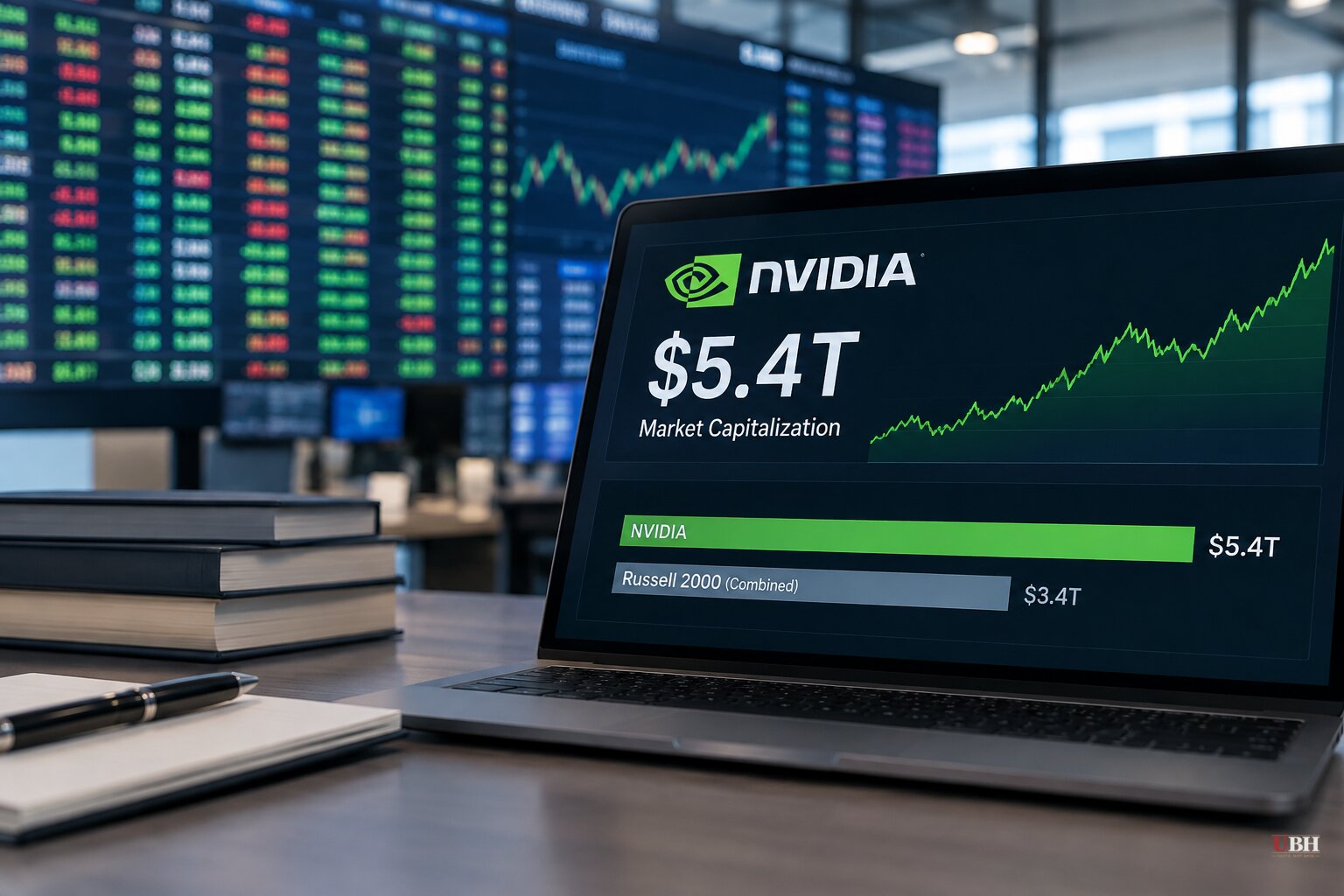
Nvidia is now worth more than every publicly traded small-cap company in America combined, and it isn't particularly close.
As of late September 2026, Nvidia's market capitalization stood at approximately $5.4 trillion, according to Crypto Briefing. That's nearly $2 trillion more than the combined value of the roughly 2,000 companies that make up the Russell 2000, the standard benchmark for U.S. small-cap stocks covering regional banks, smaller manufacturers, and mid-tier retailers.
The profit gap is even starker than the valuation gap. Nvidia generated roughly $193 billion in net income over the trailing twelve months, according to Crypto Briefing. Over that same stretch, the entire Russell 2000, all 2,000 companies added together, lost $13 billion.
The Numbers Behind the Climb
Nvidia's fiscal 2026 revenue hit $215.9 billion, up 65% year over year, Crypto Briefing reported. The company crossed the $5 trillion market cap threshold for the first time in October 2025 and has climbed since.
The most recent quarterly numbers explain why. Nvidia's fiscal second-quarter 2027 results, covering the period ended July 26, 2026 and reported August 26, 2026, showed revenue of $96.2 billion, up 106% year over year, according to The Motley Fool. Data center revenue alone came in at $89 billion, up 117%, according to TradingView. Net income was $59.7 billion, up 126% year over year. Earnings of $2.22 per share beat the Zacks consensus estimate by 13 cents, marking Nvidia's fifth straight earnings beat, TradingView reported.
CFO Colette Kress guided fiscal third-quarter revenue to approximately $108 billion and told analysts Nvidia expects roughly 70% revenue growth in fiscal 2028, calling it "a supply-constrained outlook," according to The Motley Fool. That's Nvidia's first-ever year-ahead forecast, and it's well above the roughly 44% growth analysts had penciled in, according to BigGo Finance.
Gross margins, meanwhile, are expected to bottom between 71% and 72% in the fiscal fourth quarter before settling at 72% to 73% in fiscal 2028, down from 75% in the most recent quarter, per Kress's comments reported by The Motley Fool. Tickeron also noted that Nvidia's Vera Rubin platform entered full production and that Amazon Web Services committed to deploying an additional 2 million Nvidia GPUs.
Not Everyone Agrees the Stock Is Cheap
Zacks-affiliated TradingView puts Nvidia's forward price-to-earnings ratio at 24, calling it low by the company's own historical standards. BigGo Finance, citing Motley Fool contributor Keithen Drury, puts the forward multiple at 14.4 times and argues the stock could double if it holds its 29-times trailing multiple while hitting analyst targets. 24/7 Wall St. puts it at 26 times forward. These different sources use different denominators and dates, so no single number should be treated as the final word on what Nvidia "really" trades at.
Nvidia forecasts that the five largest AI hyperscalers will spend $1.3 trillion on data centers in 2027, up from nearly $800 billion in 2026, per BigGo Finance. Alphabet and Amazon have guided to $195-205 billion and roughly $220 billion in data center capital spending respectively this year, with Google Cloud revenue up 82% and AWS up 37% in the most recent quarter cited.
The Broadcom Counterargument
Not every analyst thinks Nvidia is still the cleanest AI bet. 24/7 Wall St.'s Alex Sirois argues Broadcom's custom-chip business is the better risk-reward play into 2027. Broadcom posted $29.59 billion in third-quarter revenue, up 85.5% year over year, with AI semiconductor revenue of $16.7 billion, up 221%. CEO Hock Tan told investors Broadcom has "line of sight" to fiscal 2028 AI semiconductor revenue growth that would double to $230 billion, driven by custom chips built for Google, Meta, OpenAI and Anthropic.
Sirois notes Broadcom's stock already absorbed a 13.74% one-month drawdown while Nvidia held up, and argues that with the 10-year Treasury at 4.80%, valuation discipline matters more than growth headlines right now. Rising yields punish long-duration growth bets harder than they punish steady cash generators. Nvidia's inventory jumped to $32 billion for the Vera Rubin ramp while days sales outstanding stretched to 60 days, per 24/7 Wall St. Those represent real working-capital pressures.
What the Russell 2000 Gap Actually Means
The divergence between Nvidia and small-cap America isn't purely a story about one company's brilliance. Crypto Briefing points out that small-cap companies carry more floating-rate debt, which got expensive as rates climbed, and they lack the pricing power and scale that let a company like Nvidia absorb cost shocks. The AI boom concentrated capital into a narrow band of mega-cap technology names rather than spreading it across the broader economy.
Nvidia earned its position through real product demand and real earnings growth. A Federal Reserve that keeps benchmark rates elevated is also actively squeezing thousands of smaller, debt-reliant businesses that have nothing to do with AI. If rate cuts materialize, Crypto Briefing notes, small-caps with variable-rate debt could see the profitability gap narrow without Nvidia stumbling at all. Whether that relief arrives, and how fast, remains the open question hanging over both sides of this trillion-dollar divide.
Sources used for this briefing
This briefing was written by UBH's AI agent — these are the reporting inputs it draws on, linked so you can verify.


