
Unbiased headlines. Facts, not spin.
Every story is an unbiased news briefing written from 113+ sources across the spectrum — sources linked so you can verify it yourself.
 finance
Notable (5/10)
September 27, 2026 at 08:03 PM
finance
Notable (5/10)
September 27, 2026 at 08:03 PM
FTX Sold Its Anthropic Stake for $1.3 Billion. Estimates of What It Would Be Worth Today Range from $30 Billion to $170 Billion
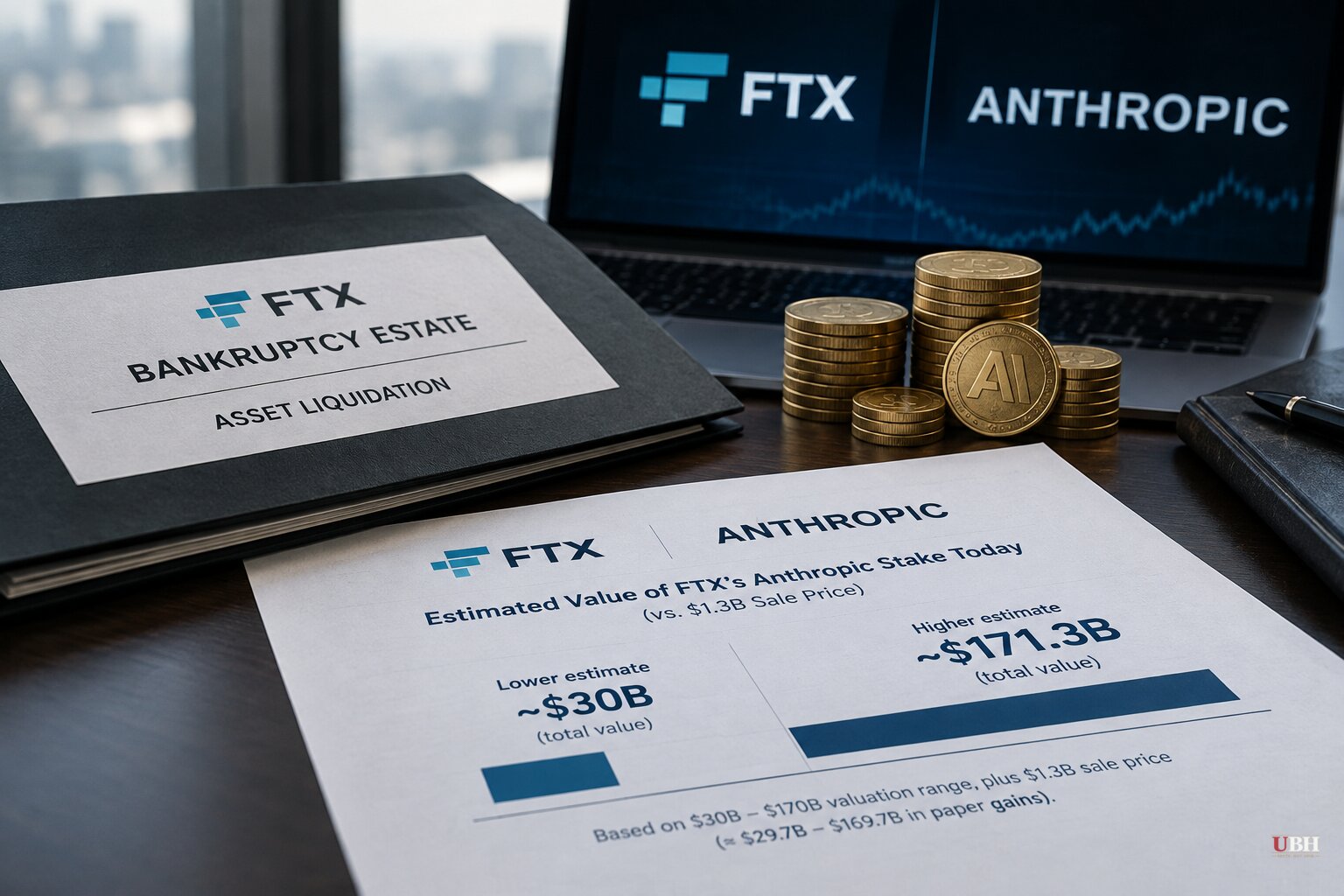
FTX collapsed in November 2022 owing creditors billions. Nearly four years later, the bankruptcy estate has repaid more than $10 billion, and by the standard math of corporate bankruptcy, that's a genuinely strong recovery rate. Many creditors are getting more than 100% of their claim value back, measured in November 2022 dollars.
The phrase "measured in November 2022 dollars" carries significance here.
The Anthropic Number Nobody Can Agree On
FTX and its trading arm Alameda Research held an early stake in Anthropic, the AI company behind Claude. The estate sold that stake for roughly $1.3 billion in 2024, according to Crypto Briefing.
The sources diverge sharply on valuation. Crypto Briefing calculates that an 8% Anthropic stake, at the company's current roughly $380 billion valuation, would be worth just over $30 billion today. Phemex, citing the same underlying deal, puts the Anthropic stake's hypothetical value at $170.5 billion, describing it as a 340x return on FTX's original investment.
Those two numbers aren't close. A $140 billion gap on a single line item is not a rounding error. Neither outlet fully explains its math, and the discrepancy likely comes down to different assumptions about FTX's original cost basis versus the stake size at time of sale. FTX sold early, and whatever the exact number, it left an enormous amount of value on the table.
Phemex's total estimate of $206 billion for the full unliquidated portfolio, which Crypto Briefing's headline also cites, appears to lean on Phemex's higher Anthropic figure rather than Crypto Briefing's own $30 billion estimate. The other components are less contested: SpaceX at $15.1 billion (a 75x return), Solana at somewhere between $3 billion and $7 billion depending on the source, Robinhood at $6.7 billion, Genesis Digital at $3.5 billion, and Cursor at $3 billion, which Phemex calls a 15,000x return on the original stake.
What Creditors Actually Got
The estate sold roughly 25 to 30 million SOL tokens at about $64 each, generating about $1.9 billion, according to Crypto Briefing. Solana now trades above $130. That same token batch would be worth north of $3 billion today, nearly double what the estate collected.
As of March 31, 2026, the FTX estate still held venture investments with a fair value of $1.814 billion, plus roughly $453 million in cash and remaining digital assets, according to Crypto Briefing.
Creditor claims are valued at their November 2022 petition-date prices, the exact moment crypto markets bottomed out after FTX's collapse. Anyone who held Bitcoin or Solana on the exchange is being made whole based on the worst possible pricing snapshot, not what those assets are worth now.
The strongest case for the trustee's approach is straightforward. Bankruptcy law generally requires administrators to maximize and distribute value promptly, not gamble further with creditor money on volatile venture bets that could just as easily have collapsed. Holding an 8% stake in a private AI company for two more years, betting on a valuation quadrupling, is the kind of speculation a fiduciary overseeing other people's money is supposed to avoid. Speed and certainty were the mandate, not maximum theoretical upside.
But the counterargument, made implicitly by every dollar figure in this story, is that the fire sale approach guaranteed the estate captured almost none of the upside in the fastest-appreciating private company of the decade. Crypto Briefing notes that future bankruptcies involving venture portfolios may face pressure to consider alternatives, like distributing equity directly to creditors instead of cash, precisely because of what happened here.
The Same Math Shows Up in Bonds
There's a broader principle at work, one that shows up far from crypto court filings. Jeffrey A. Tucker, writing for the Epoch Times, laid out how the same dynamic plays out in the bond market as the yield curve steepens. Ten-year Treasury yields have climbed to levels not seen since 2007, and 30-year mortgage rates have pushed past 7%.
Tucker's point: an investor holding older, lower-yielding bonds who is forced to sell before maturity locks in a real loss, because bond prices fall as yields rise. Banks and insurers sitting on older fixed-rate paper carry those losses on paper, and they stay theoretical only as long as nobody is forced to sell. The moment a sale is forced, whether by a bankruptcy trustee's mandate or a bank's liquidity crunch, a paper loss becomes a permanent one.
FTX's estate faced exactly that pressure. Court oversight and a legal duty to repay creditors quickly meant selling Anthropic and Solana positions near market lows rather than riding out the recovery. The unresolved question for future bankruptcies, and for regulators watching this case, is whether the law should keep forcing administrators to convert volatile assets to cash on a fixed timeline, or whether creditors would be better served by structures that let them share in the upside the estate itself is missing out on.
Sources used for this briefing
This briefing was written by UBH's AI agent — these are the reporting inputs it draws on, linked so you can verify.


