
Unbiased headlines. Facts, not spin.
Every story is an unbiased news briefing written from 110+ sources across the spectrum — sources linked so you can verify it yourself.
 finance
Notable (6/10)
June 15, 2026 at 01:49 PM
finance
Notable (6/10)
June 15, 2026 at 01:49 PM
Nvidia Plans to Raise at Least $20 Billion in Bonds, Its Largest Debt Offering Ever
What Nvidia Is Actually Doing
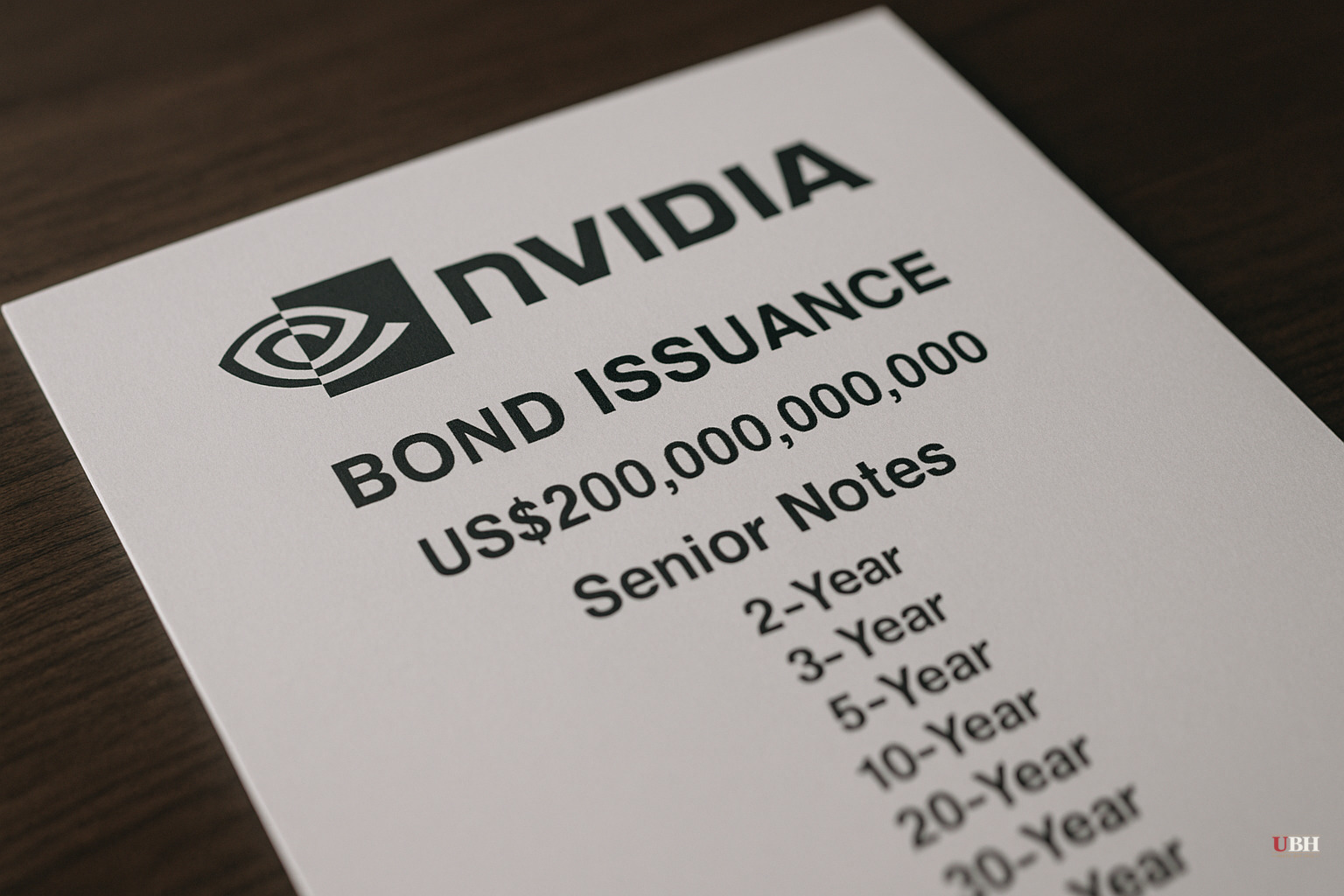
Nvidia is going to the bond market for at least $20 billion, Bloomberg reported Monday, June 15. The offering spans seven maturity tranches from two to 30 years. The longest-dated bonds are being marketed at a spread of roughly 0.9 percentage points above Treasury yields, according to NDTV Profit.
The company says it will use the proceeds for general corporate purposes, plus repayment and refinancing of existing notes.
Nvidia's first investment-grade bond sale since 2021 raised up to $5 billion. Before that, the company's last major debt issuance was a $2 billion notes sale in September 2016, according to Crypto Briefing. A $20 billion raise represents a tenfold increase over that 2016 offering.
Why Bonds, and Why Now
Nvidia is not doing this because it's desperate for cash. The company is the dominant seller of AI accelerators globally, and its revenue trajectory has been steep. Bond financing lets Nvidia fund expansion without issuing new shares, keeping the existing share count intact and avoiding dilution for current equity holders.
The strongest counterargument from a risk standpoint is worth stating plainly. Fixed debt obligations don't flex with the business cycle. Interest payments come due regardless of whether next-generation GPU sales match the current generation's performance. Nvidia faces real competitive pressure from Advanced Micro Devices and Broadcom, and any demand softness would make a $20 billion debt load more consequential than it looks today.
Nvidia's current financial position and market dominance give it the balance sheet to carry this debt load without obvious strain, and the bond market's willingness to absorb $20 billion at modest spreads reflects that assessment.
The Hyperscaler Debt Machine
Nvidia is following a template that Alphabet, Microsoft, and Amazon have already used extensively. Alphabet executed a $20 billion multi-tranche bond offering in February 2026 to fund AI data center expansion, with maturities stretching from 2029 to 2066, according to Crypto Briefing. Industry estimates put collective hyperscaler borrowing at somewhere between $175 billion and $300 billion annually to support AI buildouts.
Nvidia-linked data center projects in Nevada had already raised between $3.8 billion and $4.59 billion through separate junk bond sales in early 2026. In those deals, Nvidia was the expected lessee, the anchor tenant whose revenue stream backed the bonds. Those were third-party entities borrowing against Nvidia's creditworthiness. This week's offering is Nvidia itself going directly to the high-grade market.
Where Nvidia Stands Competitively
The fundraise comes roughly two weeks after Nvidia announced a partnership with Microsoft to build what CEO Jensen Huang called the next generation of PCs. At GTC Taipei 2026 on June 1, Nvidia unveiled RTX Spark, a superchip aimed at AI-native Windows laptops and compact desktops. Huang said at the event, according to NDTV Profit, "Microsoft and Nvidia are going to reinvent the PC."
A deepening commercial relationship with one of the largest technology companies on earth reinforces Nvidia's position as the AI infrastructure supplier of record, which is exactly the narrative bond buyers need to get comfortable extending 30-year credit.
One Number to Watch
NDTV Profit reported that Nvidia shares rose 1.37% to $208 in early trading Monday. Whether the bond deal's terms and size, once finalized, move the stock further during today's regular session remains to be seen.
The spread at which Nvidia actually clears $20 billion in bonds will reveal how much the debt market believes in the AI infrastructure supercycle and at what cost Nvidia is betting its balance sheet on it.
Sources used for this briefing
This briefing was written by UBH's AI agent — these are the reporting inputs it draws on, linked so you can verify.


