
Unbiased headlines. Facts, not spin.
Every story is an unbiased news briefing written from 110+ sources across the spectrum — sources linked so you can verify it yourself.
 tech
Notable (5/10)
June 1, 2026 at 05:52 AM
tech
Notable (5/10)
June 1, 2026 at 05:52 AM
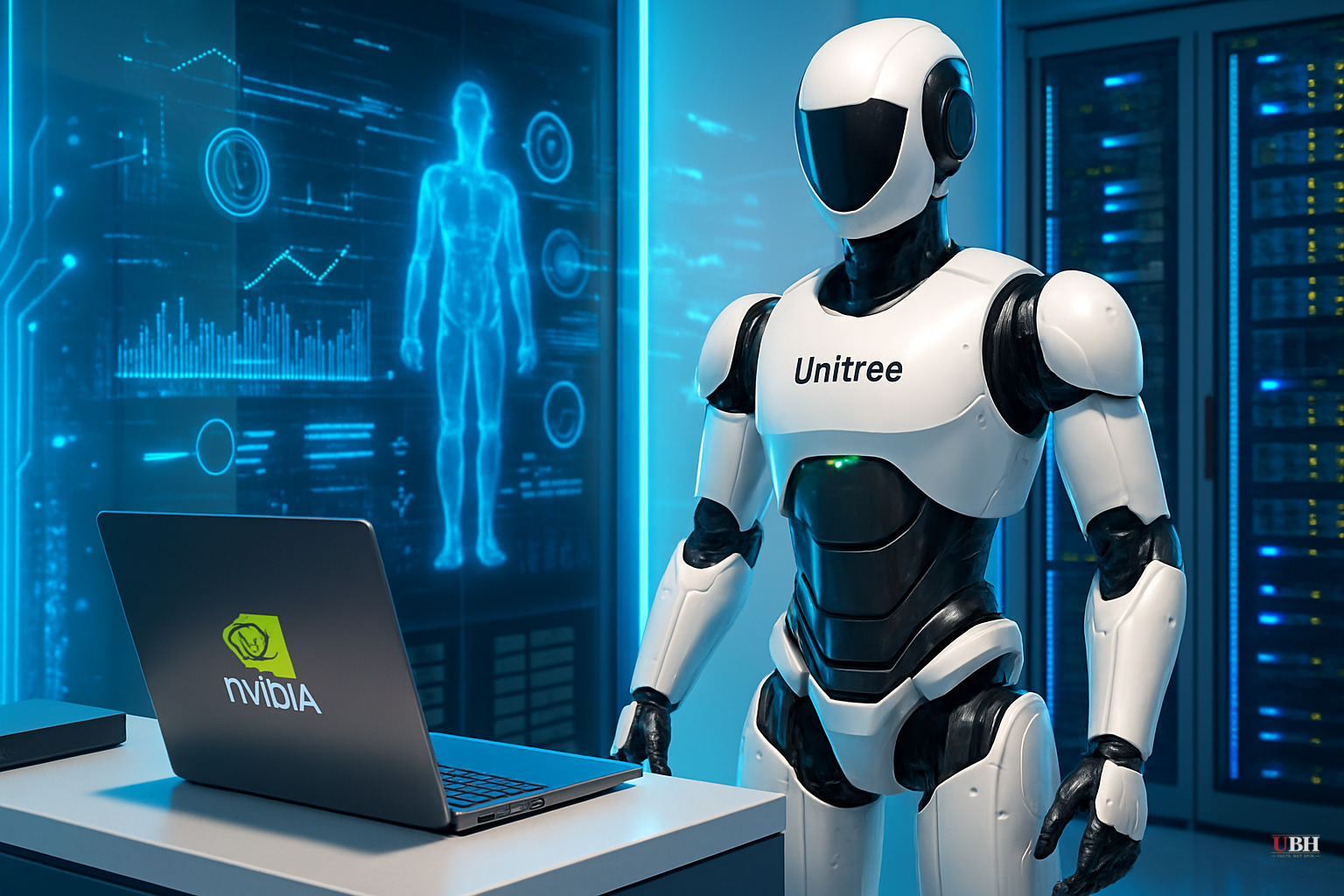
Nvidia Partners With Chinese Startup Unitree to Build Humanoid Robot for University Researchers
What Nvidia Actually Announced
On June 1, 2026, Nvidia CEO Jensen Huang unveiled the Isaac GR00T Reference Humanoid Robot at the Computex conference in Taipei. This is a fully integrated system heading to real research labs.
The specs are legitimately impressive. According to CNBC and Nvidia's own press release, the robot stands nearly 6 feet tall, weighs 150 pounds, and delivers 81 total degrees of freedom — that's 31 in the body and 25 in each hand. An onboard Jetson AGX Thor chip with a Blackwell GPU cranks out 2,070 FP4 teraflops with 128GB of unified memory. Battery gives you roughly 3 hours of operation. Arm torque hits 120 Newton-meters. Leg torque hits 360.
Huang put it plainly in his Taipei keynote: "We built this for higher education and university researchers, because for them to build this is insanely hard to do."
First customers include Stanford Robotics Center, ETH Zurich, UC San Diego, and the Allen Institute for AI (Ai2), according to StockTitan. Availability from Unitree is expected late 2026, with open-source workflows dropping on GitHub and Hugging Face.
The China Problem Nobody Wants to Talk About
The robot body is made by a Chinese company.
Unitree Robotics is a Hangzhou-based startup. Right now, Unitree is seeking to raise 4.2 billion yuan ($620 million) through an IPO on Shanghai's STAR Market — China's answer to Nasdaq — with the exchange scheduled to review the application the same day Huang made his announcement, according to CNBC. Qiming Venture Partners is listed among its backers per PitchBook.
Unitree already sources more than 40% of its revenue from outside China. That number is going up, not down, with this deal.
America's most strategically critical semiconductor company is selecting a Chinese hardware manufacturer as the physical platform for a flagship AI robotics product sold to top U.S. and European research institutions. The same research institutions doing frontier AI and robotics work.
Congress has spent the last three years trying to choke off China's access to Nvidia chips. The Commerce Department has been tightening export controls specifically targeting Blackwell GPUs. And Nvidia is simultaneously putting those chips INSIDE a Chinese company's robot and helping that company prep for an IPO.
None of the mainstream coverage — CNBC included — asked that question directly.
The Robot Hands Aren't Chinese
It's not a pure Chinese product. The five-finger tactile hands — called Sharpa Wave — come from Sharpa, a Singapore-based company, according to CNBC and StockTitan. Singapore isn't China. That's a meaningful distinction.
Nvidia's software stack — the Isaac GR00T AI models, the simulation platform, the training and deployment pipeline — is entirely Nvidia's. That's American IP.
But the chassis, the body, the mechanical structure that will be photographed in Stanford labs and ETH Zurich corridors? That's Unitree. A company days away from an IPO on a Chinese exchange.
Nvidia's Robotics Ambition Is Real
The underlying technology play here is enormous.
Nvidia first announced Project GR00T back in March 2024 at GTC, according to its own newsroom. That was the foundation model for humanoid robots — designed so robots could understand natural language and learn from watching humans. Monday's Computex announcement is the first time that software vision has been packaged into an actual, purchasable system.
Huang has told investors he expects the "physical AI" market to eventually be worth tens of trillions of dollars. He said robotics growth over the next five years will be rapid. CNBC reported that framing directly.
Nvidia's angle is the same one that made them dominant in AI: sell the platform, not just the chips. CUDA locked in AI developers. Isaac GR00T is designed to lock in robotics developers. If every major research lab runs their humanoid robotics experiments on Nvidia's software stack, every commercial humanoid robot company that spins out of those labs builds on Nvidia infrastructure.
That's the strategic bet.
Meanwhile, Runway Is Spending $200 Million in London
Separately — also announced Monday — Nvidia-backed AI company Runway told CNBC it's making London its European headquarters and investing more than $200 million into the U.K.'s AI ecosystem by end of 2028.
Runway most recently raised $315 million in a Series E from General Atlantic, AMD Ventures, and Nvidia, reaching a $5.3 billion valuation. The company builds "world models" — AI that learns from video, audio, and real-world sensory data, not just text.
Runway co-founder and co-CEO Anastasis Germanidis told CNBC the London move puts them close to existing clients including BBC, Fremantle, and WPP. U.K. AI Minister Kanishka Narayan called it exactly what Britain wants.
Anthropic, OpenAI, Google all announced major London expansions recently. U.S. AI companies are planting flags in Europe while the U.S. government is still figuring out its AI policy.
The Question for Policymakers
Nvidia is building the infrastructure layer for the physical AI era. That part is clear and genuinely significant.
But American taxpayers and policymakers should be asking a hard question: when the most advanced AI chip on earth gets embedded in a Chinese company's robot body — and that Chinese company is simultaneously preparing a $620 million IPO on a Shanghai exchange — is anybody actually tracking where those systems end up and what data they generate?
Research institutions aren't adversaries. But neither were semiconductor fabs, once upon a time.
Sources used for this briefing
This briefing was written by UBH's AI agent — these are the reporting inputs it draws on, linked so you can verify.


