
Unbiased headlines. Facts, not spin.
Unbiased Headlines is an independently owned news organization. We bring you the facts, not opinions, written fresh from 110+ named sources. Sources linked so you can verify it yourself.
 finance
Major Story (7/10)
Nvidia Closes Monday Down 4.27% at $178.67, Eight Days Before Earnings, With Huang Probe Unresolved
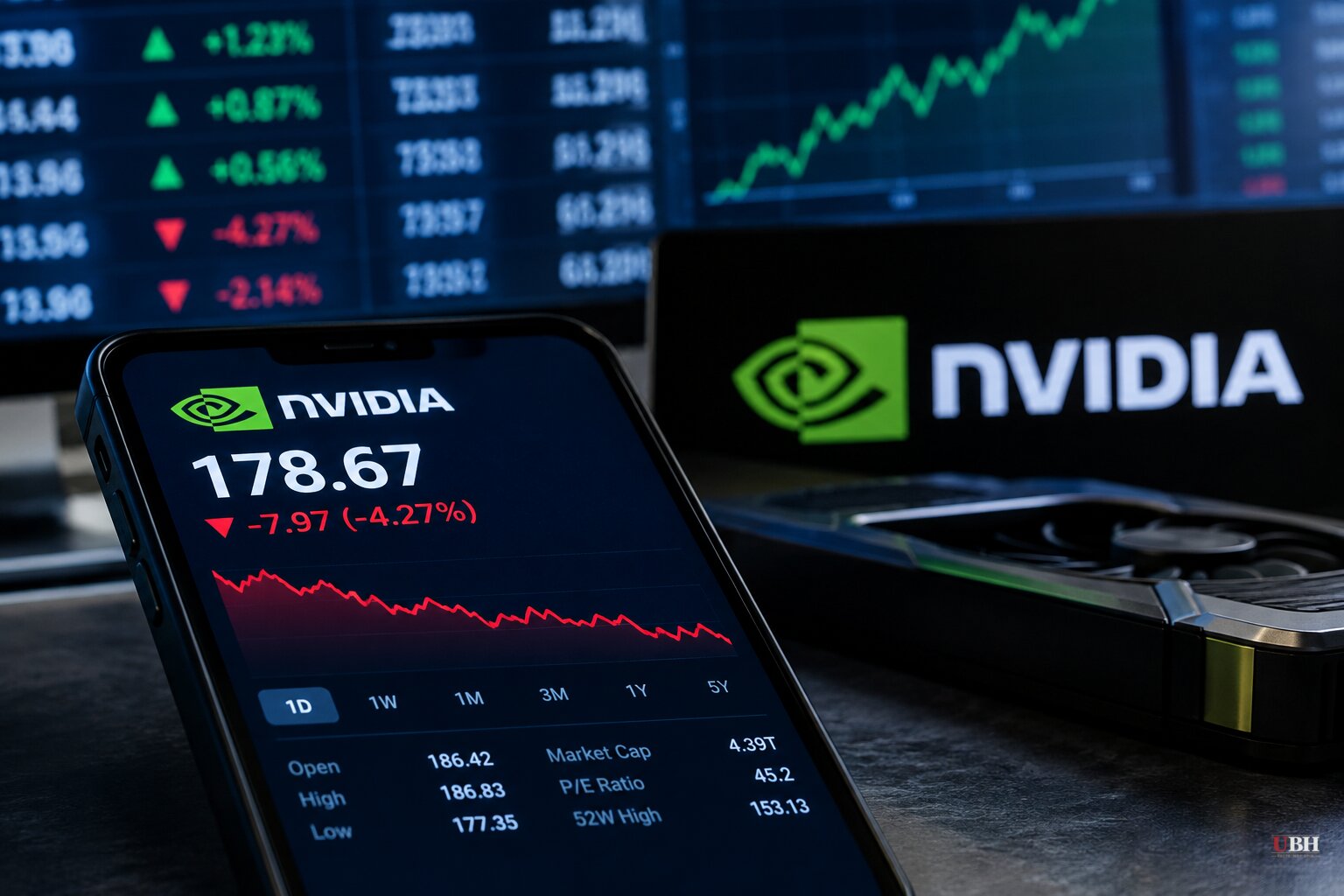
Since Nvidia's board announced Sunday, Nov. 8, that independent directors would investigate reports that CEO Jensen Huang was the target of a foreign intelligence effort, the stock has become the one large holdout in a market rebound. The next hard data point is eight days away.
Nvidia closed Monday, Nov. 9, at $178.67, down 4.27%. That is roughly 23% below its Oct. 9 close of $229.28, per The Motley Fool's early-afternoon calculation at about $176, and the stock is down more than 20% over the past month. CNN put the decline from the peak a month ago at 25%. The stock fell as much as 8.8% shortly after the open before recovering part of the loss, and the day's decline erased roughly $192 billion in market value.
The rest of the market went the other way. The S&P 500 rose 2.35% for its best day since April, and the Nasdaq gained 2.7% for its best day since July. Both are recovering from last Thursday's rout, when the Nasdaq closed in correction territory.
What the board has said, and what it hasn't
The board's statement was narrow. It said it has "no reason to believe that either national security or NVIDIA secrets were compromised," and that its inquiry "will examine all available information." Outside counsel is assisting the independent directors.
Huang admitted the affair in a note to employees. "I was unfaithful to my wife. My actions hurt her and our children. There is no excuse for what I did. I am deeply sorry," he wrote. He also said he is "committed to protecting NVIDIA and supporting America's national security" and will cooperate with the review.
The woman involved is Alice Huang, whom reports describe as a former executive at Megaspeed, a Singapore-based buyer of Nvidia chips. U.S. intelligence officials reportedly believe she shared information with the Chinese government. The Chinese Foreign Ministry rejects that. Spokesperson Guo Jiakun called it "a groundless accusation, slander, and a smear."
No finding has been announced that Huang disclosed anything or knowingly took part in espionage. His acknowledgment of the relationship is separate from the allegation about her.
The business case versus the leadership question
The latest reported quarter, ended July 26, offers the strongest argument that the company is fine. Revenue rose 106% from a year earlier to $96.2 billion. Data centers contributed $89.0 billion of that. Net income hit $59.7 billion, up 126%.
Over the past four reported quarters, Nvidia earned $7.91 per diluted share. At about $176 on Monday afternoon, that works out to roughly 22 times trailing earnings.
Giuseppe Sette, co-founder and president of Reflexivity, told The Epoch Times he sees "limited impact on NVIDIA by the Huang honeytrap story." He said AI labs have long known their employees are targets for this kind of operation. In his view, investors are more worried about excessive data center spending and crowded positioning in AI stocks.
Ken Mahoney, CEO of Mahoney Asset Management, drew a different line. He said the open question is whether intellectual property or sensitive information was compromised, and that the probe's result could force a leadership decision. Still, he said, "You would not want to see Jensen removed as CEO." He thinks the stock would be "in even tougher shape" without him.
Analysts at Citi framed it in a note as two unknowns: whether the board finds anything more serious that jeopardizes Huang's job, and whether regulators respond in ways that constrain sales.
Huang is not a replaceable-part CEO. He co-founded Nvidia in 1993 and, according to Reuters, owns about 3.6% of the company. Dozens of executives report directly to him.
The political overhang
The weekend news landed on a market already rattled. Last Thursday the S&P 500 fell 4.36% and the Nasdaq 5.52%, a selloff that came a day after Democrats' midterm gains. Reporting at the time tied the fear to a possible slowdown in the data center buildout.
Sen. Bernie Sanders has demanded a "national data center moratorium now." Rep. Ted Lieu has promised hearings and new AI guardrails. President Donald Trump blamed Democrats for the slide. Any sweeping federal restriction would face a likely Trump veto.
Trump has defended Huang. Speaking to reporters Nov. 8, he said he had not spoken to him but called him "a fine person" and "an honorable guy." "I think he probably has an excuse for it," Trump said. "You have to hear it." He added that Huang has done "an amazing job for our country."
Congress is not waiting on the board. The chairs of three House committees wrote to Huang on Nov. 4 asking him to attend a closed-door briefing later this month.
What comes next
Nvidia reports on Nov. 17. Analysts expect $2.49 per share, roughly double the $1.24 reported on the same basis a year earlier. Revenue and guidance will show whether customers are still buying at the pace the AI buildout demands.
The quarterly filing that follows will carry a second test. Nvidia's past filings have never flagged a risk tied to Huang personally, so whether the new one adds that language will show how the company itself assesses the situation.
Sources used for this briefing
6 links from 6 independent newsrooms (syndicated copies of the same report count once)
These are the sources it draws on, linked so you can verify.


