
Unbiased headlines. Facts, not spin.
Every story is an unbiased news briefing written from 110+ sources across the spectrum — sources linked so you can verify it yourself.
 finance
Major Story (8/10)
Event date: August 13, 2026
finance
Major Story (8/10)
Event date: August 13, 2026
Nvidia Bets $500 Billion That AI Chips Won't Depreciate. Chinese Hedge Funds Are Betting Against It
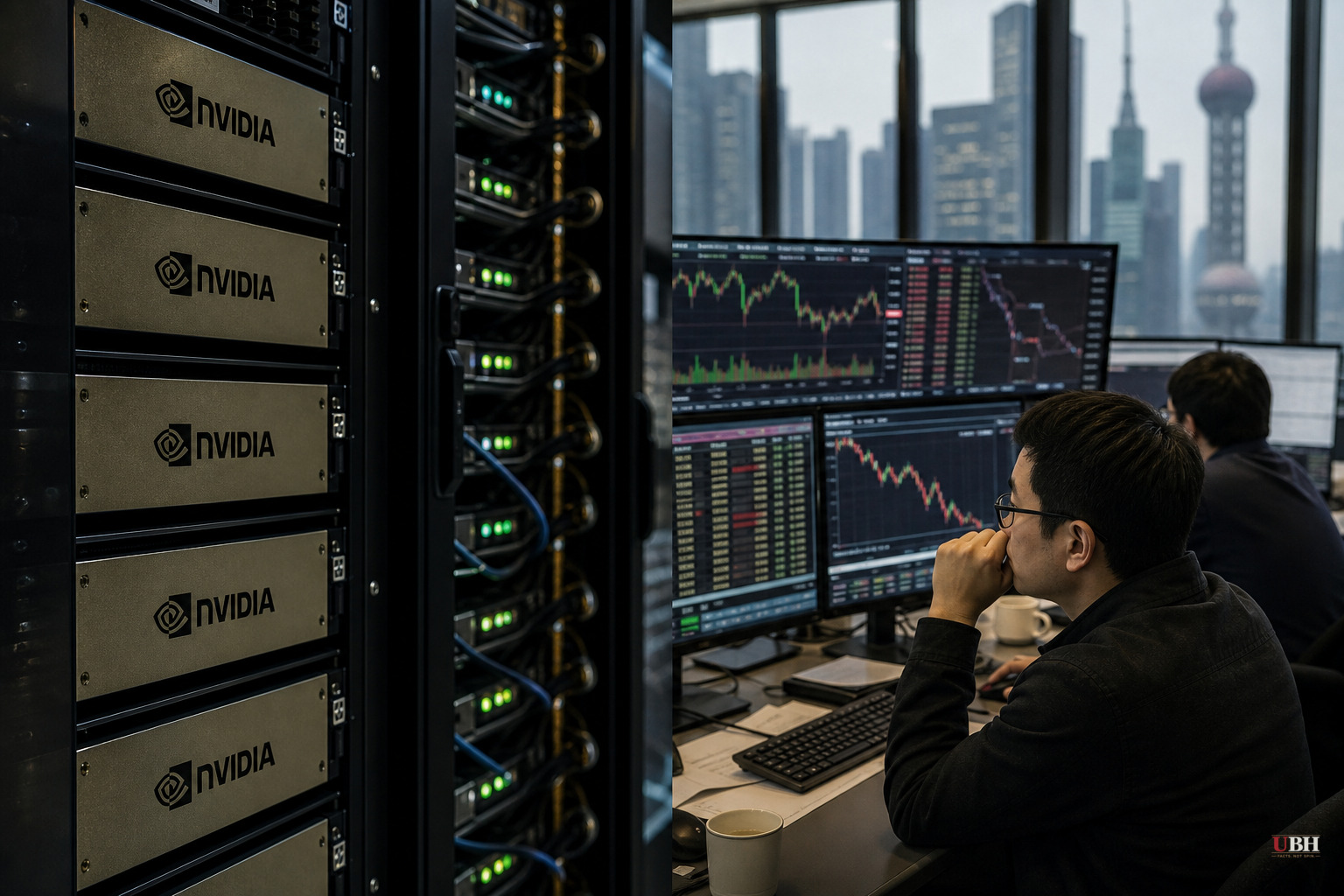
Nvidia wants Wall Street to believe a GPU is basically a toll road. Some of China's sharpest hedge fund managers think the whole AI trade is a bubble that's already starting to pop. Both can't be right, and the next 18 months of financing costs will decide which side wins.
Nvidia announced Monday it signed agreements with six major asset managers, Apollo Global Management, Blackstone, BlackRock, Brookfield Asset Management, Goldman Sachs and KKR, to mobilize more than $500 billion in third-party capital, according to CNBC. The money would help hyperscalers, frontier AI labs and enterprises finance data centers and Nvidia hardware without tapping their own balance sheets.
"This is really the first time that technology chips have become an investable asset class," Nvidia CEO Jensen Huang told CNBC, flanked by the leaders of all six firms. Huang argued GPUs are "productive," "revenue-generating" and "fungible," making them fit for the kind of asset-backed lending usually reserved for buildings, cargo ships or toll roads.
Goldman Sachs CEO David Solomon called it "a pivotal moment of a historic AI investment cycle," according to a joint release covered by Breitbart. BlackRock's Larry Fink and Blackstone's Jon Gray signed on with similar enthusiasm.
The Depreciation Problem Nobody's Solved
Nobody actually knows how fast these chips lose value. CNBC reported that Ben Emons, founder of FedWatch Advisors and a former Pimco portfolio manager who structured asset-backed loans at IndyMac, called depreciation "the one key risk here." Cutting-edge GPUs train frontier models for a few years, then get shuffled off to lower-margin inference work, which directly hits their resale value as loan collateral.
Emons told CNBC the single biggest threat to Nvidia's financing model is China. If Chinese firms ramp domestic chip production and flood the market with cheap silicon, the collateral backing hundreds of billions in loans could erode faster than the debt terms assume. To hedge that risk, Emons estimates investors will demand yields between 11% and 17% depending on where they sit in the capital structure, rates that look nothing like the low, stable returns typical of real estate-backed lending.
Traditional asset-backed loans work because a bank can repossess a building or a ship and sell it in an established secondary market that's existed for decades. There is no such market history for GPUs. Huang is asking lenders to underwrite that history into existence.
China's Hedge Funds Are Already Selling
While Wall Street signs on, two of China's most-watched hedge funds are heading the other direction. Wealspring Asset, managing roughly $1.4 billion, told clients the AI trade has become a "super bubble" whose collapse could arrive sooner than expected, according to Crypto Briefing and the South China Morning Post. Wealspring's founder, Yang Dong, has credibility here: he correctly called the peak of China's stock market in 2007.
Shanghai Banxia Investment Management Center, managing about $294 million, reached a similar conclusion by pointing to slowing revenue growth at Anthropic as evidence the bubble is already deflating.
Both funds have been cutting Nvidia and US hyperscaler exposure, meaning Microsoft, Amazon, Alphabet and Meta, and rotating into data center supply chains further from the spotlight: power systems, liquid cooling, advanced memory, electrical grid infrastructure. Neither fund disclosed specific trade sizes, so the scale of the rotation is unclear.
July 2026 brought steep drawdowns for Chinese hedge funds heavily exposed to AI stocks, with both quantitative and discretionary managers reporting significant losses, according to Crypto Briefing. Some funds cut positions outright; others injected proprietary capital to avoid forced liquidations. Average excess returns for AI-focused hedge funds declined significantly in the first half of 2026, according to industry data cited in that reporting.
The Circular Financing Concern
CNN flagged a structural worry that predates this specific deal: circular financing, where one AI company lends to, invests in, or leases to another company that then buys the first company's products. "Circular financing will end badly," Max Gokhman, head of AI and digital asset solutions at Franklin Templeton, told CNN, comparing it to the arrangements telecom equipment firms used to finance customers before the dot-com crash. Gokhman said he still believes in the AI boom and doesn't think leverage has hit alarming levels yet, but the comparison is a fair one for skeptics to raise.
The strongest case for caution is not that AI technology is fake, but that financing structures built on assumptions nobody has tested—GPU longevity, secondary-market liquidity, non-circular capital flows—are exactly the kind of thing that looks fine until a single input breaks. Peter Earle, senior economist at the American Institute for Economic Research, told The Epoch Times that "history is filled with periods in which transformational technologies attracted more investment than they could profitably absorb in the short run."
Capital expenditure on AI infrastructure jumped from $235 billion in 2024 to a projected $700 billion-plus in 2026, according to The Epoch Times, with Goldman Sachs projecting $4 trillion to $8 trillion in AI capex over the next five years and JPMorgan projecting AI investment will top $5 trillion by 2030. AI-related companies drove roughly three-quarters of the S&P 500's gains over the past year, per JPMorgan Asset Management data cited by The Epoch Times.
Fox News highlighted a separate warning sign in bond markets: commentators Mark Tepper and Darius Dale pointed to surging credit default swaps on hyperscalers including Nvidia, arguing AI's capital appetite is now competing with global sovereign debt demand, a dynamic that has historically preceded market corrections.
No regulator has opened an inquiry into Nvidia's financing structure, and no one is alleging wrongdoing. The open question is whether GPU collateral values hold up under a Chinese price war on chips, and whether Wall Street's 11% to 17% yield demands on this debt are pricing that risk correctly or just guessing.
Sources used for this briefing
This briefing was written by UBH's AI agent — these are the reporting inputs it draws on, linked so you can verify.


