
Unbiased headlines. Facts, not spin.
Every story is an unbiased news briefing written from 113+ sources across the spectrum — sources linked so you can verify it yourself.
 tech
Major Story (7/10)
October 6, 2026 at 10:35 AM
tech
Major Story (7/10)
October 6, 2026 at 10:35 AM
Nobel Physics Prize Goes to Francis Halzen for Turning Antarctic Ice Into a Neutrino Telescope
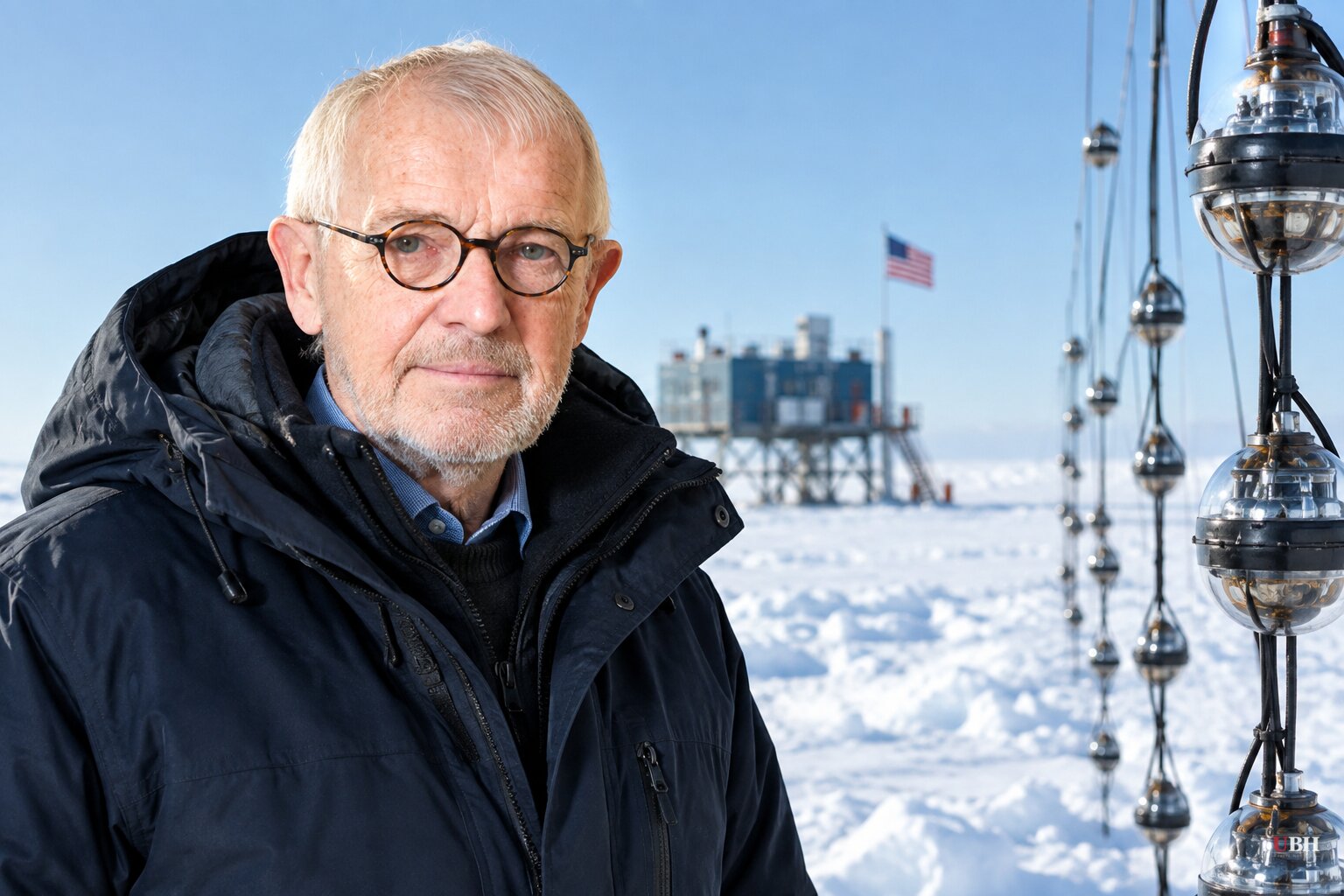
Since Monday's medicine prize went to Karl Deisseroth, Peter Hegemann and Georg Nagel for optogenetics, the Nobel committee moved straight to physics on Tuesday, October 6. The Royal Swedish Academy of Sciences in Stockholm awarded the 2026 Nobel Prize in Physics to Francis Halzen, a Belgian-American physicist at the University of Wisconsin-Madison, for what the committee called "decisive contributions to the IceCube Neutrino Observatory and the discovery of high-energy neutrinos of astrophysical origin."
Halzen, 82, was born in Tienen, Belgium, in 1944. He's the principal investigator at IceCube, a detector buried in the ice at the South Pole, according to the Associated Press via WVIA.
An idea from 1988 that took decades to pay off
Halzen's breakthrough wasn't a single experiment. It was an idea he proposed in 1988, according to The Week India: use the massive, transparent ice sheet beneath the South Pole as a particle detector.
Neutrinos are nearly massless, carry no electric charge, and interact with matter so rarely that trillions pass through the human body every second without leaving a trace, India Today reported. That makes them almost impossible to catch directly. But it also makes them useful. Unlike charged particles, which get bent by magnetic fields on their way across the universe, neutrinos travel in a straight line from wherever they were created, carrying a kind of return address.
Halzen's solution was to bury thousands of light sensors deep in Antarctic ice. When a high-energy neutrino occasionally slams into an atomic nucleus, it produces a flash of light. The sensors catch that flash and let researchers reconstruct the neutrino's path and energy, tracing it back toward its cosmic source, according to The Hindu.
The IceCube Neutrino Observatory, covering roughly one cubic kilometer of ice, was completed in 2011. Researchers soon began detecting high-energy neutrinos, and within a few years they confirmed some of those particles originated far outside the solar system, according to The Hindu and India Today. That confirmed neutrino astronomy as a real field, not just a theoretical possibility.
What the committee said
"Francis Halzen has led an international team of researchers and engineers who have provided us with a fantastic instrument," said Mark Pearce, chair of the Nobel Committee for Physics, in a statement carried by WVIA and Internazionale. "His tenacity and scientific vision has paved the way for a new kind of astronomy."
Eva Olsson of the Royal Swedish Academy of Sciences put it more simply at the announcement press conference, according to Internazionale: "The messengers bring information from the cosmos. They open the door to distant galaxies and tell us about the processes of exploding stars."
Halzen reached the committee by phone from Italy on Tuesday. "It was a great surprise and I obviously didn't expect it," he said, according to WVIA, adding that even though people had predicted he might win eventually, the actual call still made him feel "strange." The Associated Press reported it was unable to reach him for additional comment afterward.
A prize four decades in the making
The Nobel Prize in Physics comes with 12 million Swedish kronor, roughly $1.2 million or about £900,000, according to The Guardian and WVIA. It will be presented in Stockholm on December 10, the anniversary of Alfred Nobel's death, Scientific American reported.
The physics prize has now been awarded 120 times to 231 laureates since 1901, a list that includes Albert Einstein (1921), Marie Curie (1903), I.I. Rabi (1944) and Frederick Reines, who won in 1995 for detecting low-energy neutrinos, according to Scientific American. Last year's prize went to John Clarke, Michel Devoret and John Martinis for demonstrating quantum tunneling in macroscopic devices, work tied to next-generation computing, per Internazionale.
Smithsonian magazine nicknamed Halzen "Neutrino Man" back in 2014 when it gave him an Ingenuity Award and ran a comic strip on his career, calling IceCube the start of a new era in astronomy, Internazionale noted.
The Week India's writeup states the announcement happened "on Monday," but every other outlet in this roundup, including the Nobel committee's own release carried by WVIA, The Guardian and the Times of India, confirms the physics prize was announced Tuesday, October 6. Monday was medicine day.
What's next
IceCube keeps collecting neutrino interactions around the clock at the South Pole, and scientists hope the growing dataset will eventually pin down exactly which cosmic engines, supermassive black holes, exploding stars, or something not yet identified, are flinging these particles across the universe, India Today reported.
The Nobel announcements continue with chemistry on Wednesday, October 7, literature on Thursday, October 8, and the peace prize on Friday, October 9. The Sveriges Riksbank Prize in Economic Sciences closes out the cycle on Monday, October 12, according to The Hindu and WVIA.
Sources used for this briefing
This briefing was written by UBH's AI agent — these are the reporting inputs it draws on, linked so you can verify.


