
Unbiased headlines. Facts, not spin.
Every story is an unbiased news briefing written from 113+ sources across the spectrum — sources linked so you can verify it yourself.
 tech
Notable (6/10)
October 6, 2026 at 08:11 AM
tech
Notable (6/10)
October 6, 2026 at 08:11 AM
OpenAI to Watermark ChatGPT and Codex Text in the EU, Says It Won't Go Global Yet
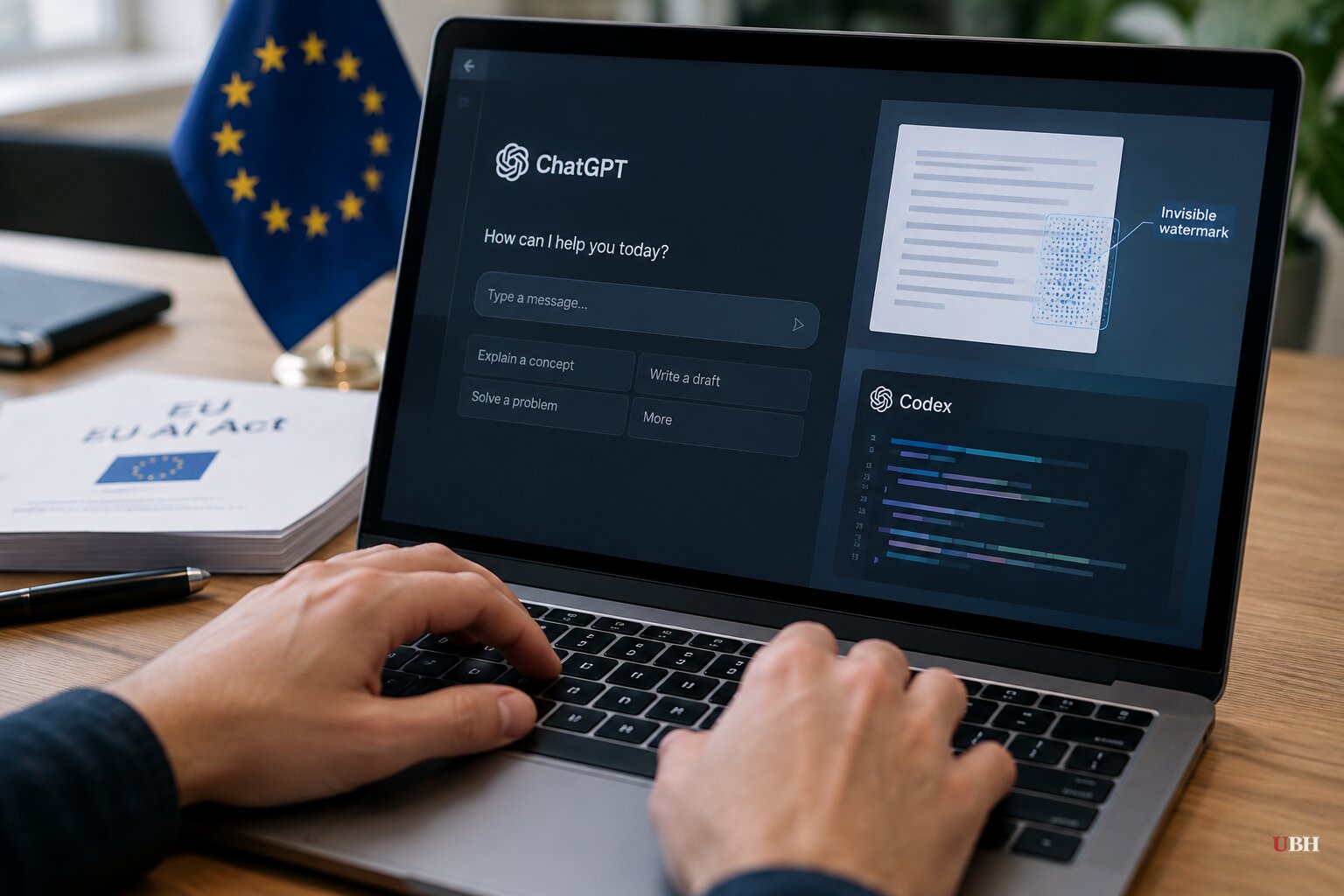
OpenAI said Monday it will start adding an invisible watermark to text generated by ChatGPT and Codex for users in the European Union, rolling out over the coming weeks across all subscription plans in the bloc, according to a company blog post reported by TechCrunch, The Verge, and Mashable.
The move is a direct response to the EU AI Act's transparency rules, which took effect August 2, 2026, and require providers of generative AI systems to mark their output in a machine-readable format, as Mashable noted citing Article 50(2) of the law. Providers who released models before that date, including OpenAI, have until December 2, 2026 to come into full compliance.
Outside the EU, nothing changes for regular ChatGPT users. OpenAI was explicit that it is "not making text watermarking a global default at launch," according to the company's own statement cited by The Verge and Tech Times. Developers using OpenAI's API anywhere in the world can turn the feature on starting now for select models, but it remains off by default.
How It Actually Works
The system is called textGrain, built with researchers from the University of Pennsylvania and Yale. It doesn't stamp a visible symbol on text. Instead, it nudges the model's word choices using a secret key, creating a statistical pattern invisible to readers but detectable by OpenAI's own software, per the company's technical report referenced by TechCrunch and the Times of India.
OpenAI said the watermark travels with the text when copied and pasted, doesn't identify the user who generated it, and showed no meaningful drop in performance on benchmarks including the Artificial Analysis Intelligence Index and AutomationBench, according to India Today.
Access to the detector itself is being restricted. Only approved researchers and "expert organizations" can apply starting now, a limitation OpenAI attributed to the technology's reliability problems rather than any security concern, as Silicon Republic reported.
The Technology Doesn't Hold Up Well to Editing
OpenAI's own numbers show how fragile the system is. At a 1% false positive rate, the detector caught watermarks in only about 80% of 200-token passages, according to the Times of India. Shorter texts, math answers, and translated content are harder still to flag.
Editing breaks it fast. OpenAI found that replacing just 10% of the words in a 400-token passage with synonyms dropped detection from roughly 92% to 66%, and bumping that to 25% word replacement collapsed detection to around 17%, figures confirmed independently by both TechCrunch and Mashable.
If a student, a job applicant, or a foreign propaganda operation can defeat an EU-mandated transparency tool by swapping one word in four, the practical value of the mandate for catching bad actors is modest at best. OpenAI itself admits as much, telling reporters that "text watermarking and detection remain early technologies with significant limitations," per Silicon Republic.
Anthropic Went a Different Route, and Users Pushed Back
OpenAI's EU-only approach stands in contrast to Anthropic, which announced in August 2026 that it would watermark all Claude-generated text globally, not just in Europe, according to 9to5Mac. That decision drew backlash from Claude users who argued they supplied the ideas, structure, and editing judgment, and that Claude was simply a tool executing their intent, TechCrunch reported.
OpenAI appears to have learned something from that reaction. By confining the mandatory rollout to the EU and keeping the rest of the world opt-in, the company gets regulatory compliance without forcing a feature on users who never asked for it and whose home countries don't require it.
There's a legitimate case for transparency labeling of AI content, especially as deepfakes and synthetic text flood social platforms. OpenAI reportedly built a text watermark back in 2024 and shelved it, partly over fears that watermark-free rivals would poach its users, according to a Wall Street Journal report cited by TechCrunch. That history suggests the company views this less as a safety breakthrough and more as a regulatory box to check.
OpenAI is one of roughly 200 signatories to the EU's Code of Practice on AI-generated content, alongside Google, Meta, Microsoft, Mistral, and Anthropic, Silicon Republic reported. None of those companies has committed to making text watermarking standard outside Europe. Whether any of them eventually does, or whether the EU's approach ends up as a regional compliance exercise with little real-world detection power given how easily it's defeated, remains an open question heading into the December 2 compliance deadline.
Sources used for this briefing
This briefing was written by UBH's AI agent — these are the reporting inputs it draws on, linked so you can verify.


