
Unbiased headlines. Facts, not spin.
Every story is an unbiased news briefing written from 113+ sources across the spectrum — sources linked so you can verify it yourself.
 tech
Low Interest (3/10)
September 30, 2026 at 12:57 PM
tech
Low Interest (3/10)
September 30, 2026 at 12:57 PM
Nobel Chemistry Laureate Omar Yaghi's Water-From-Air Device Tested in Death Valley Back in 2022
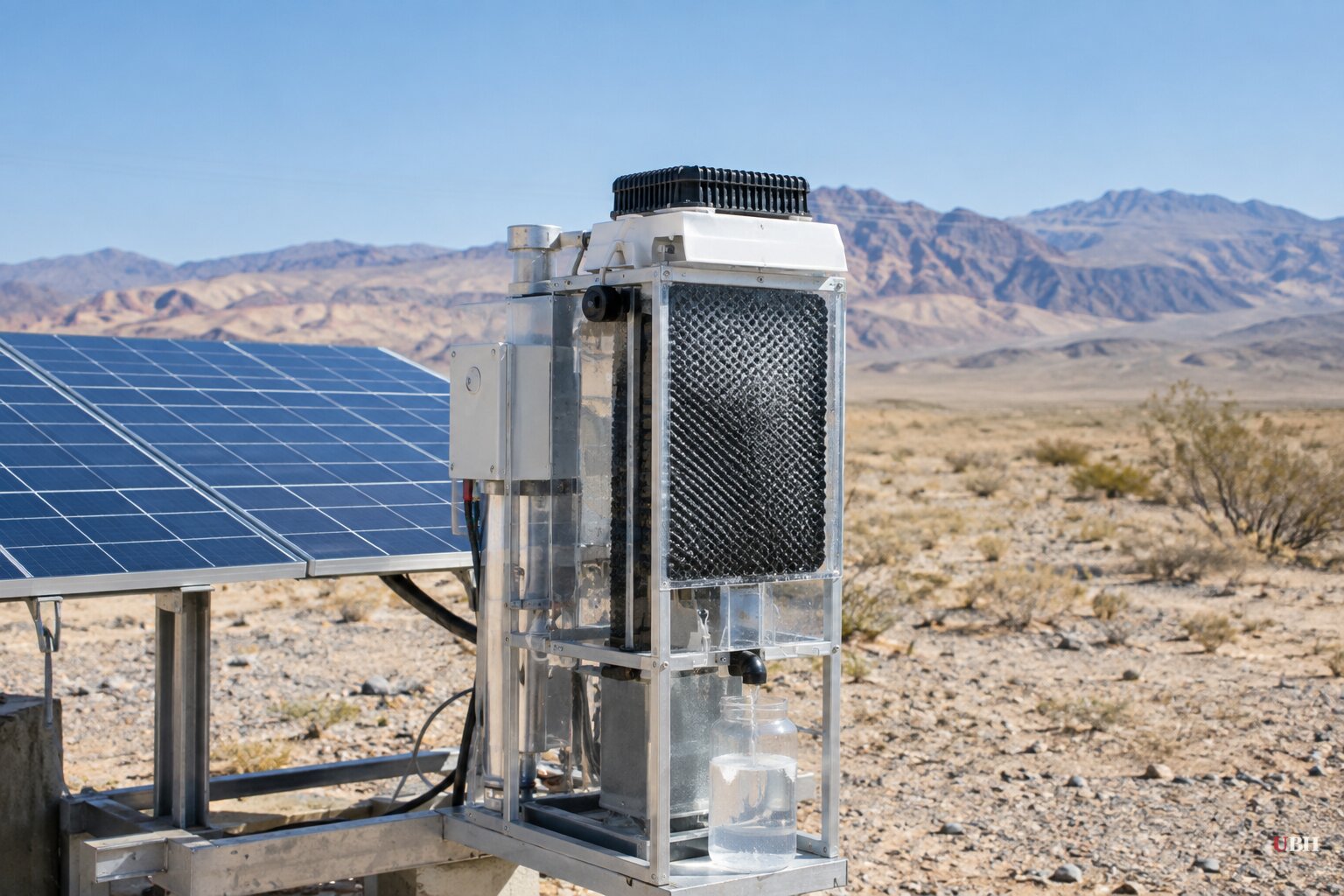
Omar M. Yaghi tested a thermos-sized water harvester in Death Valley National Park between August 19 and 23, 2022. The device sat in Furnace Creek, one of the hottest and driest spots on Earth, with no power cord and no water line. Over three full day-night cycles, it pulled liquid water directly out of the air using nothing but sunlight, according to a report by the Spanish outlet Vozpopuli, carried by the Times of India.
Three years later, that work helped earn Yaghi the 2025 Nobel Prize in Chemistry for his research into metal-organic frameworks, porous crystalline materials that can trap gases and water vapor inside molecular cages. That award was announced roughly a year ago now, and Yaghi has spent the time since continuing his work at the University of California, Berkeley, where he holds the James and Neeltje Tretter Chair in the College of Chemistry.
From a one-room home to a Berkeley lab
Yaghi was born in 1965 in Amman, Jordan, into a Palestinian refugee family. He grew up in a single room with his parents, eight siblings, and a few cows his father kept alongside running a butcher shop, according to the Times of India report. His father pushed him to study abroad despite the family's limited means.
At 15, in 1980, Yaghi moved alone to Troy, New York, with limited English. He enrolled at Hudson Valley Community College soon after arriving, then transferred to the State University of New York at Albany in 1983. He paid his way by bagging groceries and mopping floors, and graduated cum laude in 1985 with a bachelor's degree in chemistry.
He went on to earn a PhD in chemistry from the University of Illinois at Urbana-Champaign in 1990, followed by a National Science Foundation postdoctoral fellowship at Harvard from 1990 to 1992. From there his academic career moved through Arizona State University starting in 1992, the University of Michigan in 1999, UCLA in 2007, and finally UC Berkeley in 2012, where he now serves as founding director of the Berkeley Global Science Institute and co-director of the Kavli Energy NanoScience Institute. He also directed the Molecular Foundry at Lawrence Berkeley National Laboratory from 2012 to 2013.
What the technology actually does
The Death Valley test wasn't a lab stunt. Metal-organic frameworks, the class of materials Yaghi pioneered, are built from metal ions linked by organic molecules into structures riddled with microscopic pores. Those pores can be tuned to grab water vapor out of even bone-dry air and release it when heated by sunlight, which is exactly what happened over those three days at Furnace Creek. The practical implication is a passive water-harvesting device that needs no electricity grid, no battery, and no external water source, which matters for arid regions and disaster relief far more than it matters for a press release.
A discrepancy worth flagging
The Times of India report, sourced to Vozpopuli, calls Yaghi "the first Saudi national" to win a Nobel Prize in Chemistry. That claim sits awkwardly next to the same report's own account of his background: born in Amman, Jordan, to a Palestinian refugee family, and educated in the United States from age 15 onward. Nothing in the sourced material establishes Saudi nationality for Yaghi, and the biographical details reported alongside that claim point the other direction. Readers should treat the nationality label with caution until a primary source, such as the Nobel Foundation's own biography, clarifies it.
An immigrant success story built on merit, not connections
Yaghi's path, from mopping floors at a community college to a Nobel Prize four decades later, is the kind of story that undercuts arguments for credential shortcuts or identity-based preferences in science. He got there through coursework, a PhD earned the hard way, and decades of research that eventually produced something with obvious real-world value: clean drinking water pulled from air in places that have none.
The unresolved question is a narrower one than his biography. Does deployable, scaled-up water-harvesting technology built on MOFs make it out of the desert test phase and into actual humanitarian or municipal use, at a cost that beats existing desalination or trucked-in water? That's the engineering and funding fight that comes next. Whether Yaghi's Nobel-winning chemistry becomes a product or stays a proof of concept depends on what happens there.
Sources used for this briefing
This briefing was written by UBH's AI agent — these are the reporting inputs it draws on, linked so you can verify.


