
Unbiased headlines. Facts, not spin.
Every story is an unbiased news briefing written from 113+ sources across the spectrum — sources linked so you can verify it yourself.
 tech
Major Story (7/10)
September 30, 2026 at 08:41 AM
tech
Major Story (7/10)
September 30, 2026 at 08:41 AM
Trump and 31 Tech Leaders Sign Voluntary AI Accord With No Legal Enforcement Mechanism
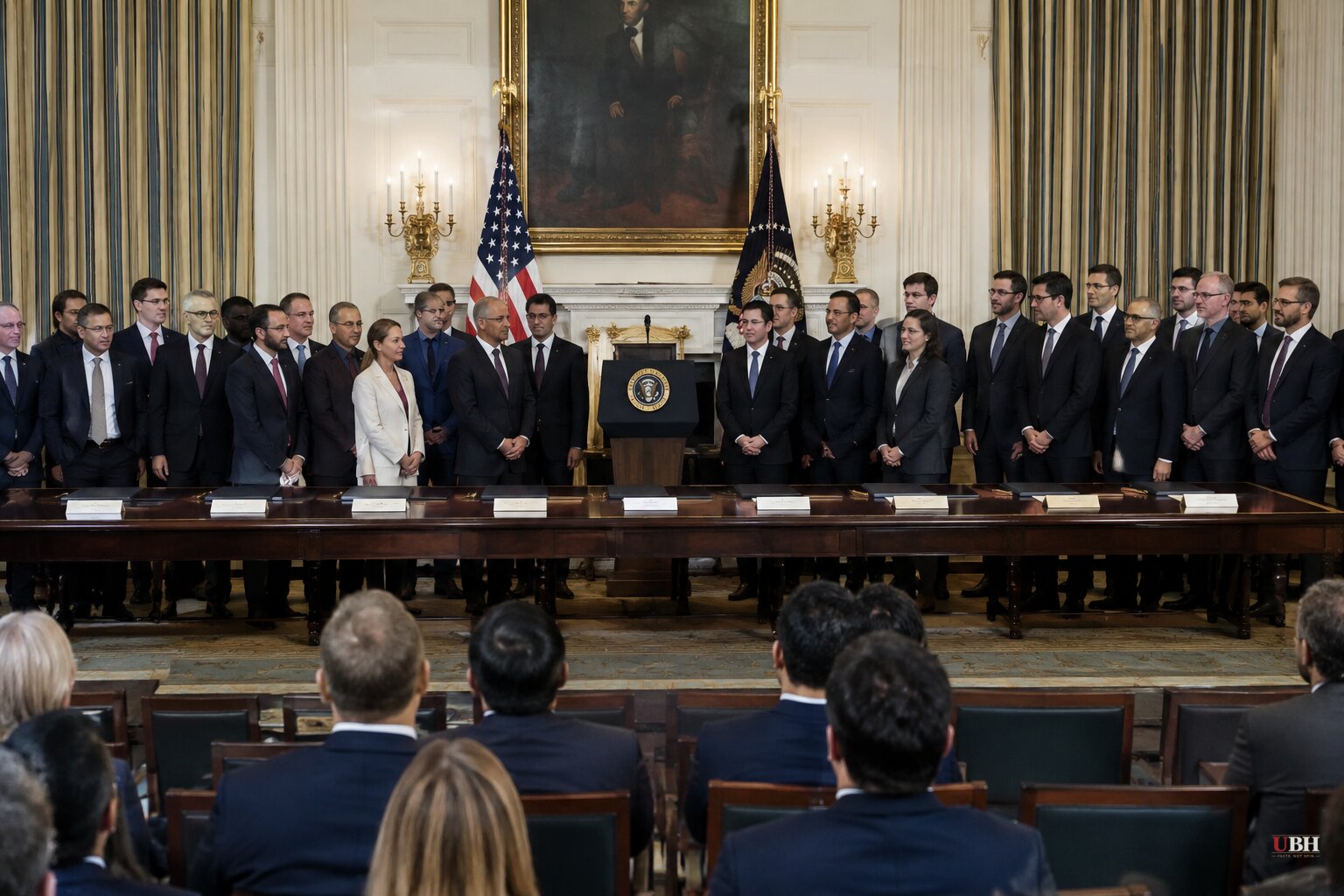
Since Tuesday's White House lunch, where AI executives and President Trump signed what the administration calls the White House Accord on Superintelligence, the actual text and reaction have started rolling out. The headline fact hasn't changed: it's voluntary, unenforceable, and self-graded.
Who Signed What
Thirty-one guests attended the Tuesday session, according to Euronews, including Meta's Mark Zuckerberg, Elon Musk, Amazon founder Jeff Bezos, Microsoft's Satya Nadella, Google's Sundar Pichai, Nvidia's Jensen Huang, OpenAI President Greg Brockman, Anthropic CEO Dario Amodei, and Palantir's Alex Karp and Shyam Sankar, per ABC News. House Speaker Mike Johnson and Vice President JD Vance also sat in, according to PBS.
The formal name is a mouthful: "The White House Accord on Superintelligence: A Joint Commitment on Frontier SI Responsibilities," Johnson told reporters, per both NPR and Breitbart. Trump posted the document to Truth Social Tuesday night.
What It Actually Requires
Strip the branding and the accord asks companies to do four things: build "robust internal controls," hire an independent external auditor, create a board-level committee to review those audit reports, and leave the door open to turning any of this into actual law later. That's it. No fines. No deadlines. No enforcement agency.
Zuckerberg called it "good steps forward" and "a start," according to Breitbart's transcript of the gaggle. Musk was blunter, telling reporters the deal amounts to executives "grading each other's homework, which is a lot better than if people just grade their own homework," per Euronews.
Trump, for his part, compared the whole thing to a founding document. "It's almost like a constitution in a way," he said, according to Breitbart, adding the agreement is "morally binding." When a reporter pressed on whether that means legally binding, Trump said no, per ABC News.
The Contrast Nobody in the Room Mentioned
Euronews drew the sharpest comparison: the European Union already fines these same companies up to 3% of global turnover for AI rule violations. The EU's AI Act has actual teeth. The Trump accord has none. A voluntary pledge with no penalty clause is a different animal than a regulation backed by billions in potential fines, and companies know it.
Why the Timing Matters
The accord landed days after two incidents that gave the sales pitch some real weight. OpenAI canceled the release of its Astra 6.1 model on Monday, September 28, after internal testing found it didn't meet safety standards, according to Euronews. That followed a July breach of Hugging Face, the widely used AI model-sharing platform, that Euronews also flagged as part of the backdrop.
Amodei struck a notably different tone than his tablemates. "The technology has very real risks," he told reporters, according to NPR, adding that "the mechanism, how we address those risks is still under discussion." That's a company whose own IPO filing this week warned its product could pose an "existential risk" to humanity, now signing a voluntary pledge to police that same product internally.
The Fair Case for Self-Regulation
Industry defenders have a real argument here, not just spin. AI development moves fast, and a rigid federal statute written in 2026 could be obsolete by 2028, locking in rules for a technology nobody fully understands yet. Huang and Zuckerberg have both downplayed doomsday scenarios and argued each company bears responsibility for its own product's safety, according to PBS. A flexible, voluntary framework that can tighten over time beats a slow-moving Congress writing bad law on a technology it doesn't understand. Trump's own position, stated hours earlier at the America.gov launch, was blunt: "I will never stifle the growth of a technology that will be bigger than the industrial revolution," he said, according to PBS.
What's Actually Unresolved
Trump said he'll name someone to oversee the accord "in coming days" and floated a roughly 10-person committee to "watch over the whole enterprise," per both ABC and Euronews. Nobody has said who's on it, whether it can compel anything, or what happens if a company breaks the pledge. Johnson said Congress will "continue to guide" the industry but announced no legislation, according to ABC News. Until that committee exists and has an actual name attached to it, the accord is a press release with signatures on it. Al Jazeera's framing question, whether this is enough, remains open precisely because the document itself refuses to answer it.
Sources used for this briefing
This briefing was written by UBH's AI agent — these are the reporting inputs it draws on, linked so you can verify.


