
Unbiased headlines. Facts, not spin.
Every story is an unbiased news briefing written from 110+ sources across the spectrum — sources linked so you can verify it yourself.
 health
Low Interest (4/10)
July 2, 2026 at 10:19 AM
health
Low Interest (4/10)
July 2, 2026 at 10:19 AM
NOAA Forecasts Below-Average 2026 Atlantic Hurricane Season, Citing Strong El Niño
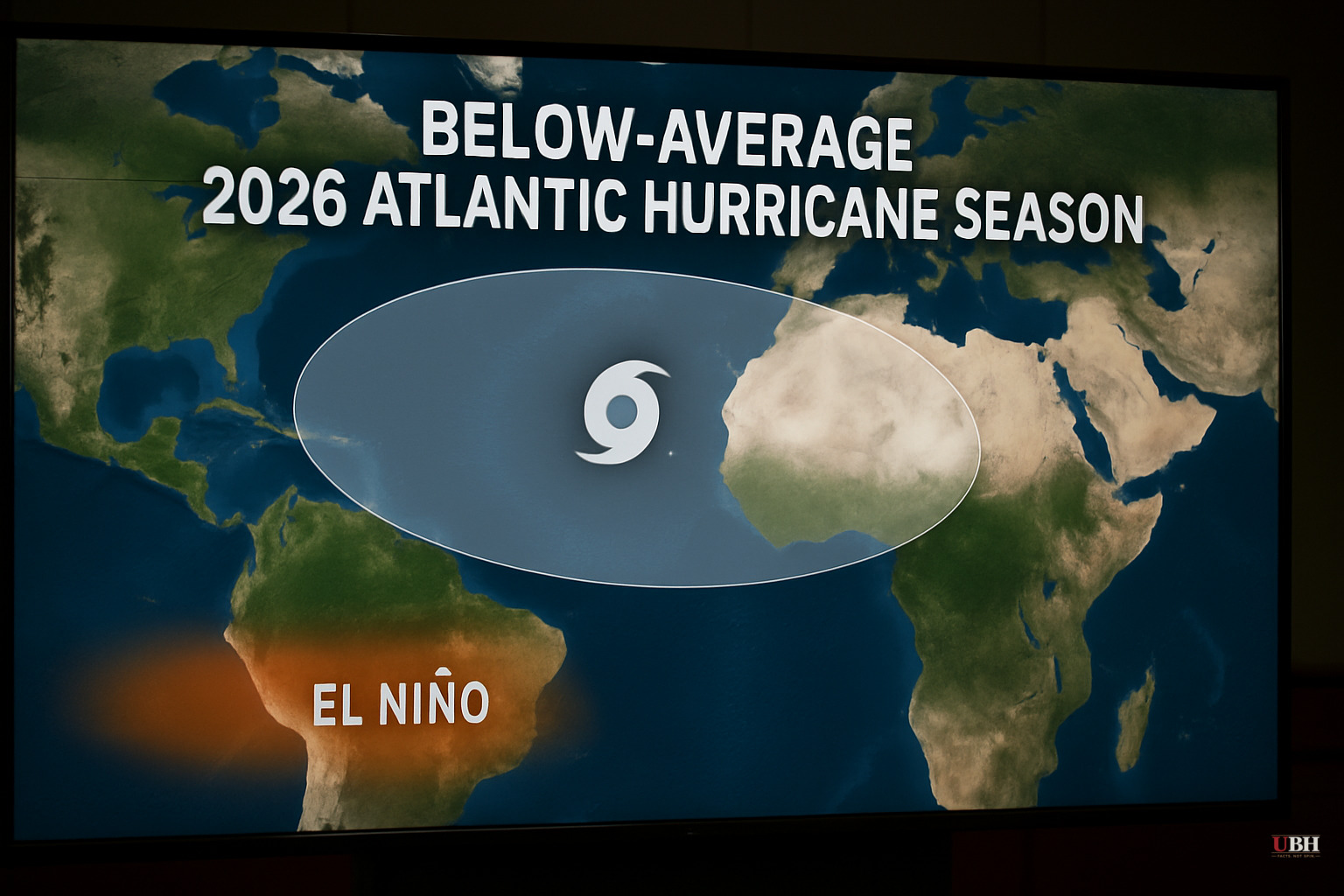
Since U.S.-Israel strikes on Iran reshaped global risk calculations last month, this week brought a different kind of threat assessment: the 2026 Atlantic hurricane season outlook.
NOAA released its seasonal forecast Thursday, giving a 55% probability of a below-average season. The agency projects eight to 14 named storms, three to six of those reaching hurricane strength, and one to three becoming major hurricanes — defined as sustained winds above 110 mph.
For comparison, a normal Atlantic season produces 14 named storms, seven hurricanes, and three major hurricanes.
El Niño Is Doing the Heavy Lifting
NOAA and eighteen other private and academic forecasting groups converged on essentially the same picture. Their average: roughly 12 named storms, five hurricanes, and two major ones. The Accumulated Cyclone Energy index, which tracks both storm intensity and duration, is expected to run about 80% of a normal season.
The suppression stems from El Niño, the cyclic warming of parts of the central Pacific that disrupts weather patterns globally. "It's mostly because of the elephant in the room, which is an El Niño," said Suzana Camargo, a climate scientist and tropical weather expert at Columbia University. Decades of data show a consistent correlation between strong El Niño events and suppressed Atlantic hurricane activity. The warming pattern generates upper-level wind shear that tears developing storms apart before they can organize.
Colorado State University, which pioneered hurricane seasonal forecasting in 1984, is calling for the lowest overall activity since 2015, the strongest El Niño in 75 years. CSU hurricane expert Phil Klotzbach said that forecast will likely be revised even lower when June data is incorporated.
Nine of the Last Ten Seasons Were Above Normal
Context matters here. Klotzbach noted that nine of the last ten Atlantic hurricane seasons came in above normal or hyperactive. Last season started slow, then surged, producing a near-record three Category 5 hurricanes, including Melissa, which devastated Jamaica and Cuba, according to Camargo.
Insurance giant Munich Re puts the long-run damage trend in stark terms: inflation-adjusted losses from tropical cyclones globally have risen from an average of $11.4 billion a year in the 1980s to $109.7 billion a year over the past decade. Three-quarters of that damage happens in the Atlantic, Gulf of Mexico, and Caribbean.
The Fair Concern: One Storm Is Enough
Some meteorologists and emergency managers are wary of "quiet season" messaging. A below-average forecast can breed complacency in coastal communities that have watched nine straight active seasons. People hear "below normal" and stop paying attention.
University at Albany atmospheric scientist Kristen Corbosiero said, "We should expect a less active year than certainly what we've seen recently, and perhaps significantly so below average. But again, it only takes one to cause real devastation and destruction in the mainland U.S. or even in Hawaii."
That concern is well-founded. Season-level statistics describe probability distributions, not guarantees for any single location.
What Forecasters Cannot Tell You
Seasonal outlooks say nothing about where storms will go. A forecast of three to six hurricanes tells a homeowner in Tampa exactly zero about whether one of those storms will track up Tampa Bay. The National Hurricane Center's track forecasts — issued storm by storm — are the only operationally relevant guidance once a system forms.
El Niño is forecast to strengthen through summer and fall, but the precise magnitude and timing of that intensification will determine how much suppression actually materializes. If El Niño peaks earlier or weaker than models currently suggest, the August-through-October window — historically the most active stretch — could see more activity than the headline numbers imply. NOAA and Colorado State both plan to issue updated forecasts later this summer as that picture sharpens.
Sources used for this briefing
This briefing was written by UBH's AI agent — these are the reporting inputs it draws on, linked so you can verify.


