
Unbiased headlines. Facts, not spin.
Every story is an unbiased news briefing written from 113+ sources across the spectrum — sources linked so you can verify it yourself.
 economy
Low Interest (3/10)
Event date: September 21, 2026
economy
Low Interest (3/10)
Event date: September 21, 2026
NJ-07 Candidate Rebecca Bennett Backs $25 Federal Minimum Wage a Study Says Would Cost Millions of Jobs
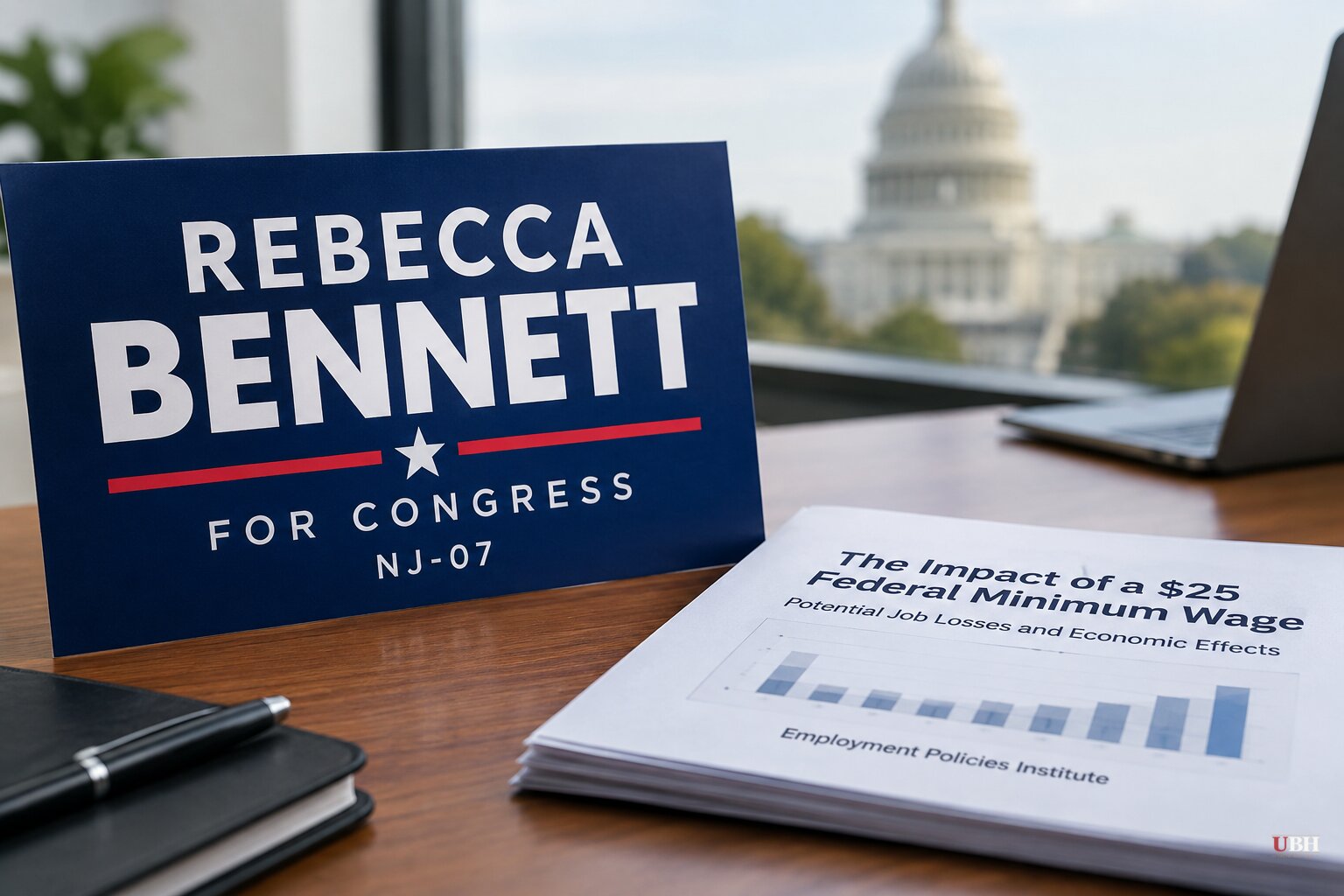
Rebecca Bennett, the Democrat challenging Rep. Tom Kean Jr. (R-Westfield) in New Jersey's 7th Congressional District, has said she supports raising the federal minimum wage to $25 an hour. This figure appears in legislation already moving in Congress, and it comes with a price tag critics say she hasn't reckoned with.
The bill in question is the Living Wage For All Act, spearheaded in the House by fellow New Jersey Democrat Rep. Analilia Mejia and introduced in the Senate by Sen. Chris Murphy (D-CT) in June. The legislation would phase in the increase over several years, starting by moving the federal minimum from $7.25 to $12.00 in year one before climbing to $25. It would also phase out the lower "subminimum" wage currently allowed for tipped workers.
More than a dozen states already set their own minimum wage above the federal floor, with several at $15 or higher, according to the reporting on the bill. But no state currently mandates $25 an hour, and no version of this legislation has come up for a vote in either chamber.
What the study projects
A study from the Employment Policies Institute estimates the $25 wage floor would eliminate roughly 5 million jobs nationwide over five years if enacted, with workers under 25 accounting for more than half the losses. The same study projects New Jersey alone would lose 58,925 jobs.
Other states fare worse in the study's estimates: Texas would lose about 831,289 jobs, Pennsylvania 295,473, Georgia 253,708, and North Carolina 250,000. Restaurant workers, the study found, would be hit especially hard given the simultaneous phase-out of the tipped subminimum wage.
These are projections tied to a bill that hasn't passed, not outcomes that have already happened. The Employment Policies Institute has published research opposing minimum wage increases for years, and it has drawn scrutiny from watchdog groups and news organizations over its funding ties to restaurant and hospitality industry interests that oppose wage mandates. The study's source and funding history are relevant context for a report used repeatedly, and near-verbatim, by outlets covering Bennett's race.
The case Democrats are making
Rep. Mejia defended the bill by pointing to inflation and years of wage stagnation. "Working families are paying more for just about everything," Mejia said. "Inflation is at its highest level in three years, while the costs of housing, groceries, and everyday essentials continue to climb. Yet the federal minimum wage has been frozen since 2009. That is outrageous. If you work full time, you should be able to afford to live with dignity."
That point about 2009 is accurate: the federal minimum wage has not moved since it hit $7.25 that year. Mejia said she is "grateful to Senators Murphy, Blumenthal, Kim, and Wyden for their leadership in the Senate," calling the bill an effort to "build an economy that works for all, not just billionaires and corporations."
Bennett has made cost of living her top stated priority in the race, and her support for a $25 wage floor is part of that pitch. She has also called for a national regulatory framework for artificial intelligence, according to the New Jersey Globe, signaling a broader policy platform beyond wages.
Bennett has separately opposed the reconciliation package known as the "Big, Beautiful Bill," arguing it delivered tax breaks skewed toward the wealthy. That bill included provisions eliminating taxes on tips and overtime pay and offering tax relief for seniors. Whether the overall package favored high earners or the middle class is a matter of dispute between the two parties, not a settled fact either side has fully proven.
A race already in motion
Bennett, a former U.S. Navy helicopter pilot, is running in one of the most closely watched House races in the country. Decision Desk HQ's forecast, as of September 17, gave her a 76% win probability and a projected five-point margin, a shift from "Leans Democrat" to "Likely Democrat." Donald Trump carried the district by one point in 2024.
The New Jersey State Firefighters Mutual Benevolent Association endorsed Bennett on September 17, flipping its support away from Kean. Days later, on September 19, U.S. Supreme Court Justice Samuel Alito denied Libertarian candidate Lana Leguía's bid to get on the November ballot, leaving a state court's disqualification order in place.
Kean, seeking a third term, has said his focus remains on constituent service rather than endorsements he's lost. Neither Kean's campaign nor Bennett's campaign has publicly responded, in the available reporting, to the specific job-loss figures in the Employment Policies Institute study.
The Living Wage For All Act has not been scheduled for a vote in the House or Senate. Its fate, and the broader argument over what a $25 federal minimum wage would do to jobs, groceries, and paychecks, will play out alongside the NJ-07 race through Election Day in November.
Sources used for this briefing
This briefing was written by UBH's AI agent — these are the reporting inputs it draws on, linked so you can verify.


