
Unbiased headlines. Facts, not spin.
Every story is an unbiased news briefing written from 110+ sources across the spectrum — sources linked so you can verify it yourself.
 finance
Notable (6/10)
June 23, 2026 at 12:18 AM
finance
Notable (6/10)
June 23, 2026 at 12:18 AM
Nine of 18 Fed Officials Now Project a 2026 Rate Hike as Warsh's Market-First Framework Takes Hold
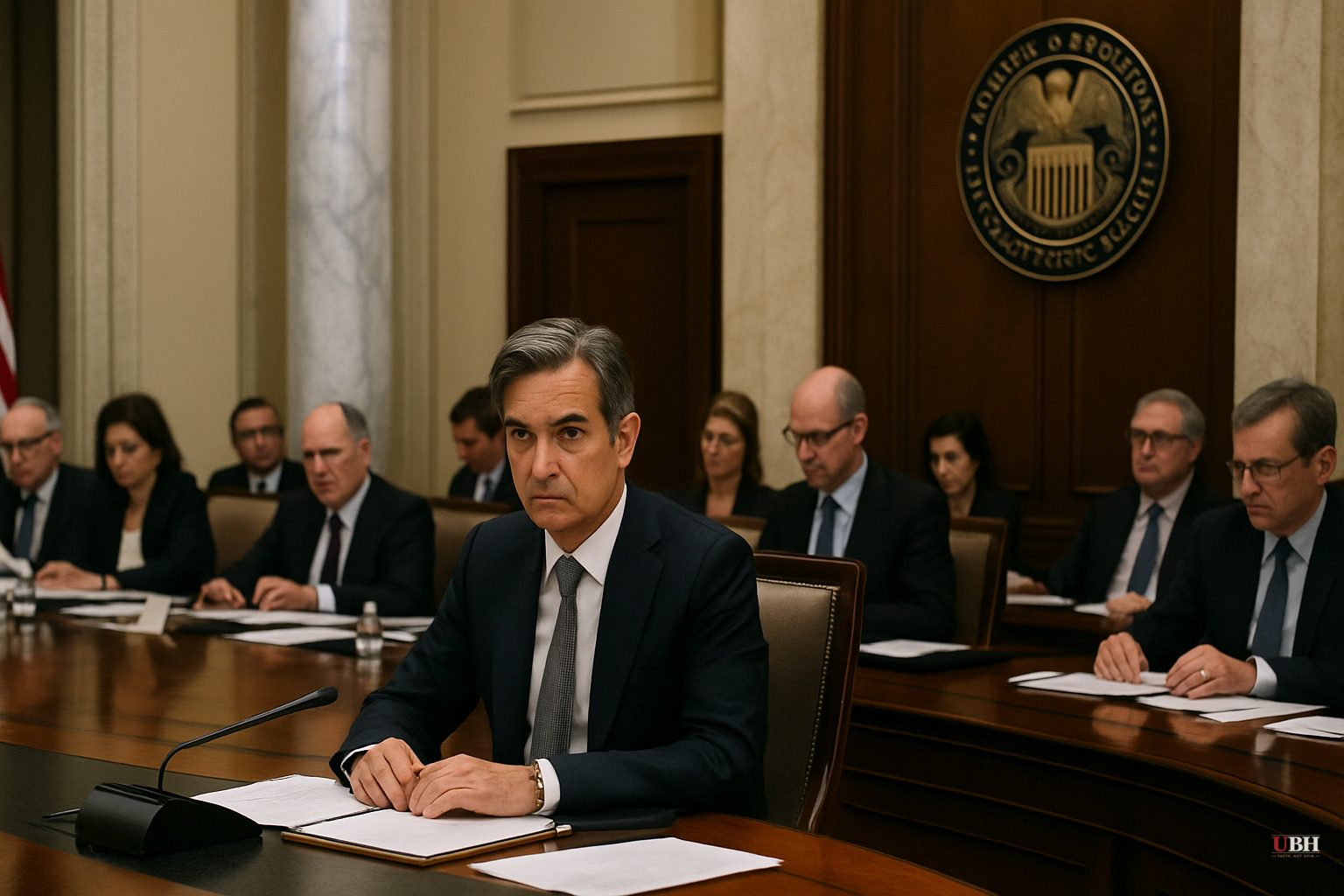
Since our June 20 coverage of Warsh's trimmed 132-word policy statement, a clearer picture of what his framework actually means for markets has emerged from the details of the June FOMC meeting.
The Dot Plot Says More Than the Statement Did
The rate hold was unanimous: 3.50% to 3.75%, unchanged, according to J.P. Morgan Wealth Management's post-meeting analysis published June 18. Nobody fought that.
What moved markets was the Summary of Economic Projections. Nine of the 18 FOMC participants now project at least one rate hike in 2026, according to Morningstar's MarketWatch coverage published June 20. Unemployment forecasts were revised down. Inflation forecasts were revised up. That combination tells you the committee thinks the economy is running hotter than it expected.
Warsh himself submitted no dot. He offered zero personal rate projections, according to Chase's analysis. That is not modesty. It is a deliberate statement about how he sees the chair's role. He is not trying to lead markets to a predetermined destination.
What's Driving the Inflation Numbers
The May Consumer Price Index came in at 4.2% year-over-year, according to Chase. The driver is energy: oil and gas prices spiked starting in March with the onset of the Iran conflict. Core CPI, which strips out food and energy, was 2.9% year-over-year and 0.2% month-over-month in May. That's still above target, but declining on a monthly basis from April's reading.
J.P. Morgan Wealth Management Chief Investment Strategist Phil Camporeale put it directly: "The one-time supply shock from oil prices that drove up inflation in the spring will gradually dissipate in coming months, leaving the Fed on hold for the remainder of the year."
That is a reasonable base case. It is also a bet that the Iran conflict does not escalate further. If energy stays elevated, the nine officials projecting a hike have a stronger argument.
What Warsh Actually Wants Markets to Do
The philosophy behind the framework is worth understanding on its own terms, not just as a style change. Wil Stith, Senior Bond Portfolio Manager at Wilmington Trust, explained it to The WealthAdvisor in coverage published June 18: Warsh wants market prices to reflect what investors actually think about the economy, not what investors think the Fed is about to signal.
"He wants financial markets to help policymakers understand what investors are seeing without shaping those views through constant signaling," Stith said. "The objective is to obtain a cleaner read on risk, economic weakness, and inflation pressures rather than having market pricing heavily influenced by what the Fed has already communicated."
Two decades of increasingly explicit forward guidance created a feedback loop: the Fed signaled, markets priced the signal, the Fed read market prices as independent confirmation, and repeated. Warsh is trying to break that circularity. Morningstar noted that explicit guidance mattered most when rates were near zero and the risk was premature tightening. That is not the current environment. With inflation the primary concern, higher rate volatility is an acceptable cost if it produces more honest price signals.
The Legitimate Concern About Less Guidance
Critics are not wrong to raise a flag here. Krishna Guha, Head of Central Bank Strategy at Evercore ISI, was cited in The WealthAdvisor coverage questioning whether markets are currently repricing on economic fundamentals or simply recalibrating to a more hawkish Fed posture. Those are different things, and the distinction matters.
If markets are just guessing at Warsh's next move rather than reading real economic conditions, the framework achieves the opposite of what he intends. More volatility around data releases could tighten financial conditions faster than the underlying economy warrants, potentially doing the Fed's work for it or overdoing it. The Morningstar analysis also flagged an important asymmetry: implicit guidance did not disappear. The statement stressed price stability without equally emphasizing the full employment mandate. That is a signal, even if it is not a forecast.
Moreover, Morningstar noted that Warsh has not abandoned risk management, nor can he. The intellectual work of weighing downside scenarios does not go away just because the press conference gets shorter.
What Has Actually Changed and What Hasn't
What changed: the statement is shorter, the easing bias is gone, the chair submitted no personal rate projection, and markets were told explicitly to do more of their own work.
What has not changed: the federal funds rate, the committee's legal mandate, or the underlying inflation and employment data the Fed must respond to.
For investors, Morningstar's practical point is that the focus now shifts back to macro data releases—CPI, PCE, payrolls—rather than parsing Fed language for hints. Larger market reactions to those releases are a likely consequence of the new regime, not a malfunction of it.
The unresolved question heading into the second half of 2026: if the Iran conflict de-escalates and energy prices fall, does core inflation's downward monthly trend continue enough to keep those nine rate-hike dots from becoming a reality? The Fed's next scheduled meeting will give a clearer read on whether this is a committee waiting to hold steady or one building toward action.
Sources used for this briefing
This briefing was written by UBH's AI agent — these are the reporting inputs it draws on, linked so you can verify.


