
Unbiased headlines. Facts, not spin.
Unbiased Headlines is an independently owned news organization. We bring you the facts, not opinions, written fresh from 110+ named sources. Sources linked so you can verify it yourself.
 politics
Breaking / Critical (9/10)
Event date: October 20, 2026 ·
Nine Days Before Midterms, DOJ Charges 28 in California and Sues Over Alaska Senate Certification
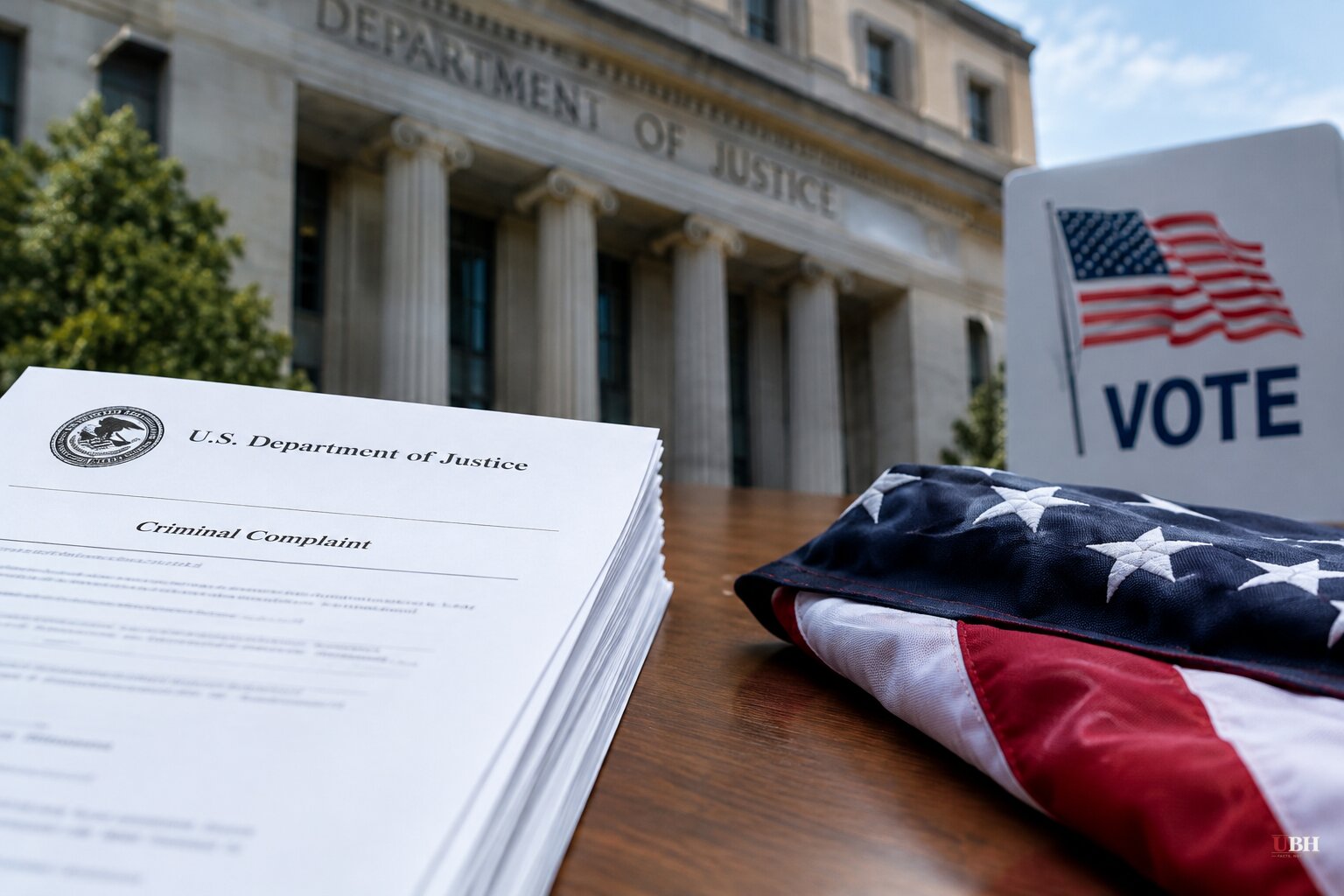
The Justice Department is spending the final stretch before the midterms doing something it has traditionally avoided: bringing politically charged election cases in public, with cameras present.
Here is the timeline so far.
The California arrests
On Oct. 13, DOJ gave California Secretary of State Shirley Weber a list of 20,000 registered voters it says are ineligible to vote based on federal records. The Guardian reports the department gave the state 48 hours to check their citizenship. California did not comply, and DOJ sued.
On Monday, Oct. 19, DOJ announced 28 arrests across the state under the banner "Operation Protect the Vote." All were foreign nationals or permanent green card holders. The charges are fraudulent voter registration and false statements in a naturalization application.
"Each of the 28 defendants charged today appears on the list of more than 20,000 likely noncitizen registrants we provided to California election officials last week," Acting Deputy Attorney General Trent McCotter said. "California refused to look at that list." He added that California "must verify the citizenship of those more than 20,000 registrants before mail-in ballots are counted."
A DHS spokesperson said ICE and Homeland Security Investigations are "actively rooting out and investigating" alleged voter fraud. "ONLY Americans should elect American leaders," the spokesperson said. The spokesperson also told CyberScoop that DHS's internal list contains more than 190,000 registered California voters alleged to be "potential noncitizens," and that the 20,000 referenced by DOJ is a subset that has gone through manual verification so far.
Those are charges, not convictions. Voting as a noncitizen in a federal election is a federal crime with a penalty of up to one year in prison, a fine, or both. Falsely claiming citizenship to register or vote carries up to five years.
What the defendants say
The Los Angeles Times spoke with several defendants and relatives at the downtown federal courthouse. Ana Domínguez, 60, a lawful permanent resident from El Salvador living in Long Beach, is accused of fraudulently registering to vote in July 2006 and lying about it in naturalization paperwork in March 2026. She told the paper she has no memory of registering.
Another man accused of the same crimes said the same: he was not aware of ever registering to vote. A third defendant, Omar Muñoz, 72, a lawful permanent resident from Belize, was arrested at his home in Commerce. His daughter, Lliani Orantes, said the family is trying to determine whether he was confused with younger relatives of the same name, including a U.S.-born son who is a registered voter.
Those are the defendants' and families' accounts, and they have not been tested in court.
Alaska, Michigan and the certification fight
The most aggressive move came in Alaska. DOJ filed a preemptive suit seeking to delay certification of the state's U.S. Senate result if the Democrat wins. Democracy Docket reports that Trump said he personally ordered the suit. The race is between incumbent Republican Sen. Dan Sullivan, Democrat Mary Peltola and a separate candidate named Daniel J. Sullivan.
Alaska's Supreme Court has already ruled that the second Sullivan belongs on the ballot, and the state's ranked-choice system lets voters rank both candidates, according to Axios.
DOJ has also asked a federal court to stop California from counting thousands of votes. It has inserted itself into a dispute over how Michigan runs its election. Democracy Docket reports that the administration threatened to prosecute election officials in all of California's 58 counties if they do not segregate ballots.
Asked Thursday whether more lawsuits are coming, Blanche said, "There's a number of states that we're looking at." He would not say whether they would come before Election Day. He also declined to rule out a DOJ attempt to block states from certifying results. "It is not DOJ's intention to — and it's never our intention to — improperly interfere with elections or the state confirmation process or certification process," Blanche said. "But, you know, to say that there's no circumstances that we would ever do that, of course I'm not going to say that."
The enforcement numbers
DOJ's own tally, first reported by Fox News Digital, shows 64 foreign nationals charged with unlawful voting across 17 states. Minnesota leads with 11, followed by Pennsylvania with 10, Texas with 9 and Louisiana with 5. The department says 104 people have been charged with voting-fraud-related offenses since Trump returned to office in 2025.
A DOJ spokesperson said: "Voting by noncitizens and other ineligible voters is a federal crime, and the department will enforce the law whether a case involves one illegal ballot or hundreds." The spokesperson pointed to the 2020 Iowa 2nd District race, decided by six votes.
DOJ told Axios its California actions concern alleged misconduct in previous elections. A DOJ official told the Guardian that no rule or policy bars these steps. Axios notes the department has long observed an informal 60- or 90-day period of heightened caution before elections, with no blanket prohibition.
The other side of the argument
Critics argue the timing is the problem. Stacey Young, a former DOJ attorney who now leads Justice Connection, said that for decades the department avoided investigative steps that might influence an election. She said this administration "pushed those experts out of the department" and now directs employees seeking guidance to political appointees loyal to the president.
UCLA law professor Richard Hasen said DOJ's stated goal is enforcing the federal ban on noncitizen voting, but that he believes the real aim is to project an image of widespread voter fraud.
On the numbers, KQED's host pointed to Nevada. The administration claimed 16,000 noncitizen voters there, later sent a list of 185 names, and state officials said all 185 were citizens. CyberScoop notes that Trump has repeatedly failed to prove widespread noncitizen voting in court, and that there is no credible evidence of widespread voter fraud in U.S. elections.
Voter-roll accuracy is a legitimate, mainstream concern, and a list of 20,000 registrants is not nothing. But the dispute is over verification methods and timing, not whether noncitizens may vote.
Other actions
Federal agents raided the DC home of Rep. Ilhan Omar, D-Minn., on Monday. The Guardian reports it was part of an immigration fraud investigation and an apparent push to try to denaturalize her. Democracy Docket reports that federal immigration agents have gone door to door questioning people about whether they registered or voted. DOJ is preparing to dispatch roughly 1,000 election monitors across all 50 states. The Guardian reports Blanche has hit the campaign trail to stump for Republican candidates.
A federal judge in Northern California blocked DHS from carrying out field operations to uncover voter fraud in nine states, according to KQED's Oct. 22 program.
The open question is certification. The Alaska suit is pending, Blanche has not ruled out more, and the first state results are only days away.
Sources used for this briefing
7 links from 7 independent newsrooms (syndicated copies of the same report count once)
These are the sources it draws on, linked so you can verify.


