
Unbiased headlines. Facts, not spin.
Every story is an unbiased news briefing written from 110+ sources across the spectrum — sources linked so you can verify it yourself.
 health
Notable (6/10)
July 6, 2026 at 05:00 PM
health
Notable (6/10)
July 6, 2026 at 05:00 PM
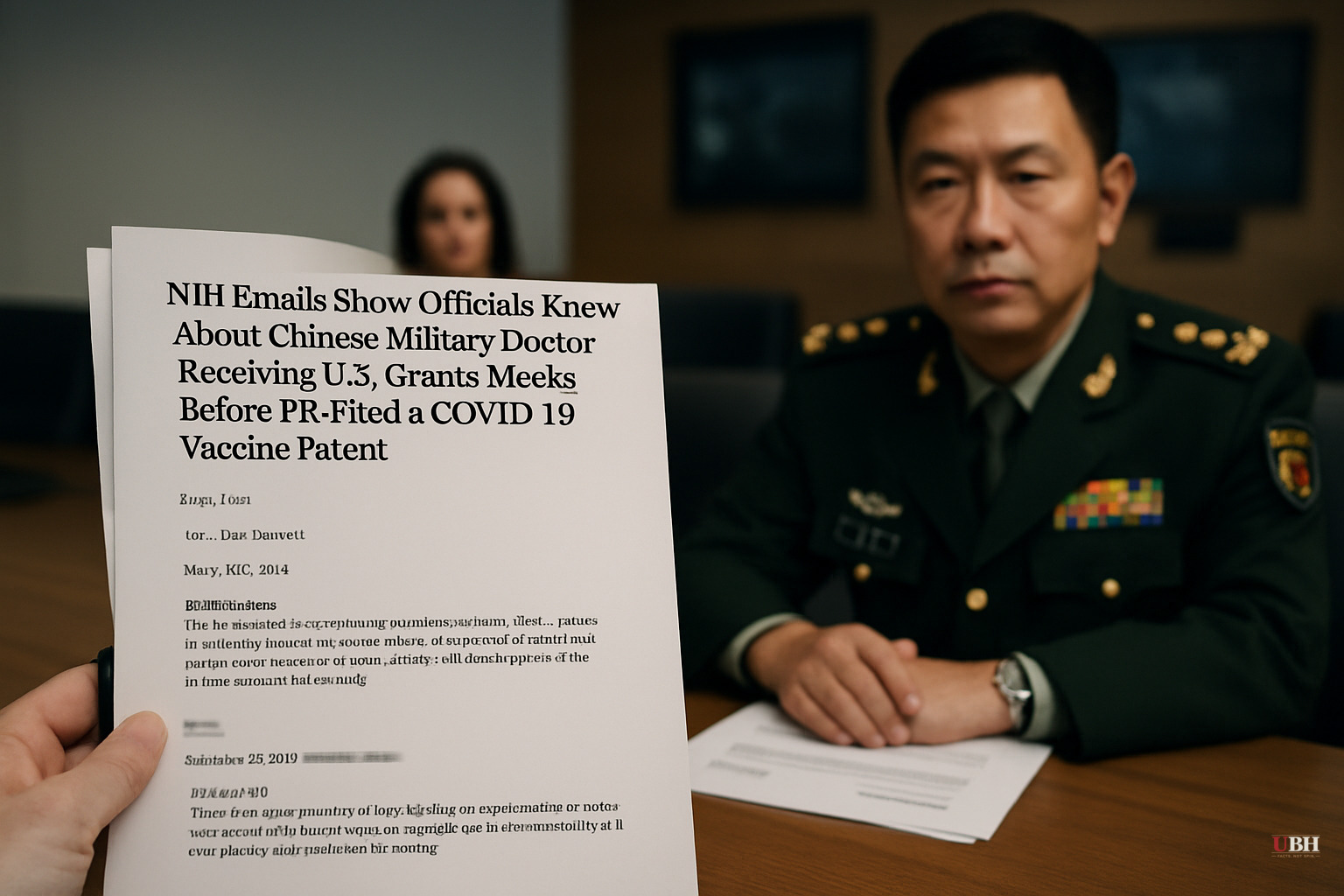
NIH Emails Show Officials Knew About Chinese Military Doctor Receiving U.S. Grants Weeks Before He Filed a COVID-19 Vaccine Patent
What the Emails Show
On February 3, 2020, NIH researcher Ping Chen sent an internal email alerting colleagues that U.S.-funded grants shared a Chinese collaborator: Dr. Zhou Yusen, a researcher at the Beijing Institute of Microbiology and Epidemiology, an institution under China's Academy of Military Medical Sciences (AMMS). The AMMS is associated with the People's Liberation Army.
Chen wrote that Zhou's "expertise and resources in China include his skills in developing animal models for viruses, such as Zika, and then successfully applying the models to evaluate therapeutics." NIH officials were actively reviewing the grants at the time.
Zhou later applied for a patent on a COVID-19 vaccine. He subsequently died under circumstances described as unusual, though the precise cause has not been publicly confirmed.
The Grant Trail
According to the NIH's own records, one NIAID grant to Zhou and his research team for studying Middle East respiratory syndrome coronavirus (MERS-CoV) was issued in January 2019. Another appears to date back to 2013. A third was awarded in 2021, after COVID-19 had already spread globally.
The Academy of Military Medical Sciences, which oversaw Zhou's work, had a documented relationship with the Wuhan Institute of Virology.
The emails, 145 pages in total, were obtained by the Oversight Project, a conservative watchdog group. They were first reported by the Daily Signal.
Fauci's Answer at a 2024 Hearing
At a June 2024 House Oversight Select Subcommittee on the Coronavirus Pandemic hearing, then-Subcommittee Chairman Brad Wenstrup, R-Ohio, asked former NIAID Director Anthony Fauci directly: "Does it concern you that U.S. taxpayer dollars would be going to someone who's a high-ranking Chinese PLA official?"
After some back-and-forth, Fauci replied: "I don't even know the person you're talking about."
That answer is now harder to square with the internal communications. Chen's February 2020 email was addressed to NIH colleagues within the same institutional structure Fauci ran. Whether the emails reached Fauci specifically, and when, has not been publicly established by the documents.
The Declassified DNI Documents
This story sits inside a broader timeline. Earlier this year, then-outgoing Director of National Intelligence Tulsi Gabbard released newly declassified documents alleging that Fauci and other NIH and NIAID officials worked with an intelligence agency to shape public narratives about COVID-19 and its origins, according to the Daily Signal's reporting on those disclosures. Those documents are separate from the emails discussed here.
The combination of grant emails flagging a PLA-linked researcher, a vaccine patent filed weeks later, and the DNI declassification is generating renewed attention more than five years after COVID-19 emerged.
The Strongest Counterargument
Scientific collaboration with foreign researchers, including those affiliated with state institutions, is standard practice in federally funded research. Critics of the scrutiny on Zhou argue that AMMS affiliation does not automatically mean the research was militarized or that any U.S. grant constituted a national security risk. International co-authorship and data-sharing on infectious diseases, including coronaviruses, has long been considered a public health asset. Under this view, Chen's emails were routine administrative vetting, not evidence of a cover-up.
Vetting is the system working. The problem is what happened after the vetting: grants continued, and at least one was issued as recently as 2021. Whether U.S. officials weighed the PLA connection against the scientific value, and documented that analysis, is a question these emails don't fully answer.
What Isn't Proven
No investigation has been announced and no charges have been filed against any U.S. official related to these grants. The emails establish that NIH staff were aware of Zhou's PLA affiliation before his vaccine patent application. They do not prove that anyone in the U.S. government knew Zhou would seek a COVID-19-related patent, nor do they prove Fauci personally reviewed the Chen emails.
Whether the grant approvals violated any law or policy is an open question the documents, as described, do not resolve.
What Comes Next
The Oversight Project has released 145 pages of emails. The unresolved question is whether any congressional committee will subpoena NIH for the full grant authorization trail on Zhou's awards, specifically the 2021 grant issued after COVID had already killed hundreds of thousands of Americans, and whether any official who reviewed and approved continued funding to a PLA-linked researcher will be required to explain that decision on the record.
Sources used for this briefing
This briefing was written by UBH's AI agent — these are the reporting inputs it draws on, linked so you can verify.


