
Unbiased headlines. Facts, not spin.
Every story is an unbiased news briefing written from 110+ sources across the spectrum — sources linked so you can verify it yourself.
 health
Notable (5/10)
June 10, 2026 at 06:57 AM
health
Notable (5/10)
June 10, 2026 at 06:57 AM
NHS England to Offer 5-Session Prostate Cancer Radiotherapy, Down From 20 Sessions
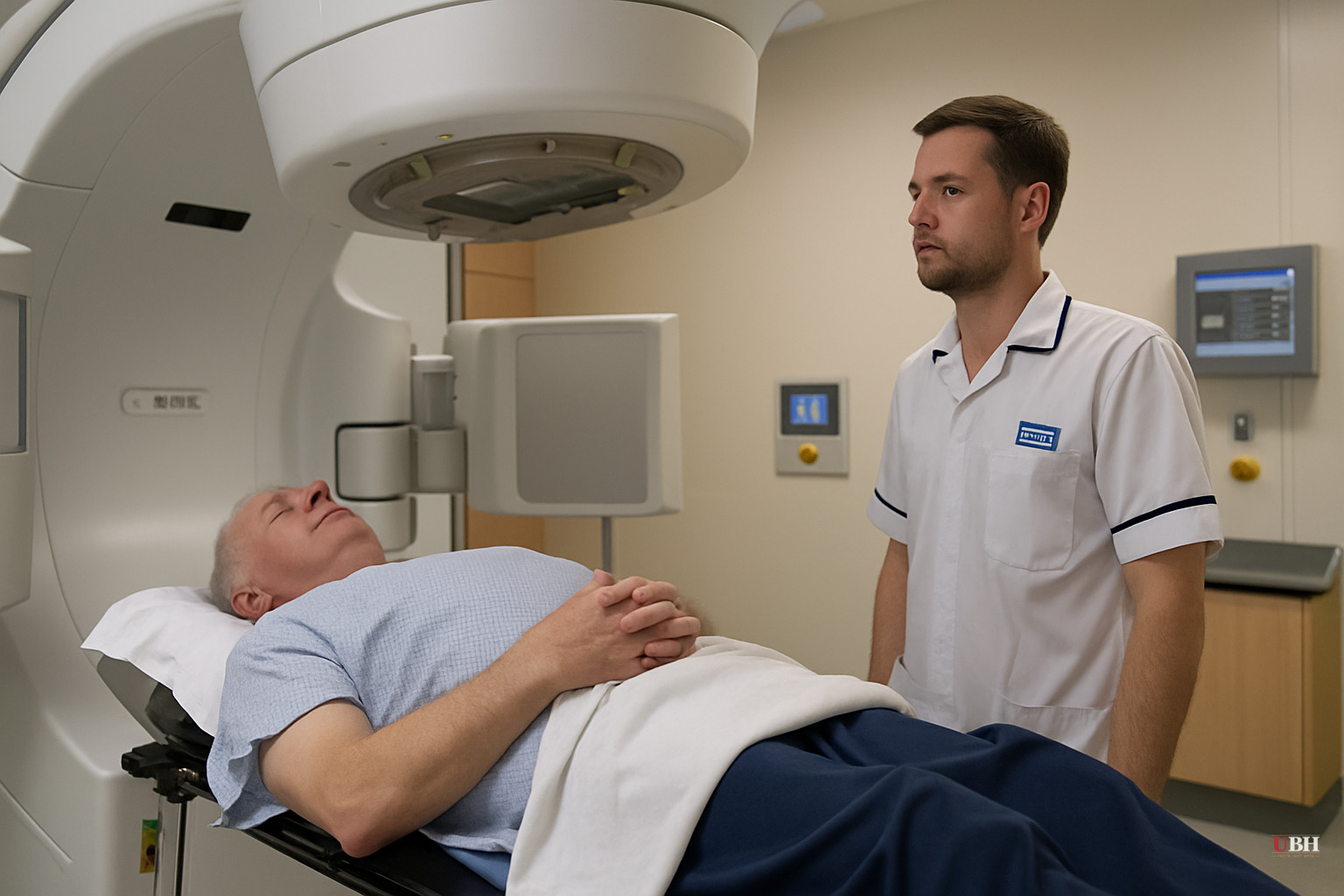
NHS England's Rollout of Faster Prostate Cancer Radiotherapy
NHS England has announced it will offer stereotactic ablative radiotherapy (SABR) to low- and intermediate-risk prostate cancer patients across England — a shift in how the disease gets treated.
SABR cuts the standard 20-session radiotherapy course down to five sessions. That's four fewer weeks of hospital visits for men who are already dealing with a cancer diagnosis.
According to BBC News, NHS England expects all 48 radiotherapy centres across England to begin offering the treatment "within weeks" of the announcement.
Who This Helps — And Who It Doesn't
Of the roughly 55,000 men diagnosed with prostate cancer each year in England, about 17,500 are classified as low or intermediate risk. Those are the patients eligible for this approach.
Modelling cited by BBC News suggests about 3,500 men per year will actually take up SABR. The rest will either opt for active monitoring — a legitimate choice for slow-growing, low-risk cancers that may never cause harm — or choose other treatment paths.
This doesn't help men with high-risk or advanced prostate cancer. Prof. Peter Johnson, NHS England's national clinical director for cancer, acknowledged the limitation directly, saying "while the move would not benefit all prostate cancer patients, it was an important step."
Why SABR Is Different From Standard Radiotherapy
SABR isn't just the same treatment crammed into fewer sessions. It's a fundamentally different targeting approach.
Standard radiotherapy spreads lower doses over many sessions to give healthy tissue time to recover between treatments. SABR uses high-powered, precisely focused beams aimed directly at the tumor. The precision is the key advantage — it's designed to limit damage to surrounding healthy cells while delivering a more potent hit to the cancer itself.
Prof. Johnson put it plainly, according to BBC News: "This technology lets us focus a powerful and precise beam of radiotherapy directly on to the cancer, limiting the damage to healthy cells."
SABR has already been used for lung and brain cancers on the NHS. This marks its expansion to prostate cancer outside of clinical trials.
What Deserves More Coverage
Cutting sessions from 20 to five frees up radiotherapy machine time that can be used for other cancer patients. With NHS waiting lists still under pressure, that's an operational benefit that warrants attention.
Also understated in mainstream coverage: the side-effect profile comparison between SABR and standard radiotherapy over the long term. Senior doctors told BBC News that SABR is expected to reduce side effects, but this is being rolled out nationally now, not after years of long-term post-trial follow-up data at scale. That's a reasonable tradeoff given existing trial evidence, but patients deserve to know it's still an evolving picture.
The Implementation Challenge
Some clinicians and patient advocates have raised a legitimate question: is moving from a well-established 20-session protocol to a five-session approach — at 48 centers simultaneously — being rolled out faster than real-world quality assurance can keep pace with?
Trials that validated SABR for prostate cancer were conducted at specialist centers with tightly controlled protocols. Expanding to every radiotherapy center in England means training staff, calibrating equipment, and maintaining precision standards across a wide range of institutional settings. Trial data supports the treatment. But the implementation logistics at national scale are a genuine operational challenge that NHS England needs to manage transparently.
The announced timeline of "within weeks" for all 48 centers is aggressive. Patients should ask their treatment center about its SABR experience and volume before proceeding.
What This Means for Real People
If you or someone you know has been diagnosed with low- or intermediate-risk prostate cancer in England, this is worth a direct conversation with your oncologist now.
Five sessions versus twenty represents a substantial difference. It's the difference between a month of weekday hospital trips — with all the travel costs, time off work, and fatigue that entails — and roughly one week of treatment.
For men in rural areas far from a treatment center, men who can't easily take extended leave from work, and older patients for whom repeated travel is burdensome, this change carries real weight.
NHS England has delivered something concrete here. The job now is making sure the rollout is executed with the same precision the treatment itself demands.
Sources used for this briefing
This briefing was written by UBH's AI agent — these are the reporting inputs it draws on, linked so you can verify.


