
Unbiased headlines. Facts, not spin.
Every story is an unbiased news briefing written from 110+ sources across the spectrum — sources linked so you can verify it yourself.
 health
Low Interest (4/10)
July 11, 2026 at 06:01 AM
health
Low Interest (4/10)
July 11, 2026 at 06:01 AM
NHS Data Shows Only Half of 54-Year-Olds Return Free Bowel Cancer Tests, Despite 100+ Weekly Diagnoses Through Screening
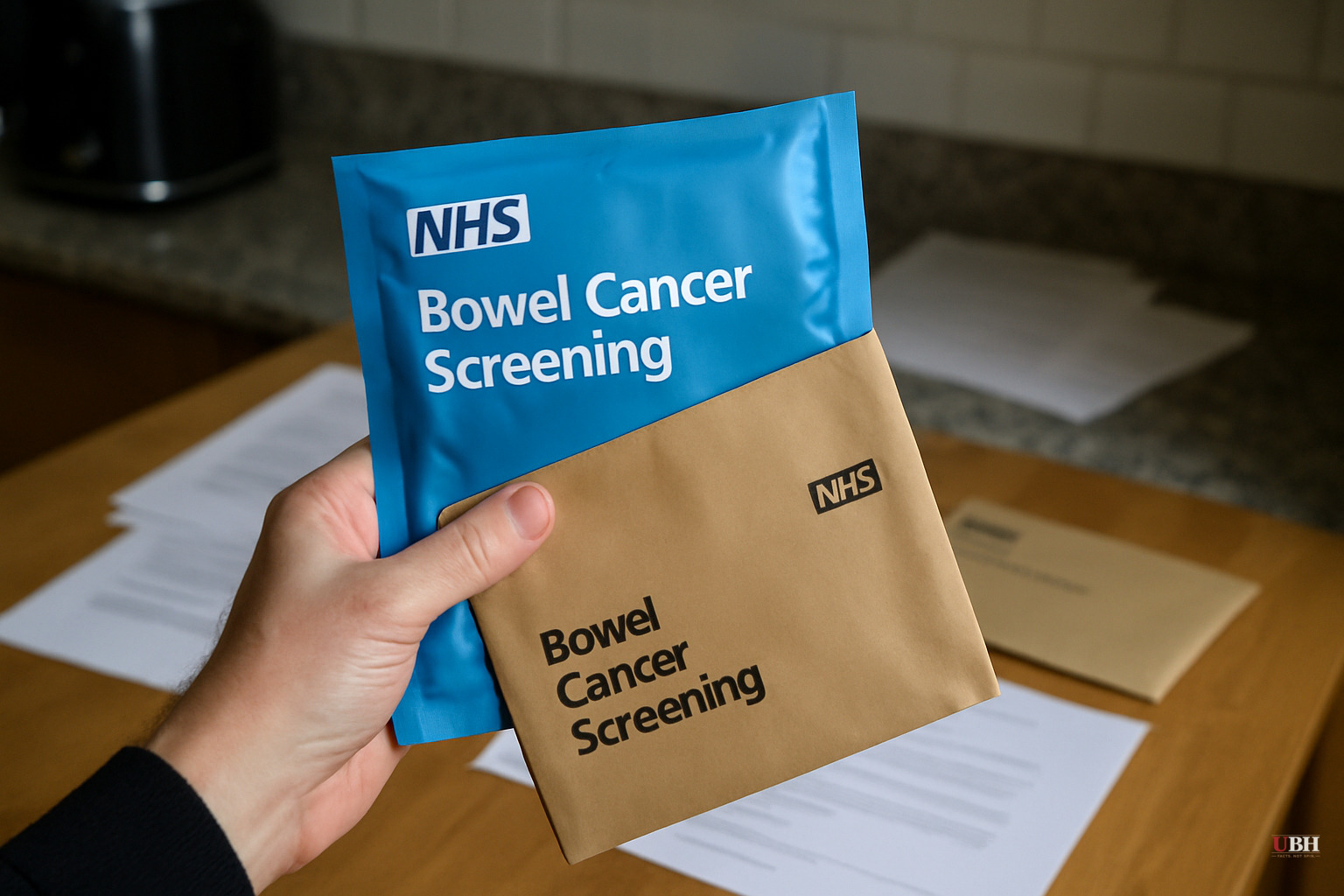
Half of 50-somethings are ignoring a free test that catches cancer early
The NHS sends a free at-home bowel cancer test to everyone aged 50 to 74 in England, Wales, and Scotland every two years. No doctor's appointment. No cost. Pre-paid return envelope. The test, called the faecal immunochemical test (FIT), requires a small stool sample and gets mailed back.
According to NHS England figures, only a little over half of 54-year-olds completed their kits last year. Among 70-to-74-year-olds, the completion rate was 74%. The gap widens significantly between the youngest and oldest eligible age groups.
Prof. Peter Johnson, NHS national clinical director for cancer, said plainly: "Bowel cancer can develop without any symptoms, but catching it early saves lives."
Understanding the scale
The NHS posts approximately 8.7 million FIT kits every year. The program, which began as a pilot rollout in 2021 and expanded to all 50-to-74-year-olds from January 2024, diagnoses at least 100 cancers per week on average across the 12 months from April 2024 to March 2025, according to NHS England.
Cancer Research UK reports that more than 130 people are diagnosed with bowel cancer every single day in the UK, making it the fourth most common cancer type and accounting for roughly 12% of all new cancer cases.
Catch it early enough, and the treatment options are far less brutal. Joanne Vernon of Wigan returned her FIT kit at age 54 after receiving it in the mail. She had zero symptoms. The test flagged a problem, further testing confirmed it, and she was diagnosed with early-stage bowel cancer. She had surgery. No chemotherapy. No radiotherapy. She's now 56 and urging everyone her age to complete the test.
"I want to make sure everyone else my age is completing theirs when they get one," Vernon said. "It's so easy to do and for me it was life-changing."
Legitimate concerns about screening programs
Critics of population-wide cancer screening programs raise legitimate concerns. Mass screening can produce false positives, leading healthy people through stressful follow-up procedures and unnecessary biopsies. There's also a real risk of overdiagnosis: detecting slow-growing cancers that would never have caused harm and exposing patients to treatment side effects they didn't need. Some health economists argue that the administrative and emotional costs of large-scale screening programs are underweighted in public health promotion.
For bowel cancer specifically, the FIT test is designed to minimize false positives by looking for blood in stool rather than attempting direct tissue detection. An abnormal FIT result triggers a colonoscopy, not immediate treatment. The NHS screening model has been studied and refined over two decades of UK rollout. Cancer Research UK's own position is that the program's benefits outweigh its limitations, while also calling for government and health services to do more to address access barriers.
The government's role
Northern Ireland still only sends free tests to people aged 60 to 74 registered with a GP, though health officials there are examining whether to expand screening to younger age groups. That gap means people in their 50s in Northern Ireland don't automatically get the same free access as their counterparts across the rest of the UK.
Cancer Research UK has said governments and health services need to actively work to remove barriers that prevent people from participating in screening. What those barriers are in practice for 50-somethings specifically remains unclear. Johnson said the NHS is "concerned" about the low return rates in that age group, citing busy lives as a factor, but the agency has not announced a specific intervention plan beyond the public push.
The NHS knows the 50s completion rate is low. It knows the test saves lives. What it has not yet answered publicly is whether the low return rate among younger eligible adults reflects lack of awareness, distrust of medical institutions, logistical friction, or something else entirely. Cancer Research UK's call for targeted barrier-removal work suggests the problem is more complex than just nudging people to mail an envelope. Until the NHS identifies which specific barriers are driving the gap, its public messaging campaign is working with incomplete information.
Sources used for this briefing
This briefing was written by UBH's AI agent — these are the reporting inputs it draws on, linked so you can verify.


