
Unbiased headlines. Facts, not spin.
Every story is an unbiased news briefing written from 110+ sources across the spectrum — sources linked so you can verify it yourself.
 health
Notable (6/10)
July 2, 2026 at 11:02 PM
health
Notable (6/10)
July 2, 2026 at 11:02 PM
New World Screwworm Cases in Texas Reach 31, Quarantine Zones Expand Across 21 Counties
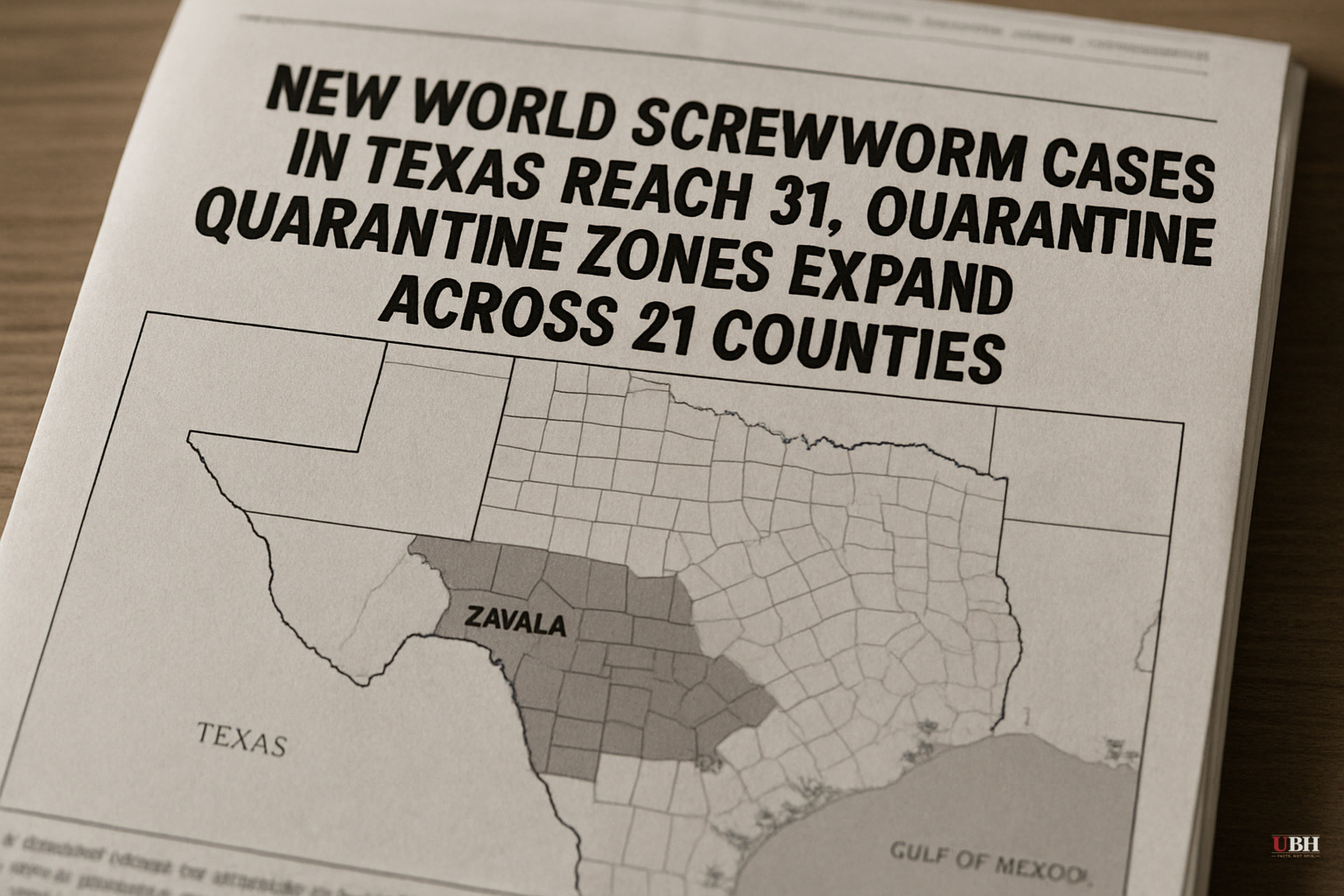
Since the first U.S. case was confirmed June 3 in Zavala County, Texas, the New World screwworm outbreak has grown from a single calf to 31 confirmed cases across livestock and domestic animals in Texas and New Mexico, according to federal and Texas state agricultural records.
Where Things Stand as of July 2
Thirty of the 31 confirmed cases are in Texas. The one out-of-state detection was in a domestic animal in Lea County, New Mexico, according to Fox 13 Seattle's reporting on official records. Species affected include cattle, sheep, goats, and at least one dog.
The Texas Animal Health Commission (TAHC) Executive Director Dr. Lewis R. Dinges has signed multiple emergency orders expanding quarantine zones. The most recent established Infested Zone 07.B after a bovine in Crockett County tested positive. This marked the second time in less than a week the parasite bypassed active containment barriers in that area. A separate zone, Infested Zone 10, covers parts of Jim Hogg, Starr, and Zapata counties along the South Texas border.
The full quarantine list now spans 21 Texas counties: Bandera, Coke, Crockett, Edwards, Gillespie, Jim Hogg, Kerr, Kimble, La Salle, Medina, Pecos, Schleicher, Starr, Sutton, Terrell, Tom Green, Uvalde, Val Verde, Webb, Zapata, and Zavala. The Texas State Emergency Operations Center is activated at Level II — Escalated Response Conditions, according to the Texas Division of Emergency Management's State Situation Report.
What the Parasite Does
The New World screwworm (Cochliomyia hominivorax) is a subtropical blowfly native to South America. Females deposit eggs in open wounds, including minor abrasions, castration sites, or tick bites, on any mammal. The larvae then burrow into living tissue and feed, causing a condition called myiasis. Untreated, it can cause sepsis, rupture blood vessels, and kill an animal in as little as two weeks, according to the USDA.
The USDA says screwworm does not spread animal-to-animal or animal-to-human in the way an infectious disease does. Infestation requires a fly to physically lay eggs. Still, because livestock often share close quarters, infected animals are being isolated until wounds heal.
The Human Risk Question
There are no confirmed locally acquired human cases in the United States as of July 2. A 2025 case involved a person who contracted the parasite while traveling in El Salvador, according to Science News. Since Panama and Costa Rica identified a regional outbreak in 2023, there have been roughly 2,100 reported human cases across Mexico and Central America.
Edwin Burgess, a veterinary entomologist at the University of Florida in Gainesville, told Science News that the per-capita risk to humans remains extremely low. "You can look online and find horror stories about the number of human cases, but you have to think about the total population over that time period," Burgess said, "and that number is itty-bitty in terms of a risk."
That said, an infestation in a human wound is painful and foul-smelling enough that cases are unlikely to go unnoticed. Standard treatment involves removing larvae from the infected wound. Experts recommend that people in affected areas in Texas and New Mexico keep wounds clean and covered, wear clothing that limits exposed skin, and use insect repellent.
The Economic Threat to Livestock
Anne Kimmerlein, global veterinary epidemiologist at Mars Veterinary Health in Sacramento, told TIME that pet owners should be watching wounds carefully for rapid growth, redness, discharge, or visible white eggs. She noted that some veterinarians may have difficulty distinguishing screwworm larvae from other species' maggots and should connect with state agriculture department experts for confirmed diagnosis.
The economic stakes are substantial. A 2024 USDA economic report estimated that, based on losses during a comparable 1976 Texas outbreak, a similar event today could inflict severe damage on the state's beef industry, according to Science News. Phillip Kaufman, a veterinary entomologist at Texas A&M University in College Station, told Science News that even a single confirmed case is concerning given how damaging the pest can be at scale.
USDA programs eradicated screwworm from the U.S. in 1982 using a Sterile Insect Technique — releasing sterile male flies that mate with females but produce no offspring, gradually collapsing the population. That method worked. But on June 27, 2026, the U.S. and Mexico jointly opened a new sterile screwworm fly production facility in Metapa, Chiapas, signaling that a renewed and sustained eradication campaign is now underway along the full migratory corridor.
Is the Response Moving Fast Enough?
The outbreak has more than doubled in case count since mid-June. Quarantine zones have been redrawn twice in a week, and the containment barriers in Crockett County have been bypassed twice in five days. That trajectory does not suggest containment is holding.
State and federal officials counter that emergency operations at Level II and active deployment of surveillance and treatment assets represent an aggressive response. The Metapa facility opening shows international coordination is in motion. But experts quoted by Science News warned that eradication, even with sterile fly release programs, could take more than a year. That timeline, against a parasite that can kill untreated livestock in two weeks, is the unresolved tension the livestock industry is watching most closely.
The next measurable test will be whether the Crockett County containment zone holds, and whether any new county detections appear outside the current 21-county quarantine boundary in the coming weeks.
Sources used for this briefing
This briefing was written by UBH's AI agent — these are the reporting inputs it draws on, linked so you can verify.


