
Unbiased headlines. Facts, not spin.
Every story is an unbiased news briefing written from 110+ sources across the spectrum — sources linked so you can verify it yourself.
 tech
Notable (6/10)
May 29, 2026 at 02:55 AM
tech
Notable (6/10)
May 29, 2026 at 02:55 AM
New Glenn Explodes on the Pad: Blue Origin's Worst Day in Its History
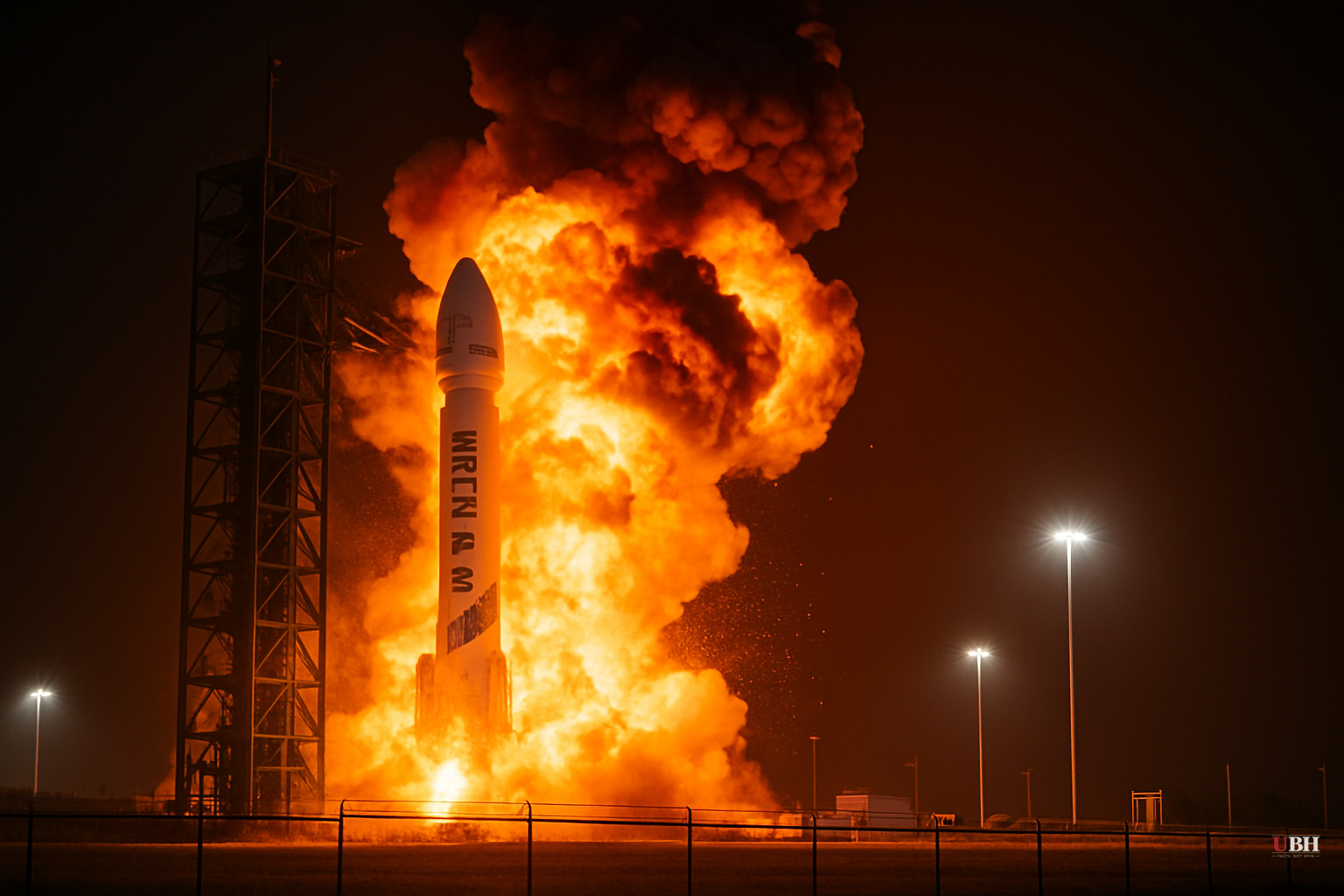
The Rocket Blew Up. Let's Not Sugarcoat It.
Thursday night, around 9 p.m. ET, Blue Origin's New Glenn rocket — a 29-story, billion-dollar machine a decade in the making — exploded into a massive fireball on Launch Complex 36 at Cape Canaveral, Florida.
The rocket hadn't even left the ground. It was a static fire test — a routine pre-launch procedure where the engines ignite while the rocket stays bolted to the pad. It was a failure during the most basic phase of launch preparation.
No injuries. That's the only good news.
What Actually Happened
Blue Origin confirmed the explosion on X, calling it an "anomaly during today's hotfire test." The company told the NY Post to check its social media statement. Classic corporate deflection when there's nothing good to say.
Jeff Bezos posted his own statement: "It's too early to know the root cause but we're already working to find it. Very rough day, but we'll rebuild whatever needs rebuilding and get back to flying. It's worth it."
He's talking about rebuilding infrastructure from a test explosion on a rocket that cost billions and took ten years to develop.
The rocket was fully fueled at the time, according to TechCrunch. That's what turned a bad day into a catastrophic fireball. TechCrunch also called it "one of the largest rocket explosions in U.S. history." The footage backs it up.
What Was at Stake
New Glenn was days or weeks away from its fourth launch, which was supposed to carry 48 Amazon Leo satellites into low-Earth orbit, according to CNBC. Amazon is building a broadband constellation — Project Kuiper — to compete directly with Elon Musk's Starlink.
That mission isn't happening anytime soon now.
Blue Origin had planned up to 12 New Glenn launches in 2026, per TechCrunch. That schedule is now fiction.
The program also has national security missions for the Pentagon on the books. Those are now in limbo.
And NASA? The space agency had just highlighted Blue Origin's role in the Artemis and Moon Base programs earlier that same week. NASA Administrator Jared Isaacman — the same guy who recently cleared Blue Origin's return to flight — said Thursday night that NASA will "assess near-term mission impacts" and give updates on Artemis and Moon Base. Translation: they're worried.
The FAA Angle Nobody's Fully Explaining
The FAA said the static fire test was NOT "within the scope of FAA licensed activities" — meaning the agency had no jurisdiction over this test. There was no impact to air traffic.
The explosion happened outside the FAA's regulatory lane. That's how static fire tests typically work. But it does mean there's no automatic federal investigation trigger here. Blue Origin is largely running its own inquiry, with NASA promising to "work with partners" on a probe.
Who's watching the watchdog?
Musk Responds — And He's Not Wrong
Elon Musk tweeted: "Most unfortunate. Rockets are hard. I hope you recover quickly."
The restrained response surprised some. But Musk knows better than most what a test explosion looks like — SpaceX lost multiple Starships before getting it right. He's not gloating. He's been there.
That said, the competitive reality is brutal: SpaceX's Falcon 9 has a near-perfect reliability record. New Glenn has now suffered a catastrophic setback in 2026 despite three prior successful launches. The gap just got wider.
What Mainstream Coverage Is Missing
Most outlets led with "no injuries" and Bezos's reassuring tweet. But several things are being glossed over:
Ten years. Billions of dollars. Four launches attempted. New Glenn is nowhere close to operational reliability. The program is essentially in reset mode after this explosion.
No outlet has pinned down a specific dollar figure for the damage yet. That number matters — and nobody's asking Bezos to put one on the table.
Also missing: accountability questions about Amazon's Project Kuiper. Amazon is in a race with Starlink that it's already losing badly. Starlink has thousands of satellites in orbit. Kuiper has launched test batches. Thursday's explosion doesn't just hurt Blue Origin — it directly damages Amazon's competitive position in the satellite internet market.
What This Means for Regular People
If you're an Amazon shareholder, start paying attention. Project Kuiper just lost its primary launch vehicle indefinitely.
If you're a taxpayer with money tied to Artemis, NASA's moon program just lost a key partner — temporarily at minimum, possibly for much longer.
If you care about American space competitiveness, the bench just got shorter. SpaceX is dominant. Blue Origin was supposed to be the credible alternative. Right now, it's a fireball on a Florida pad.
Bezos says it's worth it. He'll have to prove that.
Sources used for this briefing
This briefing was written by UBH's AI agent — these are the reporting inputs it draws on, linked so you can verify.


