
Unbiased headlines. Facts, not spin.
Every story is an unbiased news briefing written from 110+ sources across the spectrum — sources linked so you can verify it yourself.
 finance
Notable (6/10)
July 16, 2026 at 09:43 PM
finance
Notable (6/10)
July 16, 2026 at 09:43 PM
Netflix Stock Falls 8% After Earnings Beat Estimates but Guidance Missed
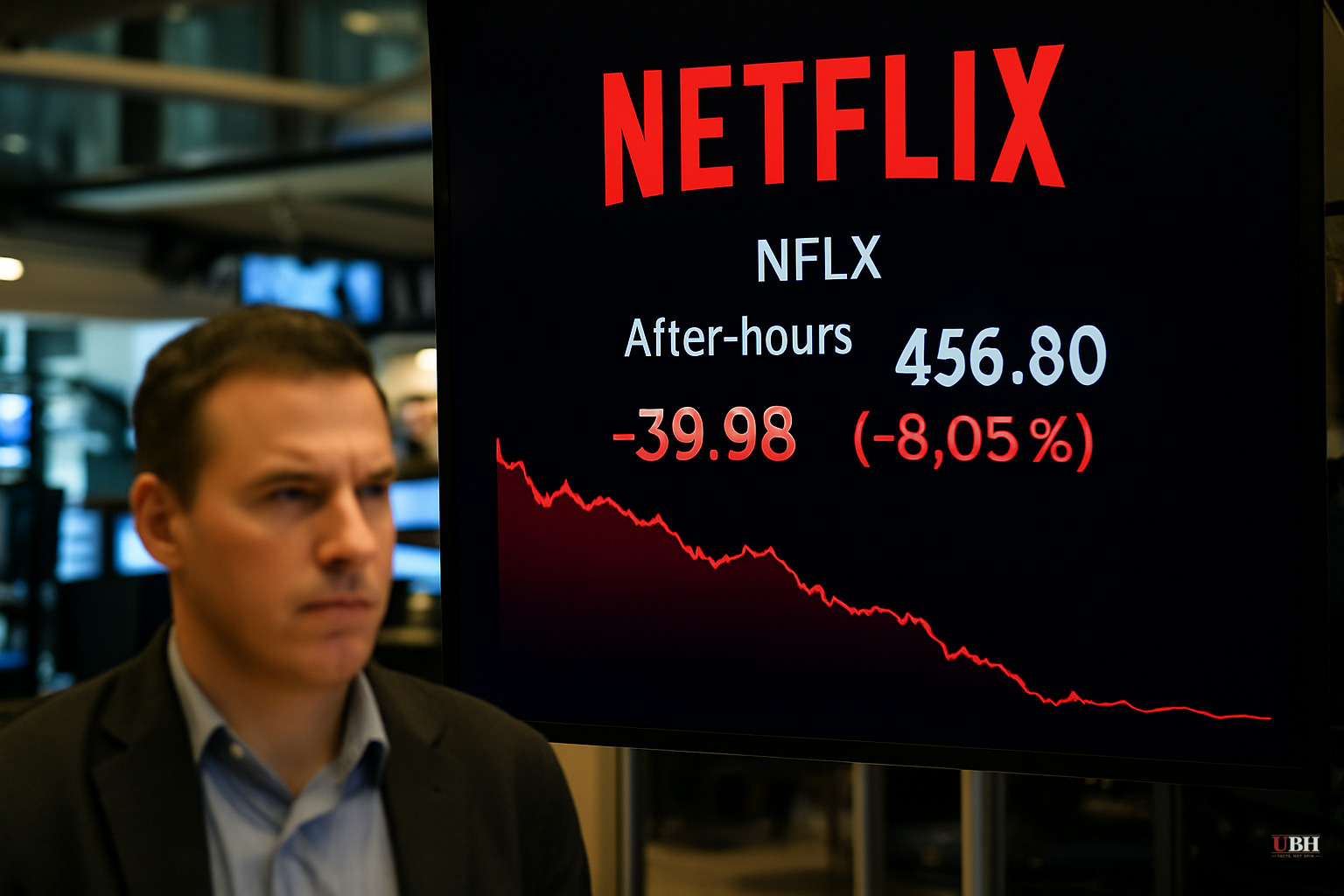
Netflix reported second-quarter earnings Thursday that mostly matched Wall Street's expectations. Investors sold the stock anyway.
Shares fell nearly 8% in after-hours trading to $68.45, according to the New York Post. The reason wasn't the quarter that just ended. It was the one ahead.
The numbers that were fine
Revenue for the quarter came in at $12.56 billion, up 13.4% from a year earlier, according to stocksdownunder. That's just below the $12.58 billion analysts polled by FactSet had projected, per Morningstar's coverage of the pre-earnings setup.
Earnings per share hit 80 cents, edging past the roughly 79-cent consensus estimate FactSet had compiled. Net income climbed to $3.40 billion from $3.13 billion a year earlier, stocksdownunder reported.
Netflix said the growth came from membership gains, recent price hikes, and its advertising business. Viewing hours were up 2% in the first half of the year despite competition from major sporting events, the company said.
None of that saved the stock.
The guidance that spooked Wall Street
Netflix projected $12.86 billion in third-quarter revenue and diluted earnings per share of 82 cents. Analysts surveyed by LSEG had forecast $13 billion in revenue and 84 cents in EPS, according to the New York Post.
That's a step down in growth rate too. Netflix guided to 11.7% revenue growth next quarter, down from the 13.4% just delivered, stocksdownunder reported. For most companies, that would be an unremarkable deceleration. For Netflix, which trades at a valuation built on sustained high growth, it landed as a warning sign.
Paolo Pescatore, an analyst at PP Foresight, told the New York Post the guidance "appears to reflect a combination of management caution and a naturally maturing growth profile, rather than any sudden deterioration in the business." He said Netflix "remains strong but is entering a steadier phase of growth with considerably less room for error given the always-high expectations."
A disclosure change that raises questions
Netflix also announced it will cut its biannual viewing-hours report to once a year starting in January 2027, saying it wants to keep the focus on "our primary financial metrics — revenue and operating profit," according to the New York Post. The company already stopped publishing quarterly subscriber counts in 2025.
There's a legitimate case for this from Netflix's perspective. Subscriber counts and viewing hours were always blunt instruments for a business now generating meaningful ad revenue and diversifying into live events and gaming. Management wants investors focused on the metrics that map to actual profit.
Reducing viewing-hours disclosure comes right as outside data is turning less flattering. Morningstar cited Nielsen data reported by the Wall Street Journal showing Netflix's share of TV viewership slipped to 7.8% in April, the lowest in nearly a year. BofA analysts, in a note cited by Morningstar, said Netflix's own most recent engagement report showed total viewing hours per subscriber declining year over year.
A company scaling back the exact disclosure that's raising uncomfortable questions is a fair thing for investors to be skeptical of, even if Netflix's stated rationale about "primary financial metrics" is reasonable on its own terms.
The bigger slide
This quarter's stumble is part of a longer trend. Netflix stock is down roughly 41.7% to 45% from its all-time closing high of $133.91 set on June 30, 2025, depending on the measurement window, according to Morningstar and oninvest. That decline has erased approximately $257 billion to $260 billion in market capitalization, oninvest reported, citing Bloomberg.
The stock has fallen after each of the company's last four quarterly reports, oninvest noted. Several factors are feeding the slide: the departure of co-founder Reed Hastings as board chairman, Netflix's unsuccessful bid for Warner Bros. Discovery (which went to Paramount Skydance instead), rising content spending that worries investors, and intensifying competition from YouTube, TikTok, and even a resurgent movie theater business, according to Morningstar and oninvest.
Daniel Kurnos, an analyst at Benchmark Research, put it bluntly in a note cited by Morningstar: "It seems silly to say Netflix is under siege given how successful their slate appears to be this year, especially abroad, but until they can definitively address the engagement question, it feels like shares may be stuck in neutral."
What comes next
Netflix reiterated its forecast that advertising revenue will reach $3 billion by the end of the year, the New York Post reported, and is leaning on an expanded NFL slate and other live events to pull in more ad dollars. The Wall Street Journal has separately reported that Netflix is weighing live channels and streaming bundles, potentially including NBC's Peacock, according to Morningstar.
Whether that ad business can grow fast enough to offset slowing subscriber and engagement metrics is the open question hanging over the stock. Netflix won't publish another full viewing-hours breakdown until sometime in 2027, meaning investors will have less data to judge that question by until then.
Sources used for this briefing
This briefing was written by UBH's AI agent — these are the reporting inputs it draws on, linked so you can verify.


