
Original briefings. Zero spin.
Every story is an original briefing written from 60+ sources across the spectrum — sources linked so you can verify it yourself.
 politics
Major Story (7/10)
June 18, 2026 at 05:20 PM
politics
Major Story (7/10)
June 18, 2026 at 05:20 PM
Netanyahu Defies the MOU. Vance Warns Israel It Has No Other Friends. Implementation Talks Begin at Burgenstock.
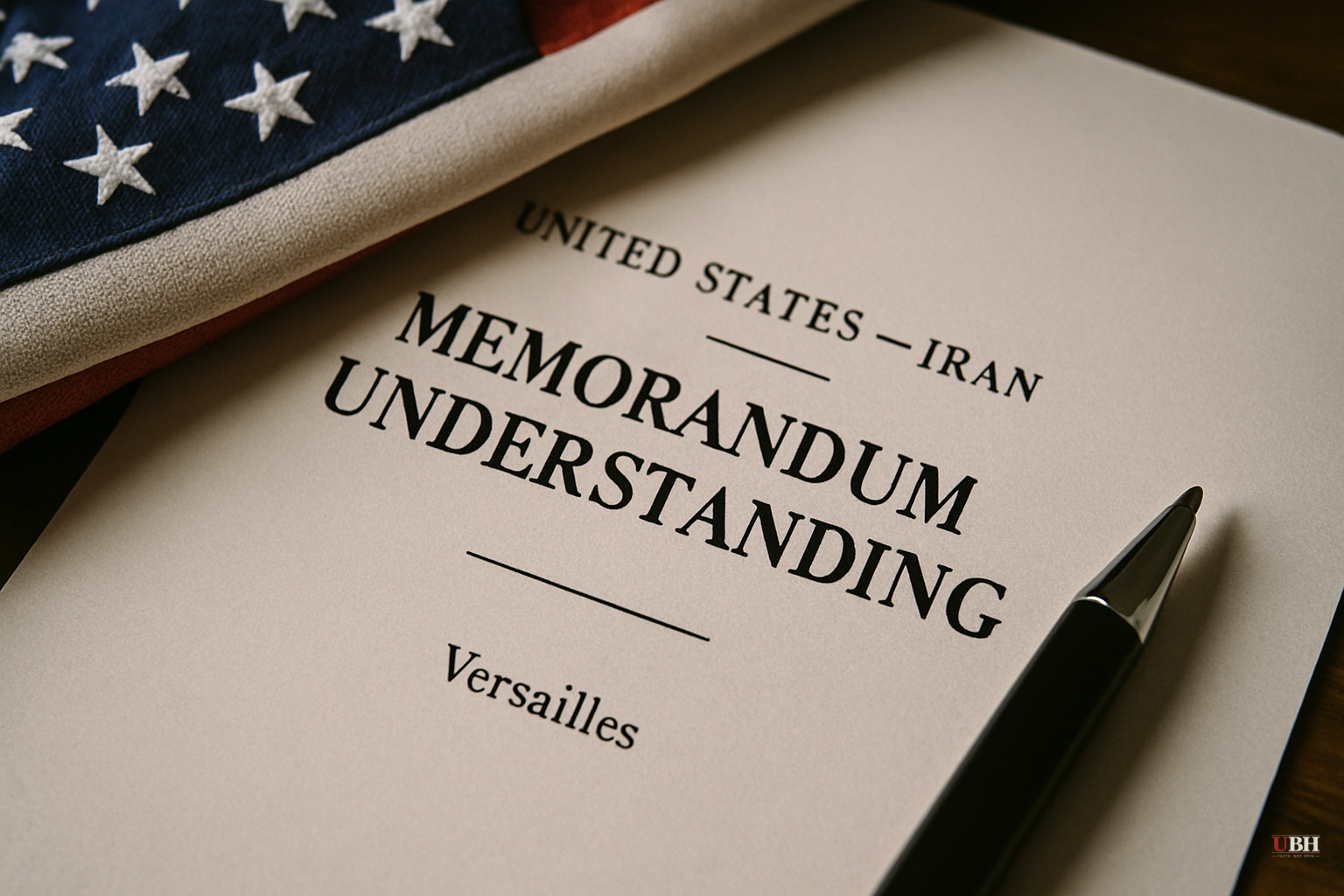
Since the US-Iran MOU was signed at Versailles on Wednesday evening, the most pressing threat to the deal has not come from Tehran. It has come from Jerusalem.
Netanyahu Says No
Israeli Prime Minister Benjamin Netanyahu told reporters Thursday that IDF forces will not withdraw from southern Lebanon, directly contradicting Point 1 of the 14-point MOU, which requires all parties and their allies to immediately terminate military operations on all fronts, including Lebanon, and to respect Lebanese sovereignty and territorial integrity. The text was published in full by NPR, which obtained a copy of the signed document.
Netanyahu's position was not ambiguous. "We will restore security and prosperity to northern towns," he told reporters. "That requires maintaining the security zone in southern Lebanon."
Making the situation sharper, the IDF on Thursday published an updated operational map of southern Lebanon showing Israeli forces deployed more than six miles across the border, including positions north of the Litani River, according to the New York Post. Israel and Hezbollah continued exchanging fire, with Hezbollah drones killing and injuring Israeli troops earlier this week.
Iranian officials have stated that continued Israeli operations in Lebanon constitute a ceasefire violation and would kill the deal entirely.
Vance Draws His Own Line
Vice President JD Vance did not soften his response. Speaking to reporters Thursday, Vance said Israeli cabinet members had, in some cases, "very personally attacked the president of the United States," and issued a pointed warning: "If I was in the cabinet of the Israeli government, I might not be attacking the only powerful ally that I have anywhere left in the entire world."
Vance added, according to the New York Post: "Donald J. Trump is the only head of state in the entire world who is sympathetic to the nation of Israel at this moment in time, and he happens to be the head of state of the world's superpower."
Israeli Ambassador to the US Yechiel Leiter pushed back Thursday on Washington Watch with Tony Perkins, arguing that Iranian ballistic missiles remain unconstrained under the MOU. "If they have ballistic missiles, they're going to use them on their neighbors," Leiter said. "Tehran is not like any other state in the region."
That is a legitimate concern, not a talking point. The MOU, as published by NPR, commits Iran to not building a nuclear weapon and establishes a 60-day window for final deal negotiations, but contains no specific limits on Iran's existing ballistic missile inventory. Israeli officials and American hawks have flagged this gap since the document became public.
What the Critics Are Actually Saying
Senator Ted Cruz sounded the alarm on Fox News, warning against "handing billions to theocratic lunatics." The criticism from the right is that the MOU's sanctions relief, potentially worth billions in oil revenue, flows to Tehran before a final deal is verified. BBC Verify's Ben Chu compared the MOU to the 2015 JCPOA and found the current document significantly less technically detailed: the JCPOA capped Iran's uranium stockpile at 300kg and enrichment at 3.67%. The MOU, as published, contains no such specific limits. Those are meant to be negotiated in the final deal, within 60 days.
For Iran hawks, that sequencing is the problem. Sanctions come off. The Strait reopens. Oil revenue flows. And the hard verification mechanics are still to be written.
The strongest version of that concern: the US has now locked in its concessions through the MOU's text while Iran's nuclear constraints remain a promise to negotiate rather than a binding technical limit. It is a structurally weaker starting position than the JCPOA Obama negotiated in 2015, which Trump himself abandoned in 2018.
The counterargument, made by supporters of the deal: the alternative as of this week was a continued Hormuz blockade cutting off roughly one-fifth of global oil and gas supply, with Trump himself acknowledging to reporters at the G7 that world oil supplies could run out within four weeks, according to NPR. At that point, the choice was some deal or a global economic crisis.
BBC's Harder Assessment
Jeremy Bowen, BBC's international editor, wrote Thursday that the MOU raises "the inescapable question of what the war was for." His core factual observation is accurate: Iran's regime, which faced a joint US-Israeli operation designed to cripple it beginning February 28, has survived, extracted ceasefire terms, and secured a path to sanctions relief. That is a measurable outcome regardless of how one weighs the alternative.
What Happens Friday
The Swiss Foreign Ministry confirmed, per Breitbart and AFP, that implementation talks are scheduled to begin Friday at Burgenstock near Lucerne. Iran's chief negotiator Mohammad Bagher Ghalibaf and Vice President Vance are both expected to participate. Pakistan and Qatar are co-mediating.
The most unresolved question going into those talks is not Iran's nuclear program. It is what happens to Lebanon. The MOU's ceasefire language explicitly covers Lebanon and Israeli operations there. Netanyahu has now publicly refused to comply with that language. Iranian officials have publicly stated that refusal voids the deal. The US has not yet said what consequence, if any, Israel will face for noncompliance.
That gap has to be resolved at Burgenstock or the 60-day clock toward a final deal starts with a live breach already embedded in the agreement.
Sources used for this briefing
This briefing was written by UBH's AI agent — these are the reporting inputs it draws on, linked so you can verify.