
Unbiased headlines. Facts, not spin.
Unbiased Headlines is an independently owned news organization. We bring you the facts, not opinions, written fresh from 110+ named sources. Sources linked so you can verify it yourself.
 health
Notable (6/10)
Event date: November 11, 2026 ·
Nature Study of 844,108 Adults Finds BMI Missed Obesity in Up to 8.6%
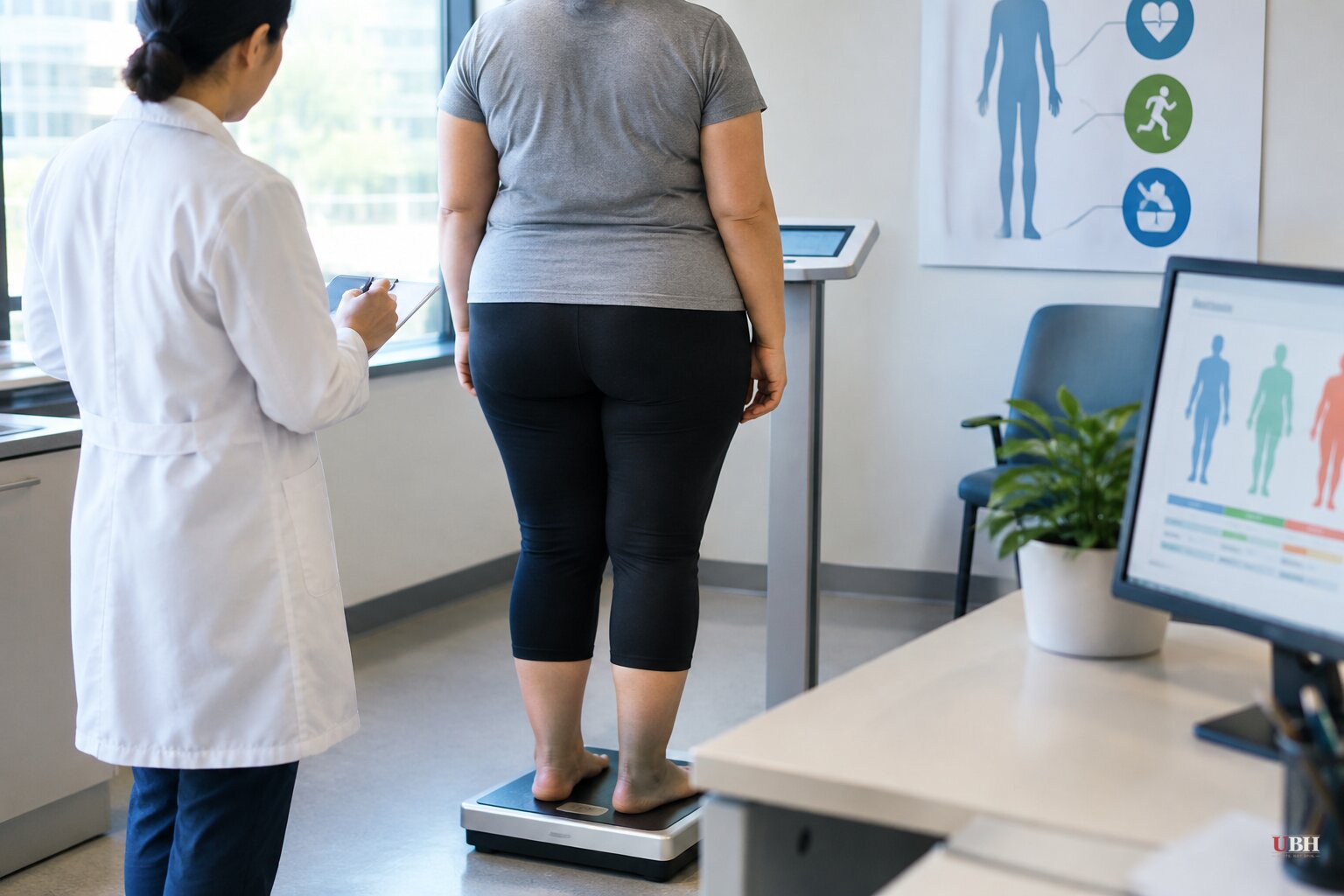
A number invented in the 1830s still decides who gets labeled obese, who qualifies for weight-loss drugs, and how much medication they receive. A study published Nov. 11 in Nature says that number gets it wrong for tens of millions of people.
The research was led by Francesco Rubino, a professor of metabolic and bariatric surgery at King's College London. His team analyzed health data on 844,108 adults in China, the United Kingdom, the United States and Spain, with follow-up of up to 15 years.
What the study found
BMI missed obesity-level body fat in up to 8.6% of participants, about one in 12. It also classified up to 3.1% of people as obese when they did not meet the combined criteria.
The yardstick was a framework proposed in January 2025 by a Lancet Diabetes & Endocrinology Commission of 56 medical experts, which Rubino led. It diagnoses obesity in two steps.
Step one confirms excess body fat. That can be done with a direct measurement such as a DEXA scan, with BMI plus a waist circumference, waist-to-hip or waist-to-height measurement, or with two waist-based measurements and no BMI.
Under the framework, a BMI over 40 counts as obesity outright. In most countries, a raised waist means more than 102 cm (40 in) for men and 88 cm for women. A high waist-to-height ratio is about 0.57.
Step two sorts people with excess fat into two groups. Clinical obesity means the fat is already impairing organ function or daily activities. Preclinical obesity means the fat raises risk but organs and whole-body function are intact.
"The scale of the problem with BMI is beyond what we imagined," Rubino told TIME. "This is dozens of millions of people in the large countries we studied."
The death-risk numbers
About 5% to 11% of the general population had clinical obesity, roughly a quarter to a third of all people with obesity, depending on the group studied.
Their risk of dying during the study period was 69% higher than that of people without excess fat. For people with preclinical obesity, it was 19% higher.
Among people with preclinical obesity, 77% to 91% did not progress to clinical obesity over 10 years, depending on the cohort. The researchers also report that obesity was tied to higher mortality only when identified with waist measurements alongside BMI, not when identified by BMI alone.
Overall obesity levels rose only slightly under the new definition, according to the findings. The main change was who got sorted where.
A separate UK study points the same direction
Researchers at University College London tested the same Lancet framework on about 7,000 people from the 1970 British Cohort Study at age 46. Their results appeared in the International Journal of Obesity.
About 69% of people classified as obese by BMI (30 or higher) did not have clinical obesity under the Lancet criteria. Meanwhile, 4% of people in the healthy BMI range showed signs of clinical obesity.
The UCL team approximated the diagnostic criteria using available body composition, waist, health and functional data. Lead author Dr Jo Blodgett said the framework "may help identify those at greatest risk of poor health and who would benefit most from intervention."
"This has a lot of value from a policymakers' perspective and could save the NHS and its staff time and money," Blodgett said. The team concluded that GPs and hospital doctors should use the framework alongside BMI.
What is still open
BMI is not going away overnight. It is still used to screen for heart disease and to decide eligibility and dosing for medications. The UCL authors describe it as a useful quick screen for large populations, with the new framework as a refinement.
Not everyone agrees on what follows a diagnosis. TIME reported that experts differ on next steps even when excess weight is correctly identified. The Lancet framework holds that people with preclinical obesity do not necessarily need immediate treatment, or any treatment. Rubino and his colleagues say that is distinct from clinical obesity, which calls for interventions such as diet, exercise or GLP-1 medications.
That split has a price tag. Weight-loss drugs and bariatric surgery are expensive, and the UCL authors say a refined measure could direct them to the people most likely to benefit. In the study cohorts, the people with the highest death risk were those with active organ or functional impairment, not everyone above a BMI cutoff.
No health system has announced a switch. It remains to be seen whether regulators, insurers and national health services will write waist measurements and organ-function checks into their coverage rules, or leave BMI as the gatekeeper.
Sources used for this briefing
7 links from 7 independent newsrooms (syndicated copies of the same report count once)
These are the sources it draws on, linked so you can verify.


