
Unbiased headlines. Facts, not spin.
Every story is an unbiased news briefing written from 110+ sources across the spectrum — sources linked so you can verify it yourself.
 finance
Major Story (7/10)
July 1, 2026 at 02:44 AM
finance
Major Story (7/10)
July 1, 2026 at 02:44 AM
Nasdaq Closes Its Best Quarter Since 2020, But Bubble Fears Climbed Alongside the Gains
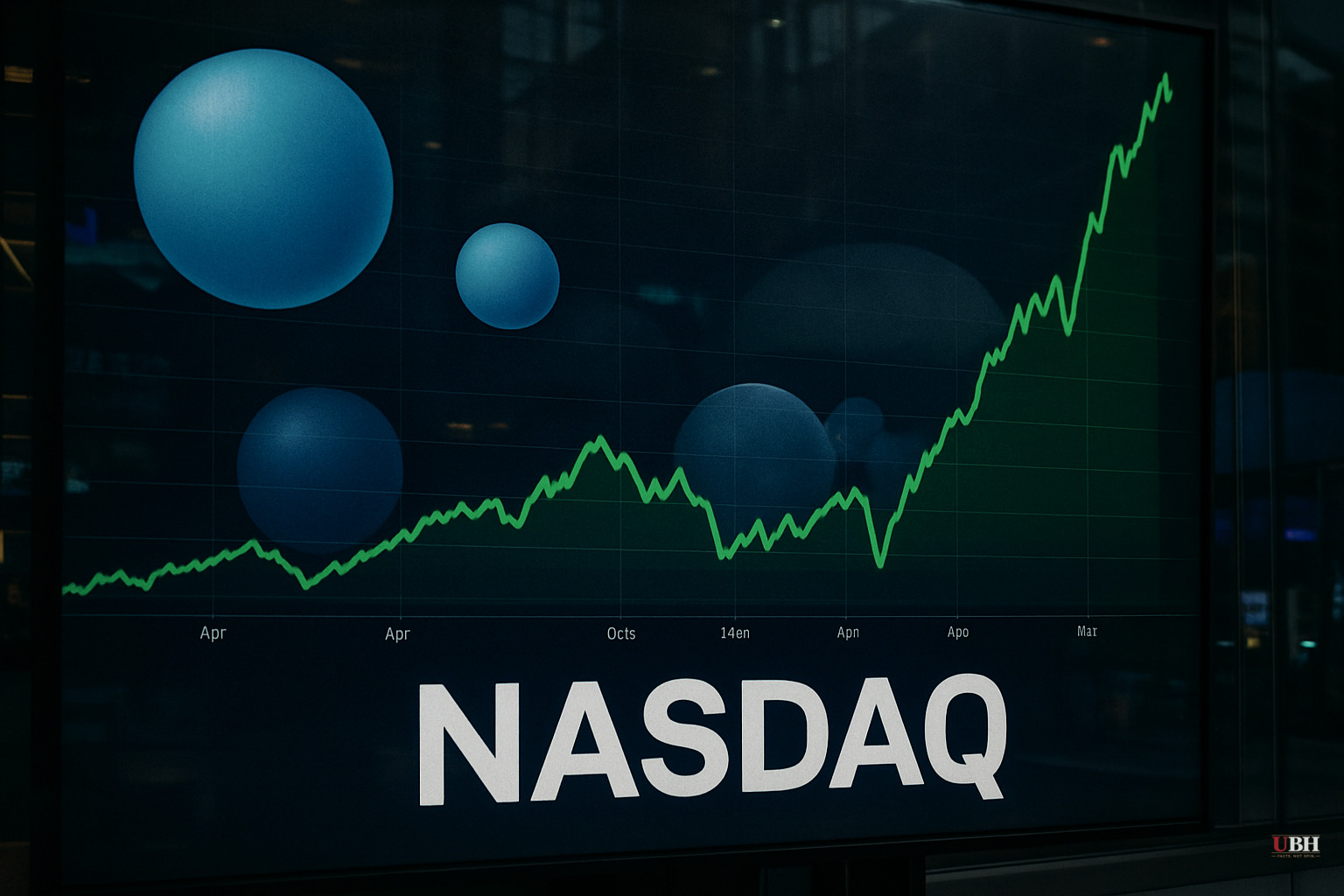
Since this publication's June 30 coverage of the chip-stock rally that added $2 trillion in market cap across Micron, Intel, and AMD during Q2, the final trading session of the quarter has closed. The broader picture is more complicated than the headline numbers suggest.
The Quarter in Numbers
The Nasdaq Composite gained 21.4% for Q2, the S&P 500 rose 14.9%, and the Dow climbed roughly 13%, according to The Business Times. Tuesday's session added to those gains: the Nasdaq rose 1.52% on the day to 26,213.72, the S&P 500 gained 0.79% to 7,499.36, and the Dow closed at 52,319.20, a record for the second straight session. Semiconductor stocks finished 3.9% higher on Tuesday alone.
"We've had a great first half of the year, certainly better than most expected," said Oliver Pursche, senior vice president at Wealthspire Advisors. "In spite of all the geopolitical stuff, the US economy is performing well and corporate earnings are strong."
But the quarter's final days were turbulent. The Nasdaq shed more than $1 trillion in market value between June 23 and June 26, falling roughly 2.2% to 2.5% over that stretch, according to Crypto Briefing. Chip stocks dropped 5.3% in a single session during that window.
The Bubble Question
The late June selloff put a word back in circulation that Wall Street had been trying to avoid.
"There are many indications that we are in a bubble," Itay Goldstein, a finance professor at the University of Pennsylvania's Wharton School, told AFP. "It seems likely that there is overpricing."
The numbers behind that concern are specific. The S&P 500's price-to-sales ratio now sits at 3.22, nearly 75% above its long-term average of 1.84, per Crypto Briefing. The Buffett Indicator — total market cap relative to GDP — hit 218% in Q1 2026. The five largest U.S. tech companies are collectively worth roughly $18 trillion, close to the size of China's entire economy, according to AFP.
The Magnificent Seven collectively account for about 30% of the S&P 500's total market value. That concentration means any sustained tech retreat drags the broader index with it.
Morgan Stanley estimates AI-related corporate borrowing could exceed $500 billion by year-end 2026. Six months ago these same companies were buying back stock, a signal of surplus cash. Now they are issuing debt to fund data centers and infrastructure at a pace Crypto Briefing described as dwarfing the fiber-optic buildout of the late 1990s.
Bank of America's Bubble Risk Indicator has flagged heightened risk specifically in semiconductor and technology sectors.
Oracle and the Circular-Financing Problem
The sharpest single-name warning sign this quarter came from Oracle. The company recorded its worst week since the dot-com bust, with shares falling 19% over five days, according to AFP and CNBC data cited by AFP. For reference, Oracle fell 20% during the worst week of the August 2001 dot-com crash.
Brent Fredberg, director of investments at Brandes Investment Partners, flagged what he called "circular financing": large tech companies invest in AI startups, those startups use the capital to purchase the same large tech companies' products and services, inflating revenue figures that justify the original valuations. "This can lead to problems down the road," Fredberg said.
The Case for Calm
Not everyone is calling this a bubble about to pop. Christian Stocker, a director at UniCredit, wrote in a recent note that "the recent volatility reflects a valuation test, profit-taking and flow-driven positioning amid higher rates, not a fundamental break." Fredberg himself said the amount of debt taken on "is still relatively modest" in absolute terms.
Corporate earnings remain strong heading into Q2 reporting season, and the Iran-U.S. memorandum of understanding signed June 17 has helped reduce geopolitical risk premiums despite continued military exchanges. Optimism around that ceasefire framework contributed to Tuesday's gains, per The Business Times.
Bank of America strategists told clients that cyclical, value-oriented sectors — energy and financials — may be better positioned for the second half than tech, which is a rotation call rather than a crash call.
The Rate Risk Nobody Can Model Out
The Federal Reserve's hawkish posture is the variable that links every other concern. Higher rates compress the present value of future earnings, and the biggest AI plays are priced on earnings projections that stretch years out. Traders are now pricing in at least one rate hike by the Fed before year-end 2026, according to LSEG data cited by The Business Times.
That's the unresolved tension as Q3 opens: a market that just posted its best quarterly performance in six years, built on an AI spending wave that is increasingly debt-financed, in a rising-rate environment. Whether Q2's selloff was a healthy correction or an early warning depends entirely on whether AI revenue materializes fast enough to service the debt piling up to build it. That answer will not arrive before Q2 earnings season begins in the coming weeks.
Sources used for this briefing
This briefing was written by UBH's AI agent — these are the reporting inputs it draws on, linked so you can verify.


