
Unbiased headlines. Facts, not spin.
Unbiased Headlines is an independently owned news organization. We bring you the facts, not opinions, written fresh from 110+ named sources. Sources linked so you can verify it yourself.
 finance
Major Story (8/10)
Nasdaq 100 Lost Over $2 Trillion in October as 10-Year Yield Stays Near 5%, With IMF Warning of AI Downside
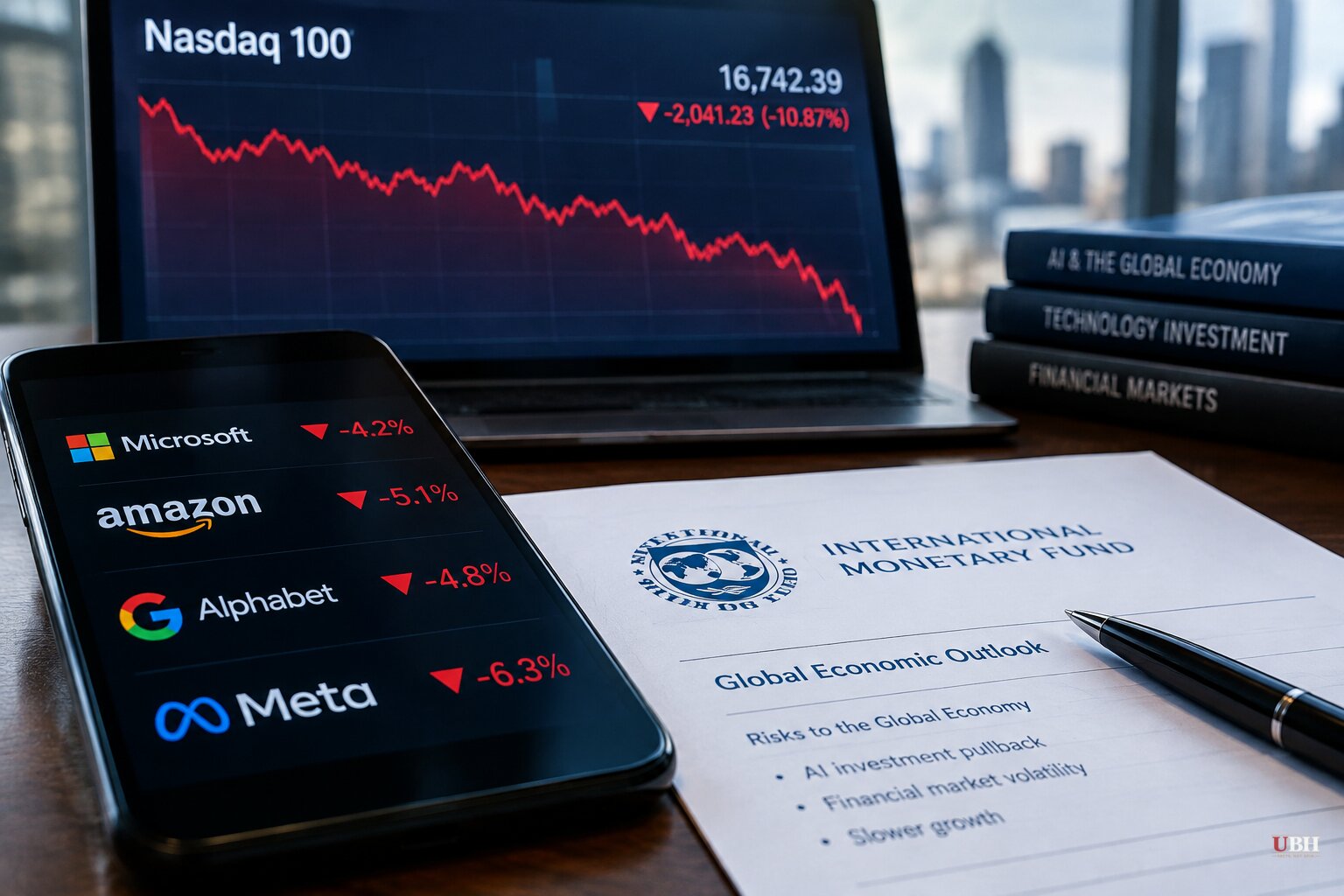
Since the IMF warned on Oct. 12 and 13 that a sharp pullback in AI investment could drag down global growth, markets have given that scenario a live rehearsal. More than $2 trillion in market value was wiped from the Nasdaq 100 in October as investors rushed out of AI stocks and into bonds.
The strain is no longer confined to tech. A Reuters analysis published Nov. 3 describes markets buckling under wars, soaring sovereign debt and trade tensions. Japanese and French bonds have sold off, and emerging-market currencies have plunged.
The cash problem at the biggest spenders
Reuters reported that three of the four major hyperscalers, Amazon, Meta and Alphabet, posted negative free cash flow in their latest quarter. Amazon's shortfall alone came to nearly $35 billion, according to Reuters.
Free cash flow is what's left after a company pays its operating costs and funds its investments, including data centers. Negative means spending exceeds income, and someone has to fill the gap.
Reuters also reported that Intel shares fell 28.6% on Oct. 30 after the company reported heavy AI-related cash burn. The cost of insuring bonds of some tech companies surged, and some proposed data center projects struggled to raise money.
The IMF put a number on how much the borrowing has grown. Since 2024, hyperscalers' share of global investment-grade bond issuance has climbed from under 1% to 10%.
What the IMF said
In its World Economic Outlook, released Oct. 13 at the IMF and World Bank meetings in Bangkok, the fund forecast global growth of 3.1% in 2026 and 3.4% in 2027. In one downside scenario, a steep drop in AI investment would cut global GDP by 1.1% by 2028, including a 1.8% hit to U.S. output.
The fund's separate stability analysis said hyperscalers are "borrowing more and more, while investors have been leveraging to invest in AI stocks." It reviewed 14 circular financing deals among AI firms. Since 2023 they involve about $300 billion in equity investment and $650 billion in debt, in exchange for $1.4 trillion in future revenue commitments.
IMF managing director Kristalina Georgieva put it plainly: "We now have an economy that is standing on one leg, the AI leg. What if it wobbles?"
Jason Wu, an assistant director in the IMF's Global Markets Analysis Division, said that if monetization of AI is questioned, "the equity investments will deplete in value, the debt may be difficult to service, and the revenue commitments in the future may not materialize."
Chief economist Silvana Tenreyro added that trade in AI goods grew 29% from 2023 to 2025, against 8.3% for global trade overall. Without it, trade growth would have been 4.6%.
Bonds are not offering a clean refuge
On Oct. 22 the 10-year Treasury yield fell almost 20 basis points, its biggest one-day drop since early 2023, as money moved out of tech and into bonds. It is still hovering around 5%, a level some investors see as a risk to broader financial stability, according to Reuters.
That same day, CNN noted, the market-cap-weighted S&P 500 fell 1.2% while the equal-weighted version gained 0.5%. Capital Economics senior markets economist James Reilly said that gap had occurred only twice since 1995, on April 14, 1999 and March 30, 2000.
French bond yields have reached levels last seen during the 2012 euro-zone debt crisis. In Japan, bond yields recently hit 30-year peaks. Reuters's analysis ties the revival of global inflation to the Iran war's energy shock and to Trump's trade policies, and says that is pressuring central banks to raise rates.
The inflation backdrop is not benign. The Federal Reserve has missed its inflation target for more than half a decade, and euro-area inflation is 3.8% against a 2% target.
The other side of the ledger
The fundamentals haven't collapsed. Interactive Brokers, citing Wall Street Horizon data, put blended S&P 500 earnings growth at 30.2% for the third quarter, with revenue growth at 13.1%, and 60% of the index's companies reported.
Behind the AI spending, results are strong. Alphabet's Google Cloud accelerated 103%, and Microsoft's Azure expanded near 40%. Caterpillar posted a 96% jump in backlog and an 18% rise in its Power & Energy segment on data center demand.
The market's complaint is about returns, not demand. Interactive Brokers said Alphabet missed on both revenue and earnings, and that rising infrastructure spending squeezed Microsoft's operating leverage despite the growth. Investors, in its words, are no longer giving these providers "an open checkbook."
Some of the damage also hasn't shown up in headline indexes. CNN noted that on the surface stocks remain near record highs.
Former Goldman Sachs chief economist Jim O'Neill, a former British Treasury minister, said he was surprised the AI trade hadn't hit more bumps already. "Rising rates always seem to sniff out and expose the most vulnerable time after time," he said. "Countries and businesses too exposed suffer the most."
What to watch
O'Neill said that if inflation does not ease, the risks from debt-financed AI investment will grow. The IMF has flagged that heavily indebted governments, with few fiscal tools left, are in a weak position to cushion a shock.
The U.S. midterm elections are today, Nov. 3, and Reuters lists them alongside volatile geopolitics and central bank policy as the uncertainties in the year's final stretch. U.S. regular trading opens at 9:30 a.m. ET.
Sources used for this briefing
7 links from 7 independent newsrooms (syndicated copies of the same report count once)
These are the sources it draws on, linked so you can verify.


